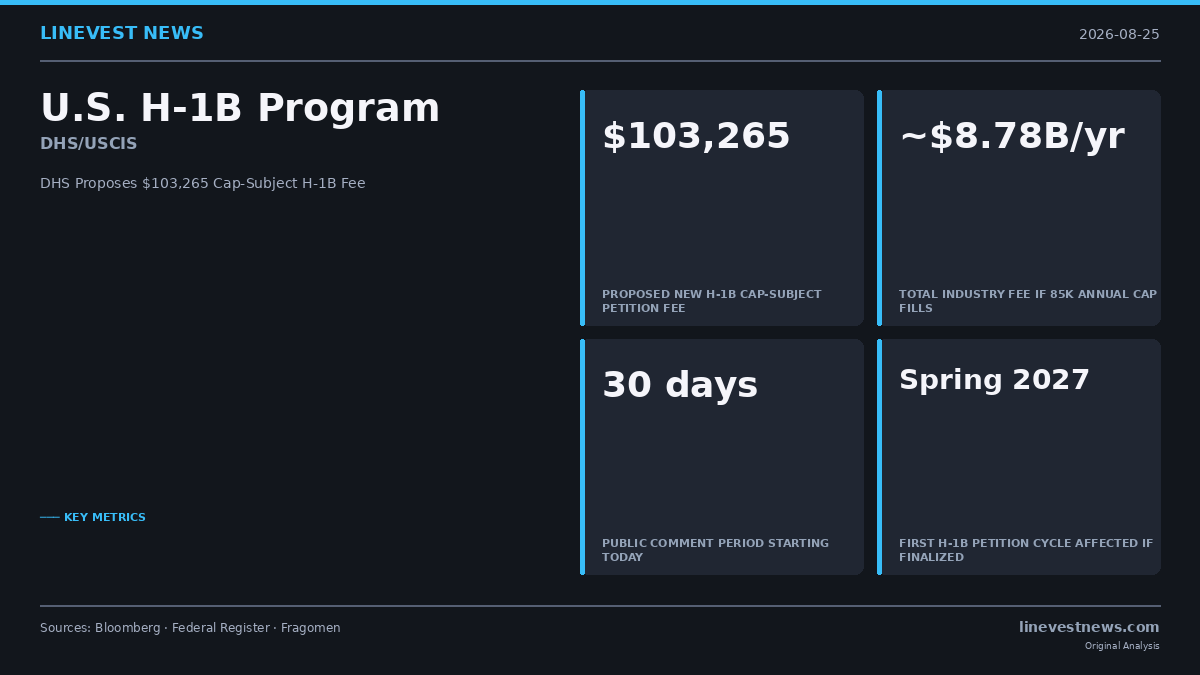
TL;DR - DHS published a proposed rule in today's Federal Register to charge $103,265 per cap-subject H-1B petition — bringing the standard petition-fee stack from ~$3,380 to ~$106,645 (roughly 31.6x) for most large technology employers (those where H-1B/L-1 holders are fewer than half of U.S. employees) - "Cap-subject" covers new entries into the H-1B program's combined 85,000-slot annual cap (65,000 general + 20,000 advanced-degree): new international hires and OPT/STEM-OPT status changes. Extensions and cap-exempt organizations are excluded; existing H-1B workforces are not repriced - A federal court struck down the predecessor $100,000 Presidential Proclamation fee in June 2026 on two grounds; the new NPRM initiates the process to cure the procedural defect, but the substantive tax-authority question remains legally live - A 30-day public comment period begins today; if finalized, the fee would apply at the April–June 2027 petition filing window (for workers selected in the March 2027 H-1B registration)
Part A — The Rule Published Today
The Department of Homeland Security posted a notice of proposed rulemaking (NPRM) in today's Federal Register, proposing a $103,265 supplemental filing fee on cap-subject H-1B petitions. The Office of Management and Budget cleared the rule on August 19 — six days before today's publication — signaling White House prioritization.
Petition Fee Stack (Cap-Subject, 26+ Employee Employer)
| Fee Component | Current | Proposed (if finalized) |
|---|---|---|
| I-129 base fee | $780 | $780 |
| ACWIA training fee | $1,500 | $1,500 |
| Fraud prevention fee | $500 | $500 |
| Asylum Program Fee | $600 | $600 |
| New DHS supplemental fee | $0 | $103,265 |
| Total petition fee | ~$3,380 | ~$106,645 |
Source: USCIS fee schedule (effective April 1, 2024); DHS NPRM (Federal Register, Aug 25, 2026); Fragomen fee analysis (Aug 25, 2026). Note: H-1B cap electronic registration ($215, separate pre-petition step) and optional premium processing ($2,805) are excluded. For employers with more than 50 employees and >50% H-1B/L-1 staff (primarily IT services firms), a Public Law 114-113 fee of $4,000 applies; their current all-in is ~$7,380 and proposed all-in ~$110,645 (~15x current vs. ~31.6x for most large tech employers).
Legal Background: Why DHS Is Using Rulemaking
The Trump administration imposed a $100,000 H-1B fee via Presidential Proclamation in September 2025. A federal court found the measure unlawful in June 2026 on two grounds: (1) the fee amounted to a tax requiring congressional authorization, and (2) the implementing guidance violated the APA's notice-and-comment requirements. The First Circuit denied a government stay motion on July 24, 2026.
The NPRM initiates the formal rulemaking process designed to cure the second defect — notice-and-comment — with the procedural remedy complete only upon issuance of a final rule after the comment period. The first objection, that the fee is a tax requiring an act of Congress, is a substantive legal question the NPRM does not resolve; it is expected to be the central argument in new legal challenges once the final rule is published.
(Sources: Fragomen, "USCIS Proposes New Fee of Over $100,000" (Aug 25, 2026); Clark Hill, "Mass. Court Strikes Down $100K H-1B Visa Fee Rule"; Vorys, "Court Strikes Down $100,000 H-1B Entry Fee.")
Part B — Investment Impact Analysis
Who Actually Bears the Cost
The $103,265 fee applies only to cap-subject petitions — those subject to the combined 85,000-visa annual cap (65,000 regular + 20,000 for U.S. advanced-degree holders). Excluded:
- Extensions — a substantial share of annual H-1B petition volume for large tech employers. Existing workers are not repriced.
- Cap-exempt organizations — institutions of higher education, nonprofits affiliated with such institutions, and nonprofit or governmental research organizations (per INA §214(g)(5)). Note: general nonprofits unaffiliated with these categories are not cap-exempt.
New hires entering the H-1B cap and workers converting from OPT/STEM-OPT are the primary affected population.
The Industry-Wide Math
85,000 combined cap slots × $103,265 = ~$8.78 billion/year in incremental industry-wide fees (if all cap slots are filled)
For context, a company hypothetically filing 1,000 cap-subject petitions annually would face ~$103 million in additional cost; at a hypothetical 2,000 petitions, ~$207 million. Major tech companies (Amazon, Microsoft, Meta, Alphabet, Apple) are consistently among the largest H-1B users in absolute terms, though cap-subject volumes are not publicly disclosed by individual companies.
Market Impact: Who Shrugs, Who Doesn't
The predecessor $100,000 fee in September 2025 produced differentiated market reactions. Mega-cap U.S. tech stocks moved only modestly — the cost, while significant in absolute dollars, is small relative to revenue bases of hundreds of billions. By contrast, H-1B-intensive IT services firms (Infosys, TCS, Cognizant) faced more direct margin pressure. These firms depend heavily on new cap-subject petitions to staff client projects, and their aggregate cap-subject petition volumes are substantially higher relative to revenue than those of mega-cap tech companies, which rely more on extensions and green card sponsorship pipelines.
The Automation Acceleration Angle
A sustained H-1B fee increases the ROI case for AI-assisted technical workflows:
- AI coding tools (GitHub Copilot, Google's Jules, Amazon Q Developer) substitute for entry-level software development headcount often filled via H-1B
- Automated infrastructure management reduces reliance on additional DevOps specialists
- AI-assisted enterprise workflows can extend existing teams without new visa filings
NVIDIA reports Q2 FY2027 earnings after the close on August 26 — tomorrow. A durable H-1B fee environment would be a structural demand tailwind for GPU compute and AI software, as employers accelerate deployment of AI tools in place of additional headcount.
Three Investor Scenarios
These scenarios represent distinct final outcomes, not intermediate states.
| Scenario | Outcome |
|---|---|
| A — Fee eventually takes effect | Finalized → legal challenges → courts uphold. Industry-wide cost rises ~$8.78B/year. IT services firms face margin compression. AI tool vendors benefit from accelerated enterprise adoption. |
| B — Fee permanently blocked | Finalized → courts strike down on substantive (tax authority) grounds, as the June 2026 court already held. No incremental cost. Legal process plays out over 2–3 years. |
| C — Fee substantially modified | 30-day comment period produces a materially lower final rule, or political reversal reduces the fee. Partial cost impact, lower legal risk. |
Key Dates
| Date | Event |
|---|---|
| Aug 25, 2026 | DHS NPRM published in Federal Register (today) |
| Sep 24, 2026 | 30-day public comment period closes |
| ~Q4 2026 | Anticipated final rule (if DHS moves expeditiously) |
| ~Late 2026 | Expected new legal challenges (U.S. Chamber, state AGs) |
| March 2027 | H-1B cap registration window (first cycle under new rule) |
| April–June 2027 | H-1B petition filing for selected FY2028 cap registrants |
| Ongoing | First Circuit appeal of June 2026 district court ruling |
This article is for informational purposes only and does not constitute investment advice. All cost figures are illustrative and based on statutory cap data and USCIS fee schedules. Companies do not publicly disclose cap-subject petition counts.
Sources: DHS NPRM, Federal Register (Aug 25, 2026); Fragomen, "USCIS Proposes New Fee of Over $100,000 for H-1B Cap-Subject Petitions" (Aug 25, 2026); Al Jazeera, "Trump administration seeks to formalise H-1B fee" (Aug 24, 2026 advance coverage); Bloomberg Law (Aug 24, 2026 advance coverage); Clark Hill, "Mass. Court Strikes Down $100K H-1B Visa Fee Rule Key Impact" (2026); Vorys, "Court Strikes Down $100,000 H-1B Entry Fee" (2026); USCIS fee schedule (uscis.gov).