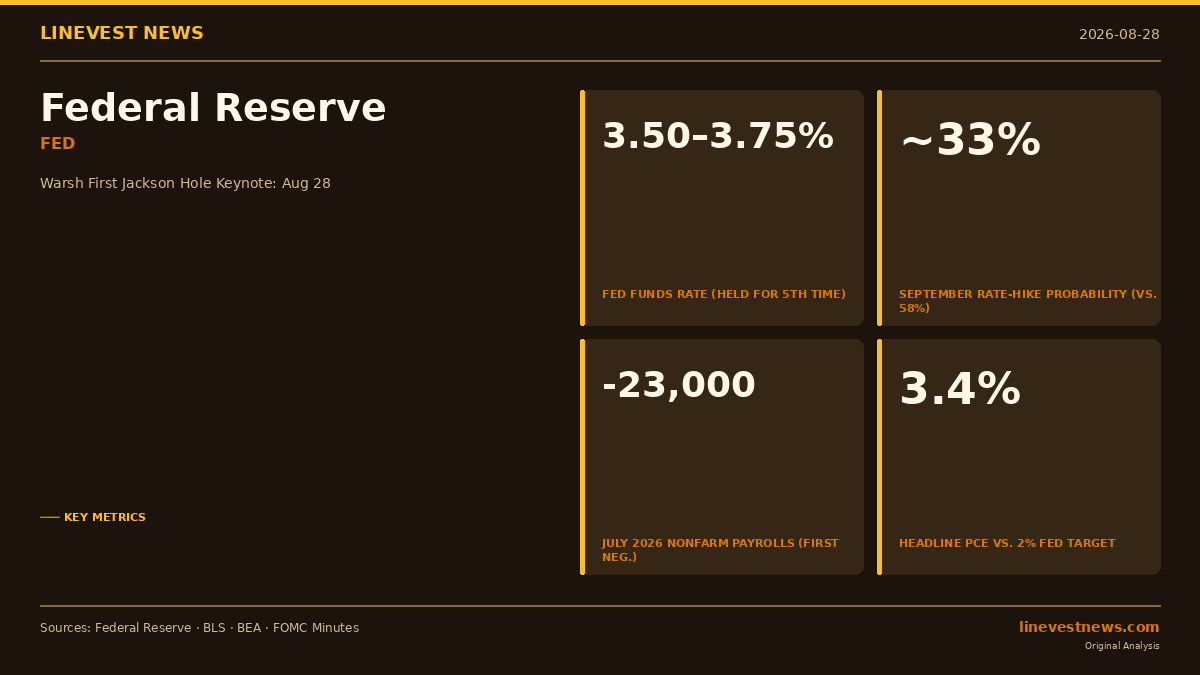
Federal Reserve Chair Kevin Warsh steps to the Jackson Hole podium Friday, August 28, at approximately 10:00 a.m. ET — his first keynote address at the Kansas City Fed's annual Economic Policy Symposium. The 20-minute speech arrives with the federal funds rate at 3.50%–3.75% (held for a fifth consecutive meeting on July 29), core PCE estimated at 3.2% year-over-year for July (analysts expect the BEA release due August 28 will hold near June's 3.2% core reading, with headline PCE at 3.4% in June), and the September 16 FOMC just 19 days away.
TL;DR - Jackson Hole Economic Policy Symposium runs August 27–29, 2026; Warsh keynote is Friday August 28 at ~10:00 a.m. ET - July 2026 PCE inflation data (BEA) releases the same morning — a one-two punch for bond markets - Current Fed funds rate: 3.50%–3.75%; September rate-hike odds have fallen from 58% to roughly 33% - Three FOMC members dissented in July, preferring an immediate 25 bp hike — a rare split for a new chair's second meeting - Warsh has signaled the speech will cover "big picture questions rather than near-term guidance"
What Is Jackson Hole and Why It Matters
The Jackson Hole Economic Policy Symposium is hosted by the Federal Reserve Bank of Kansas City each August in Grand Teton National Park, Wyoming. Central bankers, finance ministers, and academic economists from around the world attend. More importantly for markets, the Fed chair's keynote address has historically served as a venue for major policy signals — Ben Bernanke hinted at QE2 there in 2010; Jerome Powell announced the Fed's new average-inflation-targeting framework in 2020.
This year's official theme is "Financial Innovation: Implications for Payments and Policy." The formal papers will address topics like tokenization, stablecoin regulation, and central bank digital currencies. But the 20 minutes Warsh commands on Friday morning traditionally transcend the stated theme — and that is where markets' attention will be.
Warsh's First Major Public Test
Warsh was confirmed by the Senate 54–45 (one senator absent) on May 13, 2026, in a largely partisan vote, and took the oath of office on May 22. He has presided over two FOMC meetings (June and July), both of which held rates steady, but the July meeting ended in a 9–3 vote with three regional bank presidents dissenting in favor of an immediate 25 basis point increase. That level of dissent is unusual for a new chair's second meeting and reflects a committee genuinely divided on when to restart the hiking cycle.
Since taking office, Warsh has deliberately minimized forward guidance. He has shortened post-meeting statements, given evasive answers at press conferences, and stated explicitly that the Fed "operates independently from market pricing." In late July he told reporters that his Jackson Hole address was "a blank piece of paper right now," and that he planned to focus on "big picture questions rather than near-term guidance."
That communication style creates a genuine uncertainty premium heading into Friday.
The Data Context: Competing Signals
| Indicator | Value | Note |
|---|---|---|
| Headline PCE, June 2026 (YoY) | 3.4% | 2.0% Fed target |
| Core PCE, July 2026 (est., unreleased) | ~3.2% | Analyst forecast; BEA releases Aug 28 |
| July 2026 Nonfarm Payrolls | –23,000 | Weakest monthly print in over a year |
| Fed Funds Rate | 3.50%–3.75% | Held for fifth consecutive meeting |
| September 16 Hike Odds | ~33% | Down from ~58% earlier in August |
| FOMC Year-End Rate Projections | 3.6%–4.1% | Range of participants' projections |
Sources: Federal Reserve, BLS, BEA estimates via analyst surveys
The June headline PCE of 3.4% remains 140 basis points above the Fed's 2% target, while analysts forecast July core PCE — the metric that drives FOMC decisions — at approximately 3.2%, roughly 120 basis points above the 2% target (BEA releases the figure August 28 before Warsh speaks). But July payrolls printed negative (–23,000), the weakest monthly reading in over a year, suggesting the labor market is cracking under the weight of trade tensions and elevated borrowing costs. The BEA releases July PCE data at 8:30 a.m. ET on August 28 — 90 minutes before Warsh speaks — creating a compressed window where bond traders will be repricing in real time.
Three Watch Points for the Speech
1. Does Warsh acknowledge the labor market weakness explicitly? If he characterizes the –23,000 print as transitory or sector-specific noise, markets will read that as hawkish — the Fed is not yet pivoting. If he cites it as evidence of broader softening, September hike odds will compress sharply.
2. How does he handle the three dissenting votes? A new chair who publicly endorses the dissenters' hawkish view signals the committee consensus is shifting. Ignoring the dissent or framing it as a "healthy debate" suggests Warsh is comfortable leading a divided committee into a September hold.
3. Does he address the PCE data released 90 minutes before his remarks? Analysts broadly expect July core PCE to remain near 3.2% year-over-year, consistent with the June core reading. If it comes in hotter than expected and Warsh addresses it directly, that real-time responsiveness would be a notable departure from his stated big-picture framing.
Three Rate Scenarios for September 16
Scenario A: Hawkish Signal (~20% probability)
Warsh flags persistent inflation, endorses committee dissent, does not cite labor market weakness as a restraining factor.
Market reaction: 10-year Treasury yield rises 15–25 bp; USD strengthens; S&P 500 falls 1–2%, with high-multiple tech stocks leading declines; gold sells off. September hike odds re-price from 33% to 60%+.
Scenario B: Deliberately Opaque (~50% probability)
Warsh delivers prepared remarks centered on the symposium's financial-innovation theme and offers no near-term policy guidance. (Jackson Hole keynotes are prepared remarks with no Q&A.)
Market reaction: Initial volatility fades; equities range-bound; September hike odds hold at 30–35%. This matches Warsh's established pattern. Investors will then shift focus to August payrolls (September 4) and CPI (September 10) as the true tiebreakers before the September 16 FOMC.
Scenario C: Dovish Lean (~30% probability)
Warsh cites the negative July payroll print as a signal that policy is having the desired restrictive effect and that cumulative tightening is still working through the economy.
Market reaction: 10-year yield falls 10–15 bp; September hike odds drop below 15%; S&P 500 rallies 0.5–1.5% on reduced rate-risk; growth stocks outperform. This scenario has become more plausible after July's payroll miss, but Warsh's stated aversion to near-term guidance makes it a minority outcome.
Historical Jackson Hole Market Reactions
Fed chair speeches at Jackson Hole have moved markets materially in prior years — but the direction depends almost entirely on whether the chair surprises relative to market pricing. When Powell used August 2022 to deliver a blunt "we must keep at it" warning, the S&P 500 fell 3.4% that day. When Bernanke used Jackson Hole 2010 to signal a second round of asset purchases (QE2), risk assets rallied sharply.
Warsh's deliberate opacity means the absence of guidance could itself be a market event: if traders were pricing in any chance of a dovish lean (Scenario C) and get radio silence instead, that disappointment registers as effectively hawkish.
The NVIDIA Wildcard
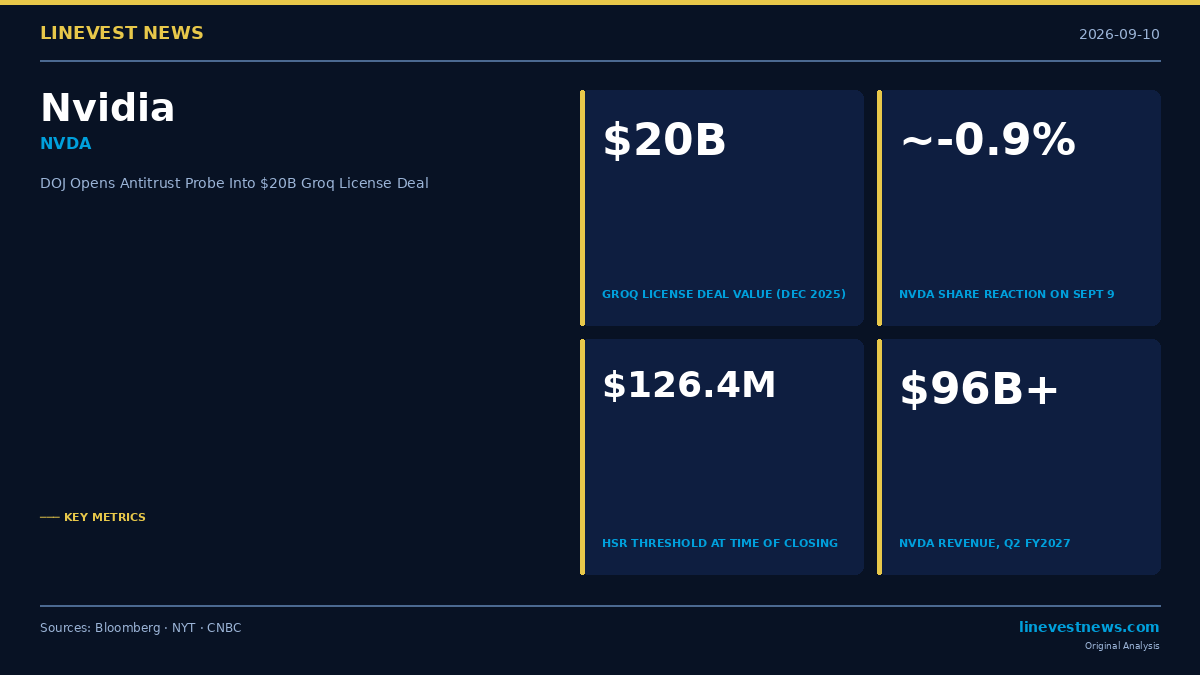
Worth noting: NVIDIA reports its Q2 FY2027 earnings after the close on Wednesday, August 26 — roughly 42 hours before Warsh speaks. A strong NVIDIA beat (NVIDIA guided for ~$91.0B ±2% revenue) could boost risk sentiment ahead of Friday, creating a different market backdrop for Warsh's Friday remarks than if NVIDIA disappoints. Rate-sensitive sectors like utilities and REITs have been pricing in a September hold; any Fed hawkishness would hit them disproportionately regardless of NVIDIA's print.
Bottom Line for Investors
The base case (Scenario B) suggests Warsh says little of immediate policy consequence, and September's outcome continues to hinge on August payrolls (September 4) and CPI (September 10). Investors positioned for a September hold are effectively betting that Warsh sticks to his established playbook.
The tail risk is Scenario A — a hawkish surprise that re-prices rate expectations sharply. Given the three-dissenter dynamic inside the FOMC, that scenario carries real weight even if Warsh himself does not tip his hand.
Regardless of which scenario materializes, July PCE at 8:30 a.m. and Warsh's 90-minute window between that data and his speech create a rare real-time setup. Watch the 10-year Treasury yield and the December 2026 Fed funds futures contract as the cleanest live reads of how markets are absorbing the speech.
This article is for informational purposes only and does not constitute investment advice. LineVest News is an independent financial news publication and is not a registered investment adviser.
Sources: - Federal Reserve: Warsh takes oath of office (May 22, 2026) - CNBC: Kevin Warsh wins Senate confirmation (May 13, 2026) - Federal Reserve: FOMC Minutes, July 28–29, 2026 - Regards of Wallstreet: Jackson Hole 2026 Dates & Schedule - InvestingLive: Jackson Hole hype outruns Warsh playbook - Kiplinger: Economic Calendar, Week of August 24–28