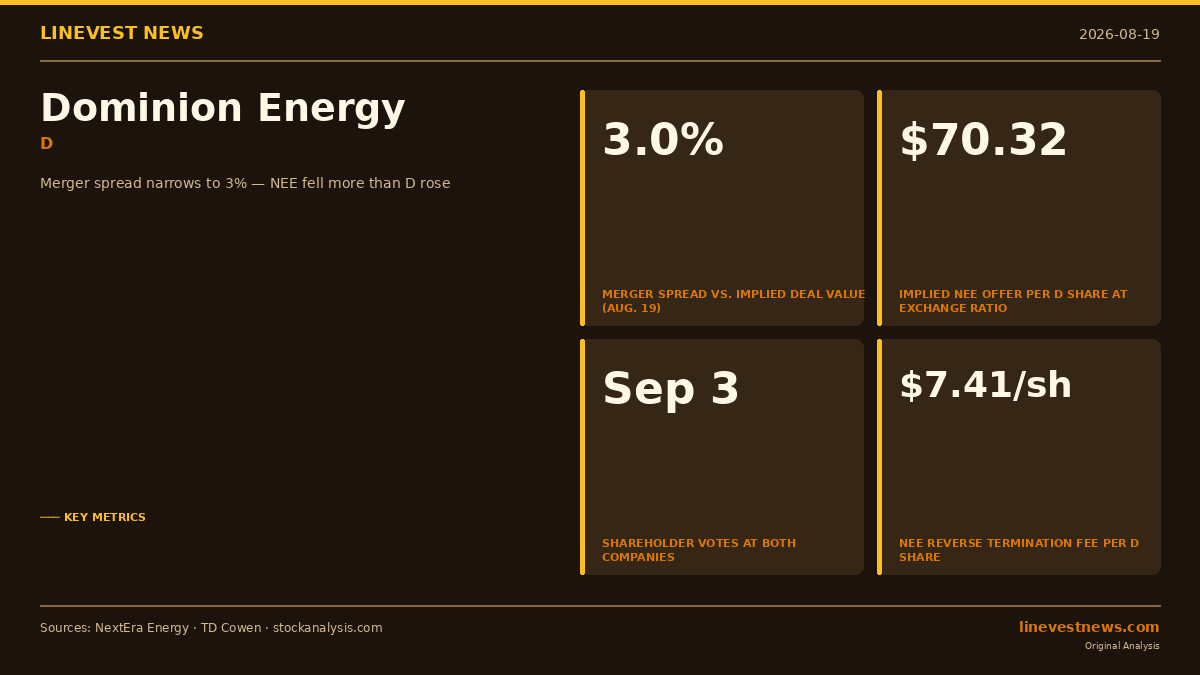
TL;DR - Dominion Energy (NYSE: D) now trades at about a 2.9% spread from NextEra's implied offer value — compressed from roughly 9% on Aug. 11 - About two-thirds of that narrowing came from NextEra (NYSE: NEE) shares falling, not Dominion rising; the deal's implied value fell $3.15/share while Dominion gained $1.49 - Virginia Governor Abigail Spanberger intervened as a formal party in the merger review — according to her office, the first Virginia governor to do so — raising the price of regulatory approval - The SCC evidentiary hearing is Nov. 17, 2026; the statutory decision deadline is Jan. 11, 2027; shareholder votes at both companies: September 3, 2026
Dominion Energy (NYSE: D), the Richmond-based utility serving Virginia and the Carolinas, now trades within about 3% of what its agreed merger with NextEra Energy is actually worth. That gap was roughly 9% when LineVest last ran the arithmetic, and most of the convergence was not Dominion climbing toward the deal — it was the deal sliding down toward Dominion, because NextEra's own shares did the larger part of the moving.
That distinction is missing from the day's news. TD Cowen, the U.S. brokerage arm of Toronto-Dominion Bank, raised its rating on Dominion to Buy from Hold on Aug. 19 on improving odds the merger closes, according to Investing.com. The upgrade landed two days after Virginia's governor became the first in state history to intervene as a party in that same review, according to her office.
The arithmetic, on the back of an envelope
The terms are simple enough to price by hand. Each Dominion share converts into 0.8138 NextEra shares plus a pro-rata slice of a one-time $360 million cash payment at closing, per NextEra Energy's announcement of May 18. Everything else is just the day's tape.
| Input | Value | Where it comes from |
|---|---|---|
| NextEra close, Aug. 19, 2026 | $85.91 | stockanalysis.com |
| Dominion close, Aug. 19, 2026 | $68.29 | stockanalysis.com |
| Exchange ratio | 0.8138 NEE per D share | NextEra release, May 18 |
| Stock consideration | $69.91 | 0.8138 x $85.91 |
| Cash pool per share | $0.41 | $360M / 879.53M shares |
| Implied value per D share | $70.32 | LineVest calculation |
| Gap to implied value | $2.03 (2.89%) | LineVest calculation |
Share count is Dominion's 879.53 million outstanding at the Aug. 19 close, per stockanalysis.com. Across that base, the $2.03 gap per share — or about $1.8 billion in aggregate — reflects a combination of deal-break risk and the time value of waiting for a close targeted for late 2027, on a company it values at $60.1 billion.
Where the narrowing actually came from
Set the two snapshots side by side and the composition of the move becomes visible.
| Aug. 11 (LineVest) | Aug. 19 | Change | |
|---|---|---|---|
| Implied value per D share | $73.47 | $70.32 | -$3.15 |
| Dominion market price | $66.80 | $68.29 | +$1.49 |
| Spread (gap / implied value) | $6.67 (9.1%) | $2.03 (2.9%) | -$4.64 |
About two-thirds of the narrowing came from the top row, not the middle.
Direction matters more than magnitude. A merger spread closes for two entirely different reasons. Arbitrageurs can bid the target up as perceived deal risk falls — a genuine vote of confidence. Or the acquirer's stock can sag, dragging the exchange-ratio value down until it meets a target that barely moved, which is a repricing of the buyer, not a verdict on the deal.
Here the larger share was the second kind. A narrow gap therefore flatters the market's actual change of mind, because part of what closed it was the prize getting smaller rather than the odds getting better. Target holders end up with more certainty about receiving less.
The politics arrived first
On Aug. 17, Governor Abigail Spanberger filed to intervene formally in the merger review before the Virginia State Corporation Commission — the state panel that regulates utility rates and mergers. Her office described it as the first time any Virginia governor has done so. The filing gives her standing to question both companies inside the docket rather than comment from outside it.
The governor named three priorities she called non-negotiable: lower energy bills, protection of the utility workforce, and Virginia's progress toward locally produced clean power. "Virginians deserve to know that their long-term interests, not simply those of the companies involved, are being put first," she said in the release announcing the filing.
A separate development emerged around the same time. SCC Chair Kelsey Bagot, who worked as a senior attorney at NextEra from September 2022 until April 2024 before joining the commission, sent a letter declining to recuse herself, writing that "mere work history with a regulated entity has not served as a categorical basis requiring recusal," as reported by the Virginia Mercury and WTOP.
A governor as a docketed party is a different animal from a consumer advocate. Ordinary intervenors argue for conditions. A sitting governor argues with the implicit weight of appointment power, legislative allies and the special session lawmakers have already floated. That does not make denial likelier — commissions are not obliged to follow governors — but it raises the price of approval, and that price is paid in commitments that reduce what the buyer keeps.
The clock is much shorter than the closing date
| Milestone | Date |
|---|---|
| Joint petition filed (Case PUR-2026-00112) | July 15, 2026 |
| Shareholder votes, both companies | Sept. 3, 2026 |
| Public witness hearings | Nov. 5 and Nov. 9, 2026 |
| Evidentiary hearing | Nov. 17, 2026 |
| Statutory SCC decision deadline | Jan. 11, 2027 |
Virginia's Utility Transfers Act gives the commission 60 days from a complete application, extendable by up to 120 more — a 180-day ceiling. South Carolina regulators set a January deadline of their own this month.
So the decisive state rulings arrive roughly ten months before the deal is expected to close. NextEra Chairman and CEO John Ketchum told analysts on the July 27 earnings call that the merger "will close in late 2027." The May 18 announcement projected twelve to eighteen months to close, putting the outer edge around November 2027.
The gap between those dates is not slack in the review; it is runway for federal clearances and integration planning. What it means for anyone pricing the stock today is that the largest source of uncertainty is scheduled to resolve within months rather than years — and a resolution with a date attached is a very different object from one without. That is a plausible explanation for why an upgrade appeared this week rather than next spring.
What would make this reading wrong
The decomposition above rests on an assumption worth naming: that NextEra's decline between the two dates was about NextEra, not about the merger. If those shares fell precisely because investors began expecting a costlier Virginia settlement, the spread narrowed for a coherent reason and the same judgment simply arrived through the acquirer's stock rather than the target's. Distinguishing the two would require stripping out sector-wide utility moves, which this article does not attempt.
The spread is the running scoreboard between the September 3 shareholder votes and the January 11 state ruling. If it is still this narrow the week before the Nov. 17 evidentiary hearing, the market will have made a confident bet on Virginia — a bet the arithmetic here suggests is reasonable, but not one that prices in a governor who has given herself standing to argue otherwise under oath.
Sources: NextEra Energy merger announcement (May 18, 2026); TD Cowen analyst note via Investing.com (Aug. 19); Virginia Governor's Office press release (Aug. 17); Virginia Mercury and WTOP (Aug. 19); stockanalysis.com price and share count data (Aug. 19); Williams Mullen regulatory client alert; SC Daily Gazette (Aug. 2026); NextEra Q2 2026 earnings call transcript (July 27). This article is for informational purposes only and does not constitute investment advice.