TL;DR
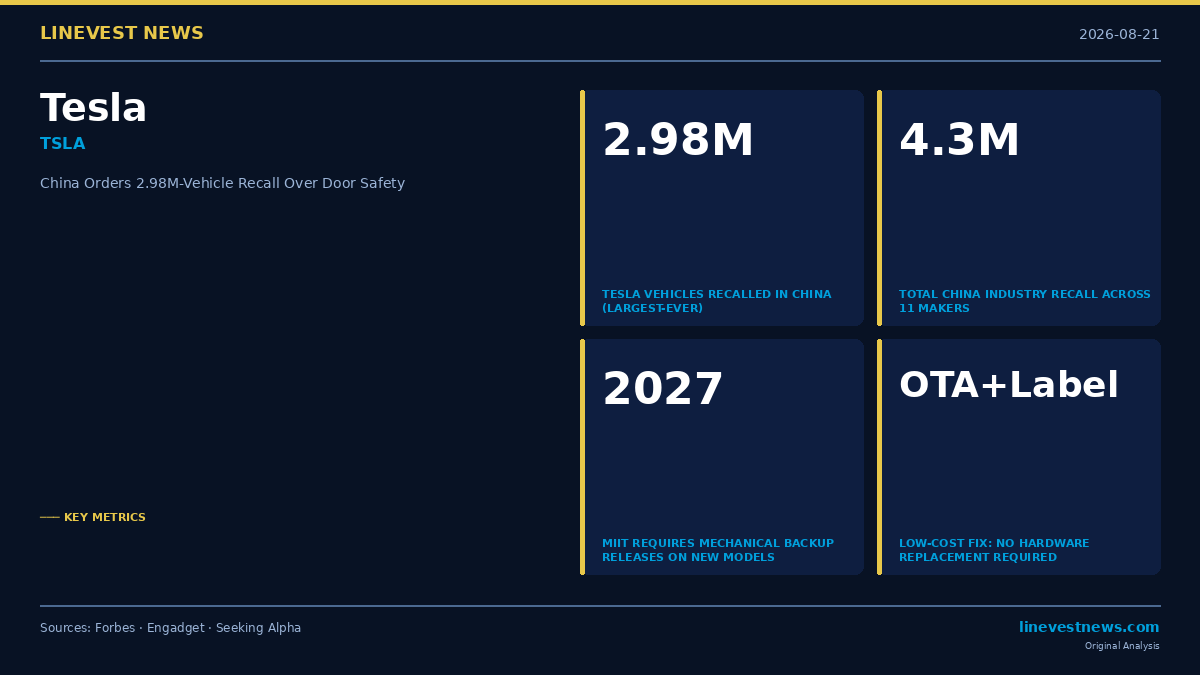
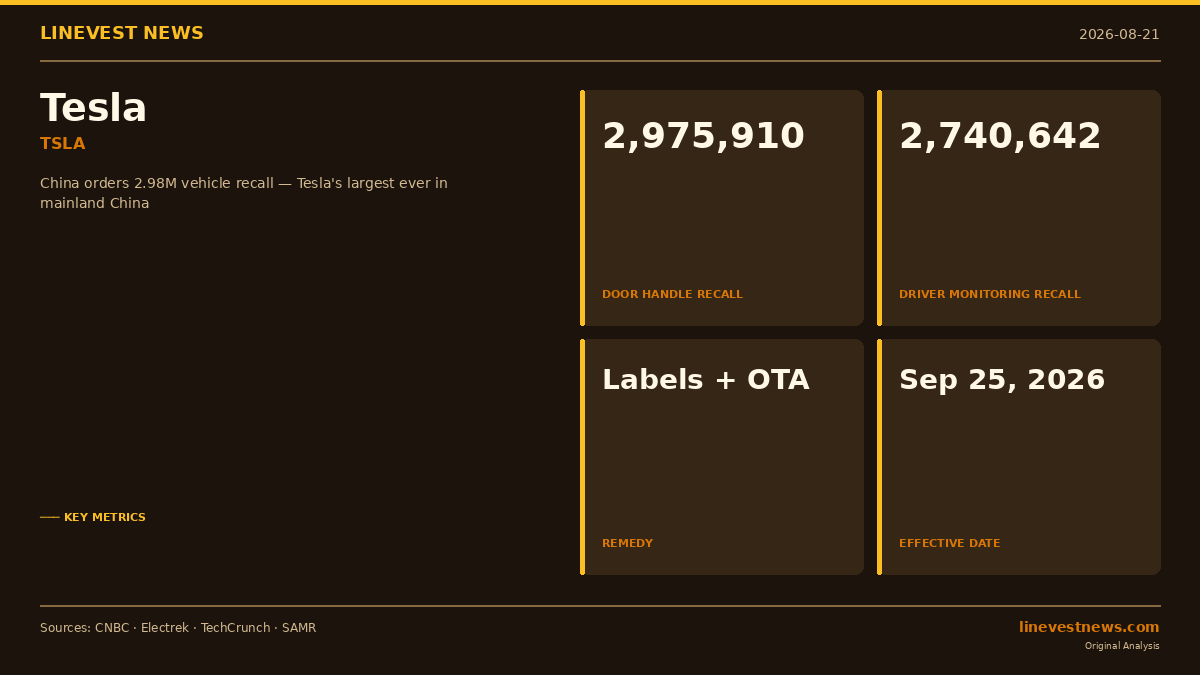
- China's SAMR orders Tesla's largest-ever recall in mainland China: 2,975,910 vehicles for hidden emergency door release risks
- A concurrent campaign covers 2,740,642 vehicles for driver monitoring deficiencies — the two populations overlap, as Campaign 2 targets a subset of Campaign 1's China-built vehicles
- Remedy: physical warning labels applied to vehicles + OTA software update (windows lower post-collision); no full hardware replacement at the door mechanism level
- Effective September 25, 2026; Campaign 1 is part of a coordinated 11-automaker action covering ~4 million vehicles industry-wide for door handle safety
- TSLA gained ~3.7% on August 21 as investors interpreted the label-plus-software remedy as limited financial impact
Part A: What China's Regulators Ordered
China's State Administration for Market Regulation (SAMR) announced two simultaneous Tesla recall campaigns on August 21, 2026 — the largest coordinated safety action Tesla has ever faced in mainland China.
Campaign 1: Emergency Door Release Visibility — 2,975,910 Vehicles
| Model | Origin | Units |
|---|---|---|
| Model Y | China-built | 1,956,713 |
| Model 3 | China-built | 973,156 |
| Model 3 | Imported | 35,590 |
| Model X | Imported | 8,328 |
| Model S | Imported | 2,123 |
| Total | 2,975,910 |
The cited defect: Tesla's interior emergency door release handle "closely matches the color of the surrounding interior trim," making it difficult to identify in an emergency — specifically when a crash disables the vehicle's low-voltage electrical system, which powers the primary electronic door latch. SAMR determined this creates an unacceptable escape and rescue risk.
The remedy combines physical warning labels — installed to help occupants locate the emergency release — and an over-the-air software update that automatically lowers the windows after a collision event, providing occupants and first responders an alternative exit path. No hardware replacement is required at the door mechanism itself.
Campaign 2: Driver Monitoring Upgrade — 2,740,642 Vehicles
A parallel recall covers 2,740,642 China-built Model 3 and Model Y vehicles. Note that the two recall populations overlap: Campaign 2's vehicles are a subset of the China-built vehicles counted in Campaign 1. SAMR determined that Tesla's existing driver-attention system — which monitors steering-wheel torque — is insufficient to confirm the driver is actually watching the road. A distracted driver could maintain enough hand pressure to satisfy the torque check without looking at the road.
The remedy: an OTA update that adds cabin-camera eye-tracking to the existing torque monitoring. Tesla began rolling out its supervised "Tesla Assisted Driving" system in China this year, and cabin camera integration is a prerequisite for expanding that program.
Both recall campaigns take effect September 25, 2026.
Industry Context: An 11-Automaker Crackdown
Campaign 1 is part of a coordinated industry action. SAMR announced simultaneous door handle recalls by 11 automakers covering approximately 4 million vehicles — one of the broadest coordinated safety actions in Chinese automotive history. Tesla, at 2,975,910 vehicles, accounts for the largest single share. Notable participants include:
- Xiaomi: ~390,000 vehicles (SU7 sedan)
- Leapmotor: ~370,000 vehicles
- Xpeng, Geely (Zeekr and Lynk & Co brands), Chery, Dongfeng, BAIC BluePark, FAW: additional volumes
Part B: Investment and Regulatory Implications
The Remedy Structure: Physical Labels Plus Software
For investors evaluating the cost of a ~3-million-vehicle recall, the key distinction is that the remedy does not require hardware replacement at the door mechanism level. Tesla will install physical warning labels on affected vehicles and push an OTA update to modify post-collision window behavior. This is materially cheaper than a traditional dealership hardware swap, which can cost hundreds of dollars per vehicle in parts and labor.
Campaign 2's driver monitoring fix requires only an OTA software push — no physical component at all. TSLA traded at approximately $345 on August 21, gaining roughly 3.7% by session close. The market's read: compliance cost, not financial crisis.
The driver monitoring update also advances Tesla's commercial roadmap in China. Cabin-camera attention monitoring is a prerequisite for broader Tesla Assisted Driving feature rollout — meaning the SAMR-mandated fix accelerates a deployment Tesla planned regardless.
Regulatory Escalation: China Leads on Door Handle Safety
The door handle recall reflects deliberate regulatory escalation. China finalized a ban on electronically actuated hidden door handles in February 2026, effective 2027. The recall is the enforcement bridge between the existing fleet and that future standard.
Regulatory attention intensified following a documented safety incident in China in which a driver was trapped inside a burning vehicle because bystanders could not operate the concealed electronic door release. Following that incident, SAMR conducted a regulatory review that led to the 2026 ban and the coordinated recall.
Parallel pressure is developing internationally:
- United States: NHTSA opened an investigation into Tesla's door latch system and is drafting new federal rules. The "SAFE Exit Act" has been introduced in Congress to mandate accessible manual door releases in all new vehicles.
- Civil litigation: Multiple ongoing U.S. wrongful-death lawsuits cite incidents where emergency responders or occupants could not operate Tesla's concealed release mechanism after crashes.
Tesla popularized the flush door handle design and is now the largest single target of the global regulatory response to that design choice.
China Market Stakes
Gigafactory Shanghai is Tesla's highest-output production facility globally, making China central to Tesla's supply chain and commercial strategy. Domestic EV competitors — particularly BYD — compete aggressively on price and local brand loyalty.
Historical precedent offers some reassurance: when Tesla recalled approximately 1.6 million China vehicles in January 2024, the market absorbed the news without lasting damage to delivery volumes. The current action is larger in scale but structurally similar — software-and-label-remediable, regulator-coordinated, and industry-wide.
Longer term, the driver monitoring upgrade positions Tesla's China fleet for broader autonomous-driving feature deployment — a revenue pathway Tesla has explicitly prioritized for the region. Investors tracking TSLA's China strategy should read this recall as a regulatory compliance milestone, not a standalone financial liability.
This article is for informational purposes only and does not constitute investment advice.
Sources: CNBC (Aug 21, 2026) · Electrek (Aug 21, 2026) · TechCrunch (Aug 21, 2026) · SAMR public filings · Al Jazeera (Jan 5, 2024)