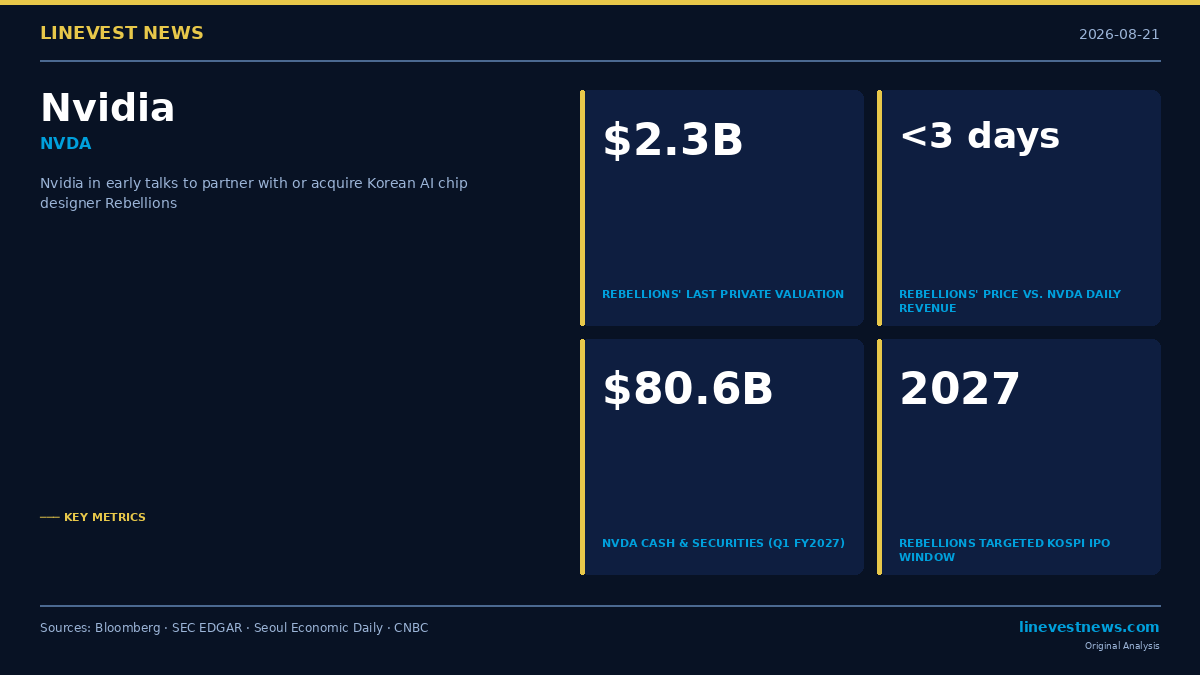
Nvidia (NASDAQ: NVDA) has opened early talks with Rebellions, a privately held South Korean designer of AI chips, Bloomberg reported on Aug. 21. On the table are a technical partnership, an investment, or an outright acquisition. Buying the whole company at its last private valuation would cost Nvidia less than three days of the revenue it booked last quarter. The cash is not the constraint here. The approvals are.
Bloomberg said Nvidia Chief Executive Jensen Huang met Rebellions co-founder and CEO Sunghyun Park at Nvidia's Santa Clara headquarters this week. Talks are preliminary and may not lead to a transaction, the report said. Nvidia did not respond to Bloomberg's request for comment, and a Rebellions representative declined to comment.
Why It Matters
The hard part here is not the price. It is the count of signatures.
Rebellions is one of the few Korean companies a foreign chip giant might want to own outright. It is also part-owned by the state, and it sits in a listing queue. Any deal runs through a founder, a ministry and an exchange. Nvidia can afford the company many times over. Whether it can obtain permission is the question this story turns on.
The price is a rounding error
Rebellions was last valued at about $2.3 billion, per Bloomberg. It has raised roughly $850 million since it was founded in 2020, from backers that include the Korean government directly. That is the number every wire report led with this week.
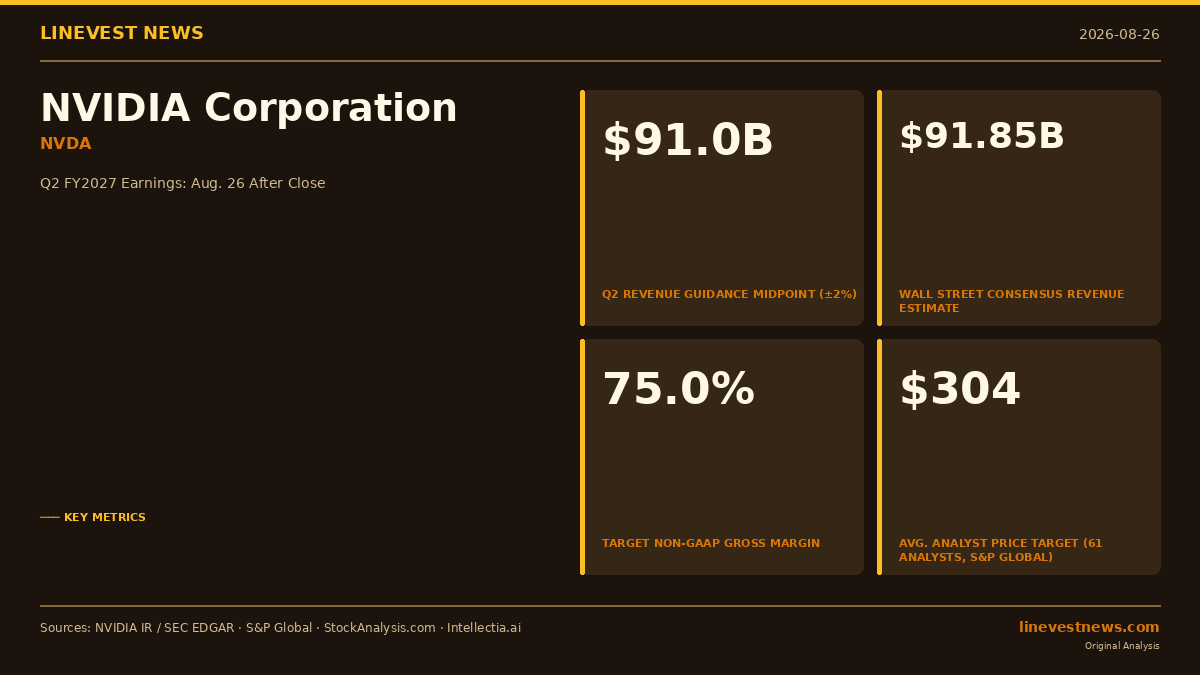
Now put it against the buyer. Nvidia booked $81.6 billion of revenue in the quarter ended April 26, according to the results it filed with the SEC. Spread evenly across a 13-week quarter, that is roughly $897 million a day. Rebellions' entire valuation is about two and a half days of it.
Nvidia also closed that quarter with $80.6 billion of cash and marketable securities, per the same filing. The purchase would absorb under 3% of that pile. Its market value was $5.2 trillion on Aug. 21, per stockanalysis.com, so the whole startup is well under a tenth of one percent of the company.
So price is not what makes this hard. A buyer that clears the whole cheque in a week of sales does not agonise over the number. What makes it hard is the list of people who have to say yes. Rebellions sits behind more gates than a private company its size normally does.
Why the timing is awkward
Rebellions is not a startup hunting for an exit. It is a listing candidate already inside the process. Seoul Economic Daily reported in April that the company was aiming for a preliminary listing review at the Korea Exchange (KRX), the operator of South Korea's stock markets, in the third quarter. August was the likeliest filing month, the paper said, because that is when half-year accounts are finalised.
Park told CNBC on July 8 that the listing itself is targeted for the first or second quarter of 2027. He also said Rebellions leans toward the main KOSPI board, Korea's senior market for large established companies. That is the alternative to KOSDAQ, Korea's junior market for smaller growth companies. An approach from Nvidia lands directly on top of that calendar.
That is the tension a founder has to resolve, and it is not obvious which way it cuts. A listing is slow, priced by a committee and permanent. A strategic buyer is fast, pays in one instalment and removes the disclosure burden entirely. Boards have chosen both, and the choice usually turns on how confident management is in the next four quarters of orders.
The government is already a shareholder
Seoul Economic Daily reported that the pre-IPO round raised 640 billion won. The state-backed National Growth Fund contributed 250 billion won and the Korea Development Bank, Korea's state policy lender, put in 50 billion won. Mirae Asset Group, one of Korea's largest asset managers, added 300 billion won.
That round set a valuation of 3.4 trillion won, which Seoul Economic Daily converted to $2.5 billion in April. TechCrunch reported the same round in March at $2.34 billion. Bloomberg now says roughly $2.3 billion. The won figure has not moved; the dollar figure has, because each outlet converted on a different day.
State money in a chip designer is not decorative in Korea. It changes what a foreign buyer must do before it does anything. Korea's Act on Prevention of Divulgence and Protection of Industrial Technology governs this. A company holding a designated National Core Technology must notify the Ministry of Trade, Industry and Energy before any foreign acquisition, merger or joint venture. Where the technology was built with government research money, the ministry's position is stronger still.
An amendment passed by Korea's National Assembly in December 2024 widened those powers. The ministry can now move to block or unwind an unapproved cross-border transfer. Its remedies include suspension, prohibition and restoration to the pre-deal state, according to a summary published by IPG Legal, a Seoul law firm. Semiconductors are among the sectors flagged for new designations.
Now set the two facts beside each other. The National Growth Fund led the round that set Rebellions' price, and the same government decides whether a foreigner may buy the company. Seoul is simultaneously the shareholder being offered a return and the regulator holding the veto. Those two roles do not always point the same direction.
Two precedents, both unhappy
Nvidia has stood in this queue before. It agreed in 2020 to buy Arm Holdings (NASDAQ: ARM), the British chip-design firm, for $40 billion. The U.S. Federal Trade Commission, the American antitrust and consumer-protection agency, sued to block the deal.
Nvidia and SoftBank terminated the agreement on Feb. 8, 2022, citing regulatory obstacles. It remains the largest semiconductor transaction never to close. Nvidia's share of the AI accelerator market is considerably larger now than it was then.
The Korean precedent is closer to the point. Wise Road Capital, a Chinese private equity firm, agreed in March 2021 to buy Magnachip Semiconductor, a Korean analogue chipmaker, for $1.4 billion. CFIUS, the U.S. panel that screens foreign investment, issued an interim order blocking it that June. The parties terminated in December 2021 and Magnachip collected a $70.2 million break fee.
Magnachip is usually cited as a Washington story, but the Korean half is the useful half. The companies also withdrew the investment notice they had filed with Korea's trade ministry. A buyer of a Korean chip company files on both sides of the Pacific. Either side can be the one that ends it.
Nvidia would be filing as an American acquirer rather than a Chinese one. That changes the politics considerably. It does not change the paperwork, and it does not change who signs at the Korean end.
What Nvidia would actually be buying
Rebellions designs neural processing units, or NPUs, which are chips built to run trained AI models rather than to train them. That job is called inference, and it repeats every single time a user asks a question. Bloomberg describes the company as optimised for data-centre inference work. Rebellions merged with Sapeon Korea, SK Telecom's AI chip unit, in December 2024.
Its server chip, Rebel100, is manufactured by Samsung Electronics' foundry, the contract arm that fabricates chips other firms design, Seoul Economic Daily reported in May. The paper said Rebel100 scores ahead of Nvidia's own H200 on inference benchmarks and claims advantages in power efficiency and price. Park told the paper the focus was deliberate from the start: "We decided to focus only on inference from day one of our founding."
Whether a buyer needs that in-house is the real strategic question. Nvidia already sells inference silicon, and sells a great deal of it. What it does not own is a credible non-Nvidia option for customers who have decided, for reasons of policy rather than performance, that they want one. Buying the alternative is one way to answer that. It is also the argument regulators tend to find least persuasive.
The interesting part is where the customers are. Seoul Economic Daily listed Middle East work with Aramco and Humain, Saudi Arabia's state-backed AI venture, plus discussions with Mistral AI in Europe. Those are exactly the buyers a sovereign-AI pitch is designed for. They are also the buyers least likely to be reassured by an Nvidia badge on the supplier.
What we said last time
LineVest covered Rebellions on May 27, when KB Financial Group (KRX: 105560), Korea's largest banking-led financial holding by market value, signed a partnership to embed the startup's chips in its financial services. The framing then was explicitly national. Rebellions would supply "high-level domestic AI semiconductor inference infrastructure and technology," per Edaily.
Three months later the counterparty across the table is American. Domestic sourcing was the argument that won KB. It is not obviously the argument that survives a sale, and KB's venture arm has been on the cap table since the 2022 Series A.
The case against this reading
All of the above assumes an acquisition. Bloomberg names three possible outcomes, and two of them barely touch the approval machinery. A technical partnership needs no ministry sign-off at all. A minority investment alongside existing backers SK Hynix (KRX: 000660), the world's second-ranked DRAM maker and the leading supplier of high-bandwidth memory to AI servers, Samsung Ventures and Arm would most likely clear as an ordinary financing.
Read that way, an Nvidia cheque is a validation stamp arriving weeks before a listing review, not a threat to it. If the talks settle there, the regulatory frame in this article is the wrong one to have applied. That is the honest risk in the analysis.
What settles it
Two dates do most of the work. Nvidia reports its July-quarter results on Aug. 26, and management has guided to about $91 billion of revenue. Korea and inference-chip acquisitions are both plausible questions on that call. An answer, or a pointed refusal to answer, will be more informative than the guidance.
The second is the Korea Exchange filing itself. If Rebellions lodges its preliminary listing review on the August timetable Seoul Economic Daily described, management has chosen the public market. If that filing slips without explanation, the talks are more than talks. No one has to leak anything for that signal to arrive.
This article is journalism, not investment advice. LineVest is not a registered investment adviser and does not recommend the purchase or sale of any security. Figures are as reported by the sources cited.
Not covered here: Rebellions' funding history round by round, the Sapeon merger terms and combined balance sheet, a side-by-side of Korea's three listing-track AI chip designers, and the Korean approval checklist a foreign acquirer would face step by step. Those are in the full report.