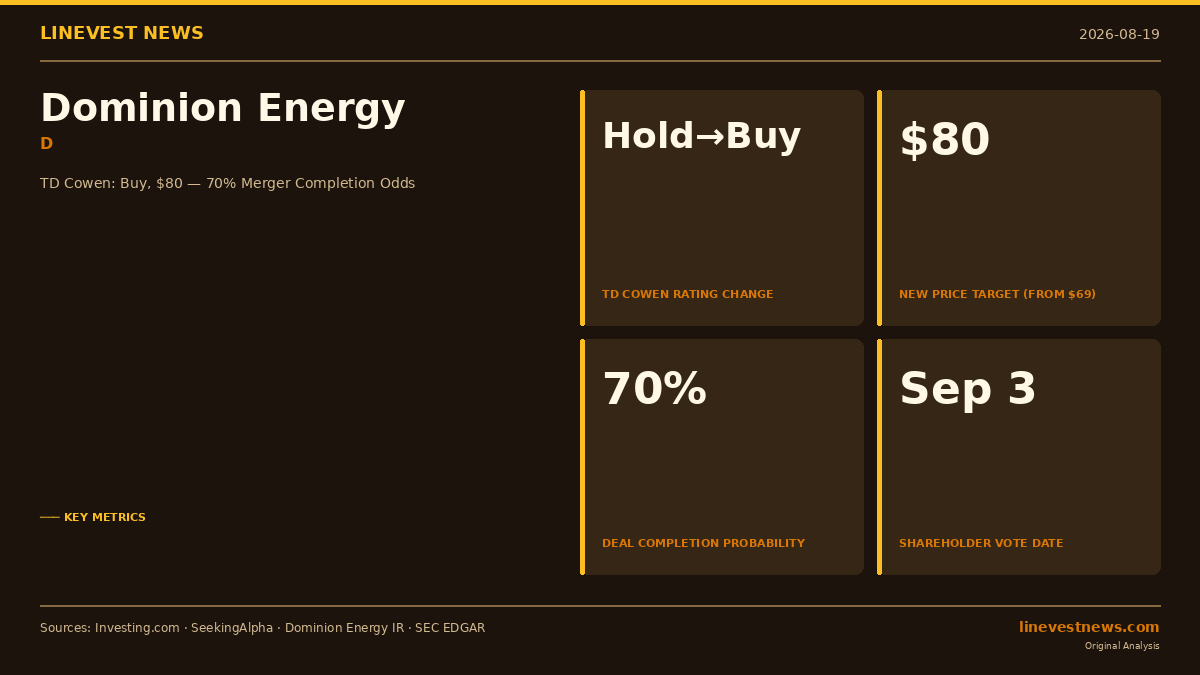
TL;DR - TD Cowen upgrades D from Hold to Buy; price target raised to $80 from $69 - Firm assigns 70% probability to successful NextEra-Dominion deal completion - Shareholder vote at both companies set for September 3, 2026 — two weeks away; deal closing expected H2 2027 - Termination fee structure provides asymmetric downside protection across multiple failure scenarios - D trades at $68.29; implied deal value ~$70.32 at current NEE price; nominal spread ~$2.03 (+2.97%)
What TD Cowen Said
TD Cowen upgraded Dominion Energy (NYSE: D) from Hold to Buy on Wednesday, August 19, raising its 12-month price target to $80 from $69. Shares were trading at $68.29 at Wednesday's close.
The $80 target incorporates TD Cowen's expectations for NextEra stock appreciation through the expected H2 2027 closing and an assessment of Dominion's standalone value; it is not directly derived from today's merger consideration of approximately $70.32. The firm views the pending NextEra Energy (NYSE: NEE) merger as the most likely outcome and believes the current stock price does not fully reflect the probability-weighted value of deal success.
TD Cowen also addressed the most prominent political risk: Virginia Governor Spanberger has intervened in the regulatory process, raising concerns about customer affordability, employment protections, and clean energy commitments. The firm views these as manageable, noting that NextEra has made substantial financial commitments on affordability — including $2.25 billion in ratepayer bill credits — and has expressed public support for employment and clean energy goals.
Deal Background
NextEra Energy and Dominion Energy announced their combination on May 18, 2026, in a deal that NextEra described as creating "the world's largest regulated electric utility business." At announcement, with NextEra shares trading near $93, the implied equity value to Dominion shareholders was approximately $67 billion — equivalent to roughly $76 per Dominion share.
Since then, NextEra's stock has retreated to $85.91, reducing the current implied value per Dominion share to approximately $70.32. The exchange ratio, however, is fixed.
Under the merger terms, each Dominion share will be converted into: - 0.8138 shares of NextEra Energy common stock - A pro rata portion of an aggregate $360 million cash payment
Based on shares outstanding as of July 24, 2026, former NextEra shareholders are expected to own approximately 74.5% of the combined company, with former Dominion shareholders holding the remaining 25.5%.
Regulatory filings were submitted July 15 with five agencies: the Virginia State Corporation Commission, North Carolina Utilities Commission, South Carolina Public Service Commission, Federal Energy Regulatory Commission, and Nuclear Regulatory Commission. The combined company expects to close in the second half of 2027.
To secure customer-facing approval, NextEra committed to $2.25 billion in ratepayer bill credits distributed over two years post-closing, plus no rate increases or merger-related fees for Dominion's current customers in Virginia, North Carolina, and South Carolina.
The Current Deal Value
At Wednesday's close of $85.91 for NEE, the deal consideration per D share works out as follows:
| Component | Calculation | Per D Share |
|---|---|---|
| NEE stock | 0.8138 × $85.91 | ~$69.91 |
| Cash sweetener | Aggregate $360M, pro rata | ~$0.41 |
| Total implied value | ~$70.32 | |
| D closing price | $68.29 | |
| Nominal spread | ~$2.03 (+2.97%) |
That 2.97% nominal spread reflects the time value of waiting until H2 2027 and residual regulatory risk. Annualized from today's date to the H2 2027 closing window — a range of approximately 10 to 16 months — the implied annual return is roughly 2.2% to 3.4%, compared with a current 12-month Treasury yield of approximately 4.2%.
Unhedged D holders stand to capture additional upside if NextEra's stock price rises before the fixed ratio is applied at closing: every dollar increase in NEE raises the implied D deal value by roughly $0.81.
Scenario Analysis
TD Cowen laid out four scenarios with explicit probability weights:
| Scenario | Probability | Fee Direction |
|---|---|---|
| Merger closes successfully | 70% | — |
| Regulators block the deal | 15% | NextEra pays break fee to Dominion |
| NextEra walks away unilaterally | 10% | NextEra pays reverse termination fee to Dominion |
| Dominion backs out | 5% | Dominion pays termination fee to NextEra |
The combined probability of deal failure is 30% (15% + 10% + 5%). In 25 of those 30 percentage points, the break fee flows from NextEra to Dominion — covering both the regulatory-block and unilateral-walkout scenarios. Only in the 5% case where Dominion itself exits does D bear a net cost. The asymmetric termination structure is the core of TD Cowen's downside-protection argument.
Key Risk: Governor Spanberger
Virginia Governor Abigail Spanberger has intervened in the merger regulatory process at the Virginia SCC — the most consequential single approval given that Dominion's largest franchise service area is in Virginia. Her concerns center on customer affordability, employment protections for Dominion workers, and Virginia's clean energy commitments.
TD Cowen views these concerns as manageable given NextEra's existing commitments, but timeline risk is real. Political scrutiny can extend the procedural calendar at the SCC even when the underlying merits support approval. Combined with pending filings at FERC and the NRC, any delayed proceeding could push the closing deeper into the H2 2027 window or into 2028.
NextEra carries relevant regulatory history here: in 2016 it agreed to acquire Texas utility Oncor, but the Public Utility Commission of Texas found the transaction was not in the public interest and rejected it in April 2017. In the current deal, NextEra appears to have designed its concession package — including the $2.25 billion bill credits and rate-freeze commitments — to directly address regulators' concerns about customer impact.
Why It Matters for Investors
Dominion standalone fundamentals provide a floor if the deal fails. The company reported Q2 2026 earnings of $0.79 per share on $4.48 billion in revenue, both above consensus. D offers a 3.91% forward dividend yield ($2.67 annualized at Wednesday's close).
Three signals to watch before September 3: 1. Pre-vote regulatory commentary from the Virginia SCC — scheduling orders or information requests can signal the depth and timeline of its scrutiny. 2. NEE price movement — the fixed 0.8138 exchange ratio means every dollar move in NEE shifts D's implied deal value by ~$0.81. 3. Governor Spanberger's formal SCC filing — her specific requests will indicate whether she seeks procedural delay, structural concessions, or substantive deal modifications.
The shareholder vote is widely expected to pass at both companies. The harder question for D holders is what unfolds during the 10 to 16 months between the vote and the H2 2027 closing window across five regulatory jurisdictions.
This article is journalism, not investment advice. LineVest is not a registered investment adviser. Figures are drawn from SEC filings, company disclosures, and public market data. Readers should verify information independently and consult a qualified financial professional before making investment decisions.