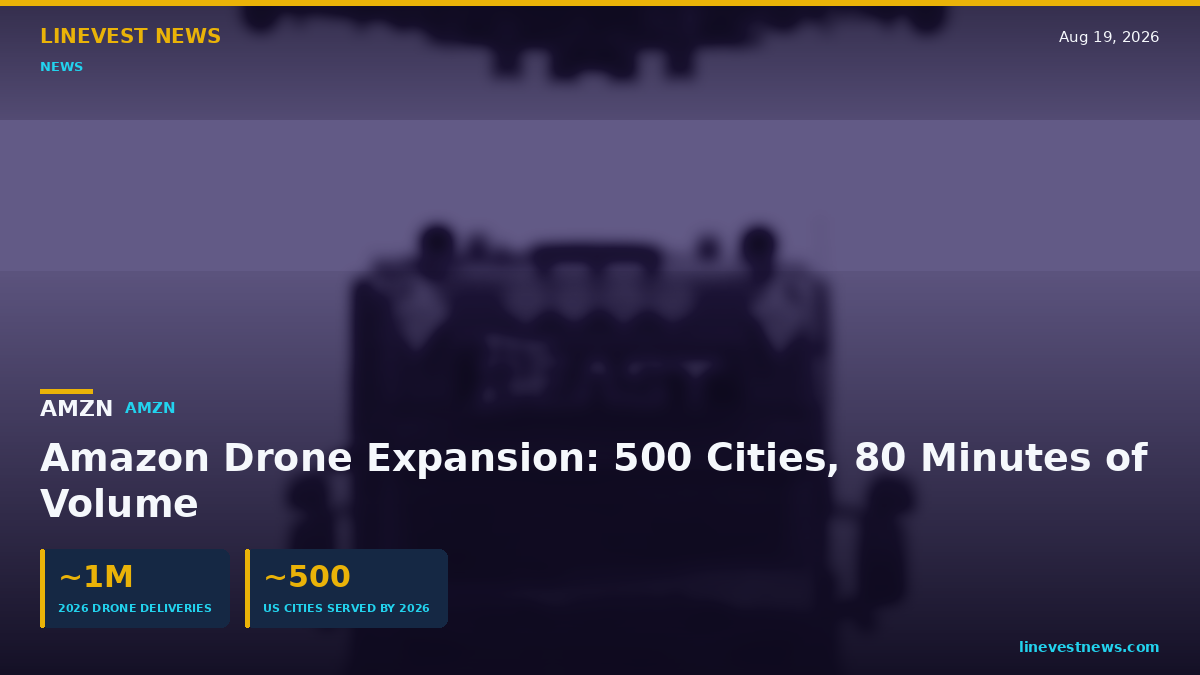
Amazon's drone unit is aiming to fly about a million packages this year. That is roughly 80 minutes of work for the ground delivery network Amazon already runs in the United States — and that ratio, not the city count in the headline, is the honest scale of what the company announced Wednesday.
Amazon.com (NASDAQ: AMZN) said Prime Air, its drone delivery arm, will serve nearly 500 U.S. cities and towns by the end of 2026, with new launch sites planned for suburban Chicago and Atlanta plus the Cleveland, Syracuse and Boise metro areas. The company describes the plan as a sixfold expansion of its current footprint, according to its newsroom post.
The million-delivery figure did not come from that announcement. CNBC reported that David Carbon, the Amazon vice president who runs Prime Air, told staff in March that the company would make a million drone deliveries this year, citing a recording of the meeting in which Carbon said "Customers continue to demand faster delivery times." Amazon has separately confirmed it has made hundreds of thousands of drone deliveries so far this year.
Why It Matters
For anyone managing money, the question is not whether the drones work. It is whether a service more than a decade in development has become large enough to register in Amazon's financial statements. The announcement is a genuine capability milestone. On volume, it is not one yet.
That distinction is easy to lose because the two kinds of news arrive in the same press release. A footprint number tells you where a service is allowed to operate. A volume number tells you how often anyone uses it. Expansion announcements are written in the first language and read, by markets, as though they were written in the second.
Two numbers, two denominators
The arithmetic is slippery and worth slowing down for. Amazon flies today from 11 sites across seven states — Arizona, Florida, Kansas, Louisiana, Michigan, Nebraska and Texas — with each site covering roughly 175 square miles, per the company's own description.
But "nearly 500" does not count sites. GeekWire, the Seattle technology news outlet, noted that the figure counts municipalities falling within delivery range rather than individual hubs. Reconciling the two published numbers gives a very different picture of what is being built:
- Launch sites today: 11, across seven states
- Coverage per site: about 175 square miles
- Implied sites after a sixfold increase: roughly 66
- Implied coverage area: about 11,500 square miles, up from about 1,925
- Municipalities per site, at nearly 500 towns: roughly 7.6
The distinction is not pedantry. Sites are the unit that costs money, requires permits and constrains throughput. Municipalities are the unit that makes an announcement sound large. Both figures are accurate — but only one describes capacity.
A hub serving eight small towns is a different capital commitment from one serving a single dense suburb, and the announcement does not say how coverage is distributed. Until Amazon breaks that out, the city count describes reach and almost nothing about volume.
Where this sits against the trucks
ShipMatrix, a parcel-industry data firm based in Warrendale, Pennsylvania, put Amazon Logistics at 6.7 billion U.S. parcels in 2025, growth of 9.9%, in its annual domestic parcel market report. That total edged past the U.S. Postal Service and made Amazon the largest parcel carrier in the country for the first time.
That figure is the right yardstick because it is Amazon's own network rather than the broader market. Drone deliveries do not add demand; they reallocate an order that would otherwise have gone into a van. The meaningful comparison is against the trucks the drones are meant to relieve.
On that basis the base works out to roughly 18 million packages a day. A million drone deliveries spread across an entire calendar year is about one package in 6,700 — the 80 minutes referenced at the top.
The longer-range target does not change the order of magnitude. In his April letter to shareholders, CEO Andy Jassy wrote that Prime Air has "plans to serve communities with 30 million customers by year-end" and expects "to deliver half a billion packages by the end of this decade," as quoted by BNN Bloomberg. That half-billion is cumulative; measured against the current ground run-rate it is roughly 27 days of deliveries.
None of this is a criticism of the program. It is a statement of where the program sits in the stack. Drones are being built as an option on a specific kind of order — small, urgent and close by — rather than as a replacement for vans. Amazon says items weighing five pounds or less that fit inside a large shoebox cover more than 60% of its frequently purchased products, which is a wide catalog but a narrow slice of total tonnage.
Conflating a capability milestone with a volume event is the standing risk in this story. Amazon has demonstrated it can operate a drone network across many jurisdictions at once. Whether customers reach for it often enough to bend the cost curve of last-mile delivery is a separate question no city count can answer.
The rule nobody has finished writing
The regulatory framing in some early coverage needs correcting, and it determines the pace of everything else. Amazon is not flying on a newly finalized federal rule. It holds FAA Part 135 certification — the same category of air carrier certificate commercial airlines operate under — and has obtained waivers permitting flight beyond its pilots' visual line of sight.
The general rule that would make those waivers unnecessary, known as Part 108, is still only a proposal. It would replace case-by-case relief with a standing framework for flights beyond the operator's line of sight, which is the single regulatory constraint that has shaped this program since its inception.
The FAA (the U.S. agency that regulates civil aviation) published its notice of proposed rulemaking in August 2025. The comment period drew more than 3,000 responses, and a brief reopening focused on electronic conspicuity and right-of-way closed on Feb. 11, 2026.
The FAA singled out those areas with seven targeted questions rather than reopening the proposal. Electronic conspicuity is the requirement that an aircraft broadcast its position so others can detect it; right-of-way sets who yields when a drone and a crewed aircraft want the same sky. Both must be settled before a standing rule can replace case-by-case permission.
A final rule that had been expected in spring of this year has not appeared, according to regulatory trackers following the docket.
That gap matters for how fast this scales. Today each new operating area is effectively a negotiation. A standing framework would turn the expansion from a permitting exercise into a logistics one — the difference between opening sites at the pace of a regulator and at the pace of a warehouse network.
Community friction is the other soft constraint, and federal rulemaking does not resolve it. Noise has been a recurring local objection wherever the service launched, GeekWire reported, with Amazon countering that its aircraft are quieter than an idling delivery truck at the drop. Slowing a rollout does not require a regulator; it requires a city council.
Walmart got to a million first
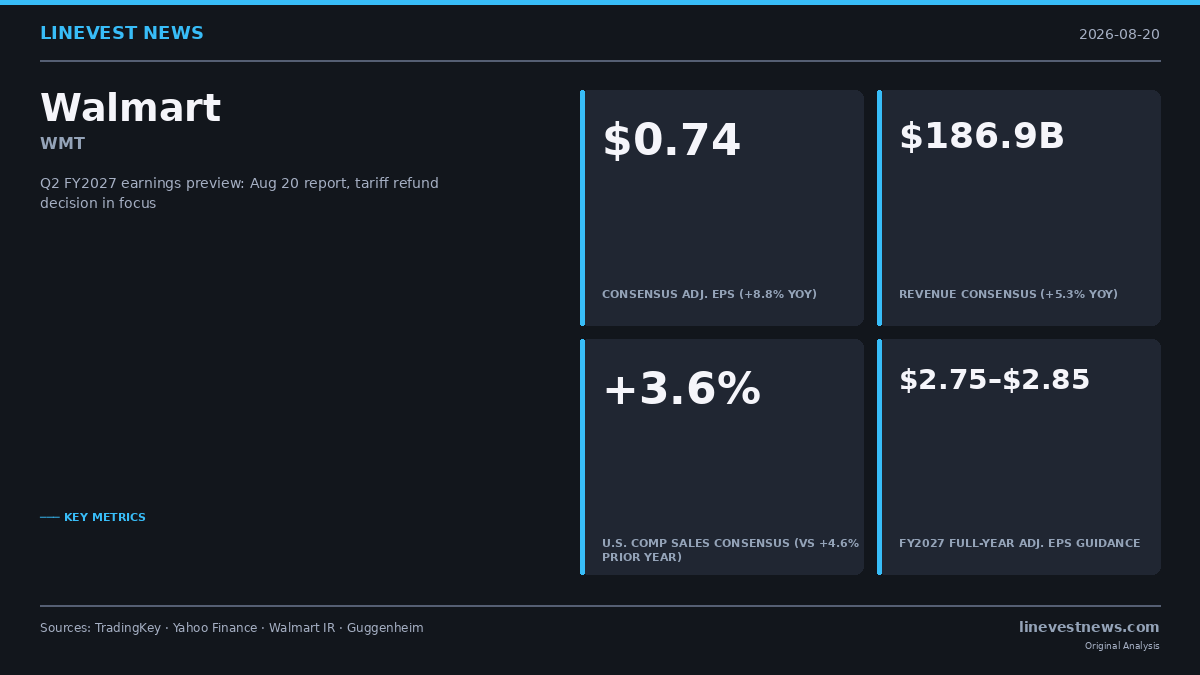
The competitive scoreboard is what the volume math makes legible. Walmart (NYSE: WMT) announced on May 29 that its drone program had completed 1 million deliveries — the same number Amazon is targeting for all of this year, except Walmart reached it as a cumulative total.
Walmart also disclosed that 40% of that million came in a single quarter, its fiscal 2027 first quarter, at an average delivery time of 23 minutes across 66 participating stores.
Set those two disclosures beside each other and the picture is not that one company is plainly ahead. Amazon is announcing a footprint; Walmart is reporting throughput, and that throughput is accelerating. One company is telling you where it will be, the other is telling you what it did.
Walmart and Wing, the drone subsidiary of Alphabet, announced plans in January to add 150 stores reaching more than 40 million Americans, expanding to over 270 locations in 2027.
Zipline, a South San Francisco–based drone maker, is the other provider Walmart names, and it flies for the retailer in the Dallas–Fort Worth metroplex. Two vendors give Walmart a hedge Amazon lacks.
The two strategies differ in a way that should surface in operating data long before either income statement. Amazon flies from delivery stations built for the purpose and controls the catalog end to end. Walmart flies from stores it already operates, so the marginal cost of a site is a rooftop already on the books. Which model compounds faster is the open question.
More than a decade of "four or five years"
Jeff Bezos introduced Prime Air on "60 Minutes" in December 2013, telling Charlie Rose the service would need "at least four or five years" and naming FAA approval as the obstacle. Amazon's early FAQ guessed the rules might be settled "as early as sometime in 2015," per GeekWire's account of the period. In 2023, CNBC reported the program was being held back by regulation and weak demand.
That record argues for reading timeline language carefully rather than dismissing it. The service is genuinely flying now, daily, for paying customers, which was not true for most of its history. But every prior public timeline has slipped, and the binding constraint named at the outset — federal approval — remains unresolved.
What we said last time
LineVest has covered Amazon twice in the past three weeks: on July 31, that second-quarter net sales reached $200.6 billion with AWS growing 37%, and on Aug. 1, the exemption from the National Highway Traffic Safety Administration that let Amazon's Zoox unit begin charging for driverless rides.
The contrast with that Zoox piece is the instructive one. There, a single federal grant with defined limits — a two-year exemption capped at 2,500 vehicles a year — unlocked commercial operation on a known date, and we described it as a milestone that reshaped a competitive landscape. Prime Air has no equivalent document.
It runs instead on a certificate plus a stack of case-by-case waivers while the rule meant to replace them sits unfinished. Two autonomy businesses, three weeks apart, on entirely different regulatory footings — and the drone expansion is the one whose ceiling is set by paperwork rather than engineering.
What would make this reading wrong
If the FAA finalizes Part 108 before year-end, the case-by-case ceiling comes off and the site-opening curve could steepen well past anything a sixfold plan implies, at which point the volume comparison above ages quickly. The reading offered here — that this is a capability announcement rather than a volume event — rests entirely on the permitting bottleneck staying where it is. A finalized rule is the one development that would break it.
The checkpoints
Three dated items will settle this rather than any amount of argument. Whether Amazon discloses a full-year drone delivery count and whether it lands near the million Carbon named internally — a figure absent from Wednesday's announcement. Whether the FAA's Part 108 final rule reaches the docket. And Walmart's next milestone disclosure, showing whether its accelerating quarterly pace held.
None of these moves a company of Amazon's size by itself. Together they decide whether the drone line is a long-running science project that finally became infrastructure, or a service that reaches a few hundred sites and settles there.
Segment-level economics of the delivery network, the four-quarter shipping-cost trend, peer comparison against Walmart's logistics build-out and the capital-expenditure bridge behind Amazon's fulfillment footprint are covered in the full report.
Disclaimer: This article is journalism, not investment advice. LineVest is not a registered investment adviser. Nothing here is a recommendation to buy, sell or hold any security. Readers should conduct their own research and consult a qualified professional before making investment decisions.