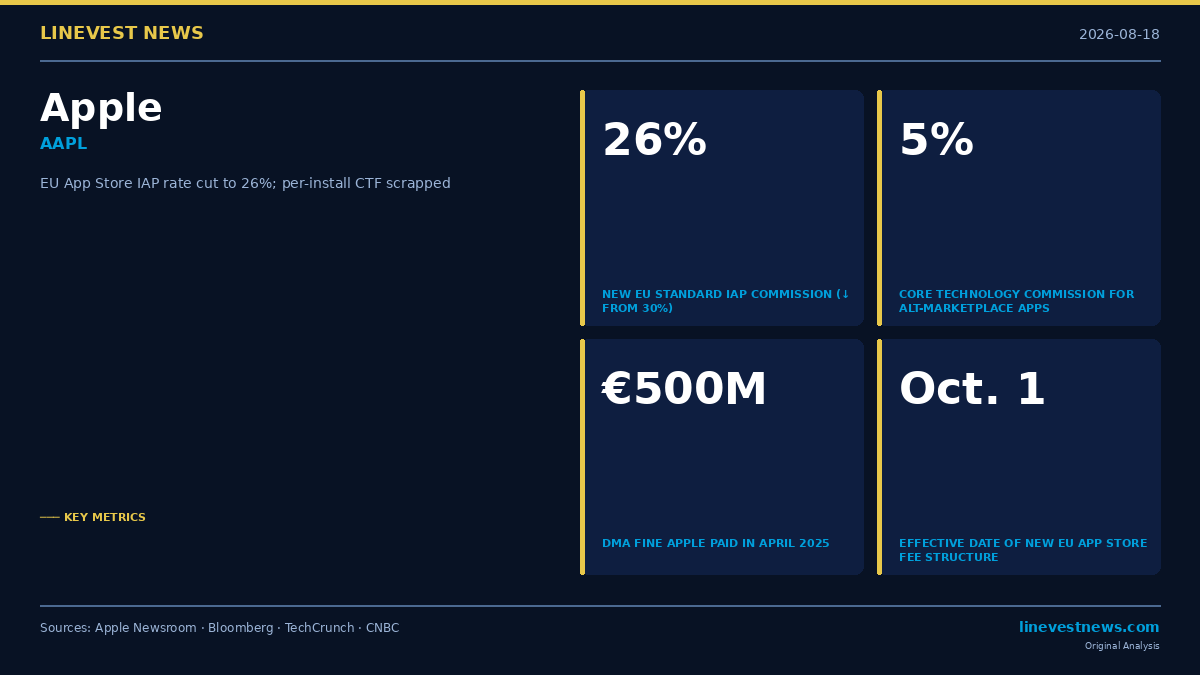
TL;DR - Apple cut EU App Store in-app purchase (IAP) commission from 30% to 26%, effective Oct. 1, 2026 - The per-install Core Technology Fee (CTF), introduced in early 2024, is replaced by a flat 5% "Core Technology Commission" for apps distributed outside the App Store - Apple settled its Digital Markets Act (DMA) dispute with the European Commission; the EC "welcomes" the changes after months of negotiations - Alternative app marketplace eligibility requirements are significantly loosened, opening the door to more third-party stores in the EU - Apple's Services segment posted $30.74B in Q3 FY2026 revenue at ~75.6% gross margin — the EU fee cut narrows that margin buffer going forward
Part A: What Apple Changed
Apple on August 18, 2026 announced a sweeping overhaul of its EU App Store business terms, acting in what the company called "close collaboration" with the European Commission to resolve disagreements over its Digital Markets Act compliance. The new framework takes effect October 1, 2026; developers can sign the new terms immediately.
New EU App Store Fee Structure
| Transaction Type | Standard Rate | Program Rate* |
|---|---|---|
| App Store IAP (Apple payments) | 26% (↓ from 30%) | 15% |
| App Store IAP with alternative payment processor | 20% | 10% |
| App Store app with link-out to web checkout | 15% | 10% |
| App via alternative marketplace or web distribution | 5% Core Technology Commission | — |
*Program rates apply to: Small Business Program, Mini Apps Partner Program, Video Partner Program, and auto-renewing subscriptions after the first year.
The most structurally significant change is the elimination of the per-install Core Technology Fee — a charge Apple introduced in early 2024 for high-volume developers distributing apps outside the App Store. Critics, including Epic Games and Spotify, had labeled it a punitive barrier designed to make DMA compliance commercially unviable. Apple replaces it with a flat 5% commission on digital transactions, which aligns more closely with what developers actually earn rather than penalizing installs.
Alternative marketplace eligibility requirements are also substantially relaxed. Previously, marketplace operators needed at least two years in the Apple Developer Program plus one million EU installs, or significant financial backing. Under the new rules, eligible entities include publicly traded companies, firms with qualifying venture capital backing, organizations that have completed a licensed accountant audit, and government, educational, or nonprofit entities — creating multiple on-ramps where previously there was a narrow gate.
Some guardrails remain: Kids category apps cannot link to external checkout sites, users under 18 require parental approval for off-App Store purchases, and developers must lock in their chosen payment method for 12 months.
Regulatory Background
The EU's Digital Markets Act designated Apple's App Store as a "core platform service" subject to interoperability and fair-access requirements; Apple's gatekeeper obligations under the DMA became enforceable in March 2024. In April 2025, the European Commission fined Apple €500 million for DMA noncompliance — among the first enforcement actions under the regulation. A subsequent EU fee restructuring was widely criticized as "malicious compliance" — technically meeting the letter of interoperability requirements while making alternative distribution economically unattractive through the per-install CTF.
The August 18 announcement represents Apple's most substantive concession yet. A Commission spokesperson confirmed the EC "welcomes Apple's changes" following "close dialogue" and said it will monitor implementation.
Part B: Investor and Market Implications
Services Margin: Headwind, Not a Crisis
Apple's Services segment is the company's highest-margin business. In Q3 FY2026 (ended June 27, 2026), Services generated $30.74 billion in revenue — up 12% year over year — at a gross margin of approximately 75.6%, accounting for roughly 45% of Apple's estimated $52 billion quarterly gross profit despite contributing about 28% of revenue.
The EU represents a meaningful but manageable portion of that revenue base. Apple does not break out App Store revenue by geography; its reported Europe segment also encompasses the UK, the Middle East, and other non-EU markets not subject to the DMA, so precise EU-only sizing is not possible from public disclosures. Working from reported figures as an approximation: if one-quarter of EU-area App Store commission revenue flows through the standard 30% tier, a 30%→26% rate cut reduces Apple's take by 13.3% (4/30) on that portion, implying an annual headwind in the range of $200–300 million — meaningful but manageable relative to Apple's approximately $205 billion annual gross profit pool. The more relevant risk is precedent: if other jurisdictions adopt similar DMA-style regulations (the UK's Digital Markets, Competition and Consumers Act; Japan's Act on Promotion of Competition for Specified Smartphone Software), the effective rate reduction scales globally.
End of the Regulatory Overhang Calculation
For AAPL shareholders, the strategic value of this settlement is cleaner than the margin arithmetic. Each quarter Apple remained in DMA noncompliance carried tail risk of escalating fines — the DMA provides for initial penalties up to 10% of global annual turnover, rising to 20% for repeated infringement, which on Apple's approximately $435 billion annualized revenue base would represent up to $43–87 billion in potential exposure. Settling removes that overhang and frees management bandwidth from Brussels.
The European Commission's welcoming response is notable. Brussels has shown a consistent willingness to litigate through fines when tech companies resist; that it is publicly endorsing this framework suggests Apple has given sufficient ground to close the chapter — at least on fee structure. Ongoing DMA investigations into Apple's interoperability and browser choice obligations remain separate matters.
Developer Ecosystem Shifts
The loosened alternative marketplace requirements have immediate implications for companies that have publicly pursued EU App Store alternatives. Epic Games launched its iOS game store in the EU on August 16, 2024; under the new, less burdensome eligibility criteria, its standing as a qualifying marketplace operator is secure and its user acquisition economics improve significantly with the removal of per-install charges. Spotify — a long-standing critic of Apple's in-app purchase rules — stands to benefit from the 10–15% link-out rates, which make web checkout meaningfully cheaper than routing through Apple's standard IAP.
For smaller developers, the elimination of the per-install CTF resolves a structural barrier to testing alternative distribution without the risk of per-download liability accumulating against modest revenues. This is likely to accelerate, if modestly, the number of apps that choose dual distribution (App Store + web) in the EU.
Competitive Positioning and Long-Term Watchpoints
Apple's 30% standard commission in the United States remains unchanged. The EU's 26% rate now creates a geographic differential that sophisticated developers will navigate. Developers building apps with significant EU user bases will increasingly architect payment flows to capture the lower EU rate, potentially shifting revenue booking patterns — a dynamic that could intensify as developer tooling catches up.
The 12-month lock-in on payment method choice is a meaningful constraint. Developers who opt for alternative processing in the EU cannot easily revert to Apple IAP within a year, reducing the risk of a mass opt-out that would pressure Apple's cut further.
The next regulatory watchpoints for AAPL: (1) UK CMA implementation of its Digital Markets, Competition and Consumers Act, expected to follow a broadly similar DMA template; (2) Japan's Act on Promotion of Competition for Specified Smartphone Software, enacted June 2024, under which the Fair Trade Commission has pursued Apple separately; (3) the Epic v. Apple contempt proceedings in the United States, where the Supreme Court granted certiorari in June 2026 and is set to hear oral arguments in its October 2026 term — a distinct matter from EU DMA compliance but potentially consequential for U.S. App Store fee structures as well.
This article is based on Apple's official newsroom announcement, European Commission statements, TechCrunch, MacRumors, Bloomberg, CNBC, and 9to5Mac. This is journalistic analysis, not investment advice. All figures are sourced from public disclosures and are accurate as of the date of publication.
Sources - Apple Newsroom: https://www.apple.com/newsroom/2026/08/apple-announces-changes-for-apps-in-the-european-union/ - Bloomberg: https://www.bloomberg.com/news/articles/2026-08-18/apple-lowers-app-store-fees-in-europe-to-settle-dispute-with-eu - TechCrunch: https://techcrunch.com/2026/08/18/apple-overhauls-its-eu-app-store-fees-loosens-rules-for-alternative-app-stores/ - CNBC: https://www.cnbc.com/2026/08/18/apple-eu-app-store-fees-iphone.html - MacRumors: https://www.macrumors.com/2026/08/18/eu-app-store-fee-change/ - 9to5Mac: https://9to5mac.com/2026/08/18/apple-overhauls-app-store-fees-in-the-eu-with-new-unified-terms/