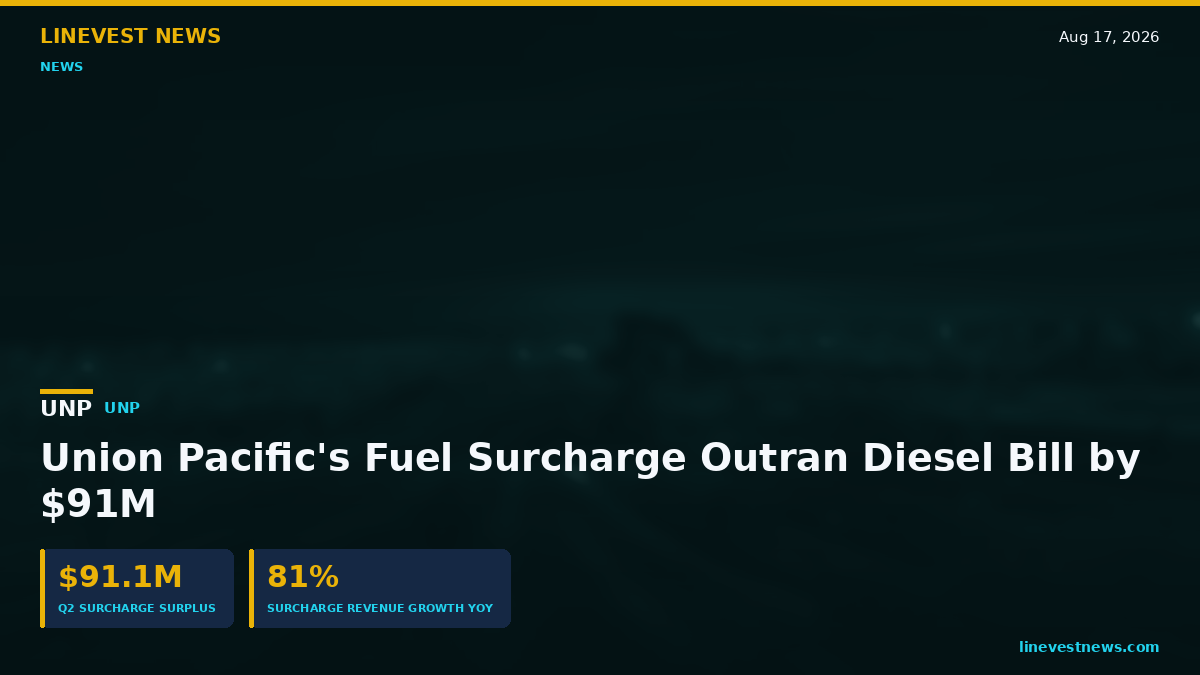
Union Pacific (NYSE: UNP) collected about $91.1 million more in fuel surcharges than it spent on diesel last quarter. Across the first half of the year, it was the only large U.S. railroad to show a net surplus on that same measure, according to filings with the Surface Transportation Board — the federal agency that regulates U.S. freight rail rates and mergers — first reported by Reuters on Monday, Aug. 17. The figure is an arithmetic story rather than a market surprise: roughly two-thirds of the railroad's entire revenue increase for the quarter came from a charge meant to recover fuel costs, not to earn a margin on them.
What the filings show
Surcharge revenue minus fuel cost for the second quarter, per Surface Transportation Board filings as reported by Reuters:
| Railroad | Surcharge revenue vs. fuel cost |
|---|---|
| Union Pacific (NYSE: UNP) | +$91.1 million |
| CSX (NASDAQ: CSX) | +$8.4 million |
| Norfolk Southern (NYSE: NSC) | +$3.6 million |
Across the first six months, on the same filings as reported by Reuters:
- Union Pacific: +$56.3 million — the only major carrier in surplus
- BNSF, the railroad unit of Berkshire Hathaway (NYSE: BRK.B): −$658.1 million
- Union Pacific, first quarter alone: −$34.8 million, on $607.6 million of surcharges collected
- Union Pacific, full-year 2025: −$48 million, on $2.3 billion of surcharge revenue
The quarterly swing is the story. Union Pacific ran a shortfall in the first quarter and a surplus in the second, and the two roughly net to the half-year figure. The company's published surcharge formula did not change between the two quarters. What changed was the calendar.
Why It Matters
Revenue growth normally reads as a demand signal — more freight moved, or moved at better rates. That is not what happened here, and the difference matters more than the dollar figure does. What grew fastest was a formula tied to an outside index, and a formula stops contributing once the input it tracks stops climbing.
A fuel surcharge is not a price. It is a pass-through, an add-on tied to an outside fuel index so neither carrier nor shipper is betting on diesel when they sign a multi-year contract. A pass-through that reliably returns more than it recovers is, by construction, no longer a pass-through.
Railroads are unusual among freight modes in having to show this arithmetic to a regulator. Trucking companies, airlines and ocean carriers also levy fuel surcharges, but they do not file the cost side and the revenue side together in a public docket where customers can read them. That obligation is why one filing line becomes a story about pricing power.
The lag is written into Union Pacific's own tariff
The explanation is not in the earnings release. It is in the tariff Union Pacific publishes for customers, which states that the charge "will be billed to applicable shipments beginning the second month following the month on which the DOE average price calculation was based." The reference index is the U.S. Department of Energy's national average retail diesel price. Per the same tariff, surcharges begin once that monthly average reaches $2.30 a gallon, at one cent per mile.
The delay exists for a mundane reason. A railroad cannot re-rate millions of shipments in real time against a weekly index, so the industry settled on a monthly average applied with enough distance for billing to catch up. Shippers accepted it because the same lag protects them on the way down, and in a quiet fuel market it is close to neutral.
It is not neutral through a shock. When diesel climbs hard, the railroad bills a cheap old index against an expensive current fuel bill and loses money on the pass-through — what happened in the first quarter. When the lagged billing index posts a rate above what the carrier currently pays for fuel, the surplus flows in the carrier's direction. The path of diesel costs and billing rates this year — with a first-quarter deficit reversing in the second — produced that swing exactly.
Two-thirds of the revenue growth
From the 10-Q — the quarterly report public companies file with the SEC — for the period ended June 30, 2026, and the July 23 earnings release:
- Operating revenue: $6.154 billion → $6.864 billion, an increase of $710 million
- Fuel surcharge revenue: $569 million → about $1.03 billion, an increase of roughly $460 million
- Fuel expense: $576 million → $938 million
- Average fuel price per gallon: $2.42 → $3.86, up 60%
- Freight revenue excluding fuel surcharge: +4.5%, against +11.5% including it
Set those lines beside each other and the composition is plain. The pass-through charge grew about 81% year over year while the cost it exists to recover grew about 63%. Strip the surcharge out and freight revenue grew 4.5%, against the 11.5% headline.
None of this is hidden or improper. The tariff is public, the index is published by the federal government, and the Board designated it a safe harbor. The observation is narrower: the largest single contributor to the quarter's revenue growth was a mechanism the company calls cost recovery — and cost recovery does not compound. It reverses when the input price does.
Against the income statement the surplus is small. Operating income was $2.763 billion, which makes $91.1 million about 3.3% of it.
Per share, the gross surplus works out to roughly 15 cents before tax on the diluted share count in the filing. At Union Pacific's approximately 24% effective rate, the after-tax earnings contribution works out to roughly 11 cents.
That is where it matters — against the beat, not against the size of the company. Adjusted diluted earnings per share of $3.08 landed about 22 cents above the consensus estimate cited by Reuters, so the surcharge gap accounts for about half of the surprise the quarter was praised for.
Note what the surplus did not do. The quarter's operating ratio — the share of revenue eaten by operating expense — stood at approximately 60% even with the gap in hand, and management attributed part of that to fuel price. A pass-through inflates revenue and expense at once, flattering the top line while diluting the cost ratio.
2008, and the ruling that came before it
This has happened before, at nearly the same point in a fuel cycle. In the second quarter of 2008, CBS News calculated that Union Pacific booked $585 million of fuel surcharges against a $436 million rise in fuel costs, and asked how customers felt about a cost-recovery charge becoming a profit center. That used a different denominator than the STB filings do, so the figures are not comparable. The pattern is.
The regulatory response arrived before that quarter, not after it. In January 2007 the Board ruled in Ex Parte 661 that computing a surcharge in a way that does not correlate with the fuel cost of the actual shipment is an unreasonable practice, and barred surcharges set as a percentage of the base freight rate. In its place it blessed the Department of Energy diesel index as a safe harbor.
That is the quiet irony here. The remedy for surcharges that did not track fuel costs was an index that tracks them accurately but late. Regulators traded a mechanism that could be wrong in direction for one that is wrong in timing — and the second failure mode is the one generating headlines now.
Why the timing is awkward
The agency reading these fuel filings is the agency reading Union Pacific's merger application. Union Pacific and Norfolk Southern, the eastern railroad it agreed to buy for roughly $85 billion, are before the Board in Docket FD 36873. The record so far, per the docket:
- January 2026: original application rejected as incomplete
- April 30, 2026: revised application filed
- May 28, 2026: accepted, then held in abeyance pending supplemental information
- Late July 2026: applicants finish filing it
- 10-Q: closing expected in 2027; buybacks paused for the deal
A quarter in which the fuel pass-through outearned the fuel bill is not a legal problem. It is a rhetorical one. Union Pacific's case rests on service and competitive benefits to shippers — the constituency whose objections carry weight in a merger review. Opponents now have a figure from the company's own filings to put before the regulator deciding the case.
"Rail fuel surcharges overall are up 43 cents a mile since March and now sit above the previous record from September 2008," Kyle Henzel, president and chief operating officer of the freight booking platform Ship.com, told Reuters. "That's not a typo."
Union Pacific did not dispute the arithmetic. "Ultimately, fuel surcharges are a component of the overall cost we negotiate with customers," the company told Reuters — framing the charge as one term inside a negotiated rate rather than a standalone pass-through. That is a fair description of how rail contracts are struck. It is also a different one from what the charge's name implies, and that gap is the shippers' complaint.
The BNSF contrast
On the same filings, BNSF ran $658.1 million of surcharge revenue below its fuel cost over the first half — the mirror image of Union Pacific's result. Our Aug. 17 analysis of Berkshire Hathaway's second quarter walked through its operating earnings without reaching that fuel line.
Two railroads, one index, opposite outcomes. Diesel cost both the same thing. The difference is contract mix: how much freight moves under a surcharge program at all, and how much tonnage sits under all-in negotiated rates. That is a commercial choice, not a fuel-market event.
What would make this reading wrong
The lag cuts both ways and already has. Union Pacific ran a deficit in the first quarter and a $48 million deficit across all of 2025 on $2.3 billion of surcharge revenue. Add this year's half-year surplus to last year's shortfall and the program has returned roughly $8 million more than it cost — a rounding error at this scale. If that is the right frame, the quarter was a timing artifact rather than a pricing decision, and it unwinds on its own.