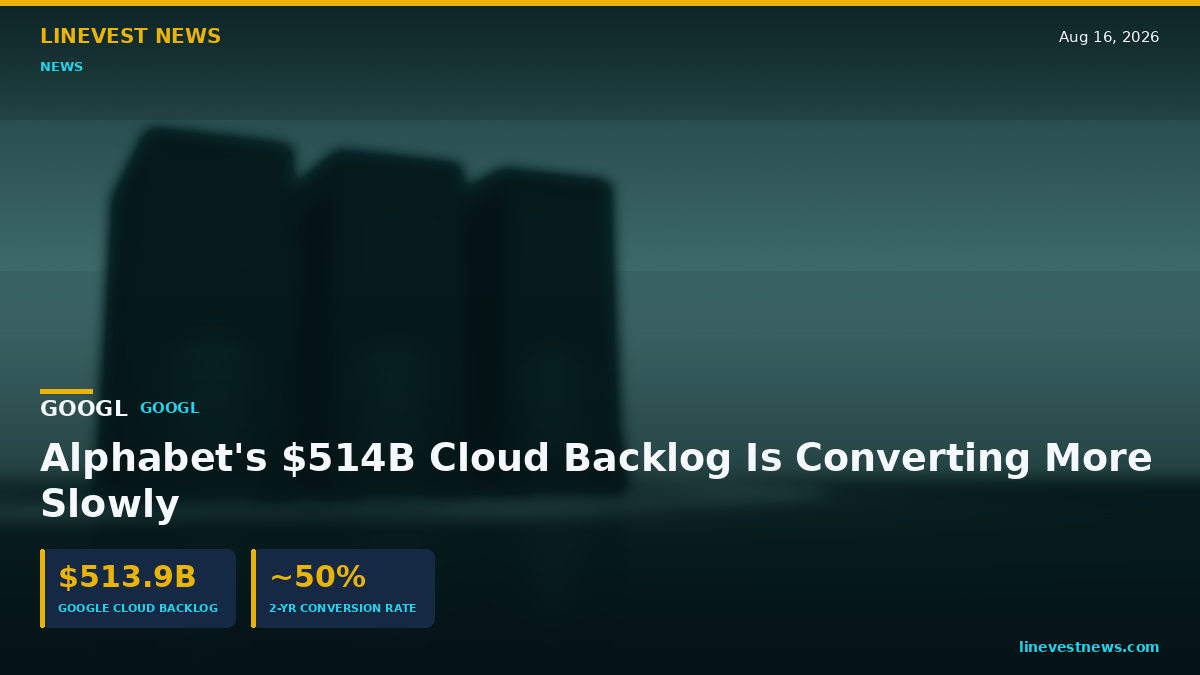
Alphabet's latest quarterly filing contains a sentence its earnings press release does not: the company expects to recognize just over 50% of its record total remaining performance obligations as revenue within the next two years. A year earlier, the identical disclosure line put that share at approximately 55%.
Between those two filings the order book grew nearly fivefold. The portion scheduled to arrive inside a two-year window grew with it in dollar terms — but not as fast. As a share of the total, it shrank. That is the part of the Google Cloud story the headline number cannot tell you, and it sits in the Form 10-Q — the quarterly report public companies file with regulators — that Alphabet (NASDAQ: GOOGL) filed with the SEC on July 23.
Why It Matters
Backlog has become the signature metric of the AI infrastructure era. When capacity is scarce and contracts run for years, the order book is the cleanest proof a provider can offer that demand is real.
What a total cannot say is when. A commitment signed today and served years from now is not the same asset as one served next quarter, though both land in the same headline figure.
What a backlog is, and what it is not
Revenue backlog — accountants call it remaining performance obligations — is neither cash nor revenue. It is the dollar value of commitments inside signed customer contracts that a company has not yet delivered against. It tells you demand has been contracted. It does not tell you when the money arrives, whether the seller can build the capacity to serve it, or what that capacity costs to build.
That is why the recognition schedule matters more than the headline total. A backlog that converts quickly behaves like an order book. A backlog that converts slowly behaves more like a statement of intent stretched across many years, carrying more of the risk that circumstances change before delivery.
Alphabet discloses both the size and the schedule. Only one of them travels through the news cycle.
The two filings, side by side
The figures below are lifted from Alphabet's own quarterly reports to the SEC, twelve months apart.
| Disclosure | Q2 2025 10-Q | Q2 2026 10-Q |
|---|---|---|
| Total remaining performance obligations | $108.2B | $519.5B |
| Portion related to Google Cloud | not split out | $513.9B |
| Expected to convert within 24 months | approximately 55% | just over 50% |
| As of | June 30, 2025 | June 30, 2026 |
One caveat belongs here before anything is built on that comparison. Alphabet changed the definition in the first quarter of 2026 to include contracts with an original expected term of one year or less, and the Q1 2026 10-Q put that addition at roughly $7.3 billion — nearly one and a half percent of the total. The growth in the order book is overwhelmingly real rather than definitional.
Here is the calculation the filing does not perform. Apply the prior year's 55% ratio to today's $519.5 billion and about $286 billion would be due within two years. Apply the ratio Alphabet actually disclosed, read at the low end of "just over 50%," and the figure is closer to $260 billion.
The difference on that reading — roughly $26 billion — is business that the older schedule would have placed before June 2028 and the current one places after it. Because Alphabet gives the share only as a rounded phrase rather than an exact percentage, the gap is an estimate, not a disclosed figure. Nothing was cancelled to produce it. The mix simply moved.
What moved is worth stating plainly. The same disclosure line, filed by the same company under the same accounting rules, now describes a longer wait between the signature and the delivery it promises.
Lengthening is not the same as weakening
A stretching backlog is not automatically a warning sign. Multi-year AI infrastructure commitments are structurally longer-dated than the software subscriptions that used to dominate this line, and a customer willing to sign for delivery several years out is arguably expressing more confidence than one signing for next quarter, not less. Duration and quality are separate questions, and the filing speaks only to the first.
What lengthening does change is the financing picture. The further out contracted revenue sits, the longer the interval between the capital spent to build capacity and the cash collected for using it. That interval has to be funded by something. The funding decision is visible elsewhere in the same set of documents.
What it costs to deliver
On the July 22 earnings call, CFO Anat Ashkenazi gave analysts the spending number that framed the entire quarter:
"We are updating our full-year 2026 CapEx guidance range to $195 billion-$205 billion, up from our previous estimate of $180 billion-$190 billion."
She then made clear the raise was not a one-year event:
"We continue to expect our CapEx to increase significantly in 2027 and will provide more details at a later date."
Set the two disclosures against each other. Capital spending guidance for calendar 2026 alone, at the $200 billion midpoint, equals roughly three-quarters of the $260 billion the filing implies the entire order book will convert across two full years.
That comparison is not an accusation of waste. Infrastructure is built ahead of the revenue it serves, by definition, and the assets have useful lives far longer than the contracts currently signed against them. But it does establish the shape of the commitment: one year of building costs roughly three-quarters of what two years of contracted delivery brings in.
The near-term revenue bar is the other half of the arithmetic. Roughly $257 billion recognized across eight quarters averages about $32 billion a quarter, against the $24.8 billion Google Cloud booked in the second quarter. Cloud revenue has to run roughly 30 percent above its current quarterly pace, on average, for that schedule to hold.
CEO Sundar Pichai framed the constraint as a demand-side one on the same call, saying the company continues "to be supply constrained, a sign of momentum and rapid adoption." Both readings can hold at once. Being unable to build fast enough is a better problem than being unable to sell, and it remains a problem solved with capital.
The cash the buildout consumes
The company's own reconciliation table in its earnings release shows how quickly the spending changed the cash profile.
| Quarter | Operating cash flow | Capital expenditure | Free cash flow |
|---|---|---|---|
| Q4 2025 | $52,402M | $27,851M | $24,551M |
| Q1 2026 | $45,790M | $35,674M | $10,116M |
| Q2 2026 | $39,069M | $44,924M | −$5,855M |
| Trailing 12 months | $185,675M | $132,402M | $53,273M |
Capital expenditure guidance at the midpoint runs roughly 3.8 times trailing twelve-month free cash flow. Alphabet has already acted on that gap: the release discloses that in June it issued Class A stock, Class C stock and mandatory convertible preferred stock for aggregate net proceeds of $49.6 billion, expressly "to be used for general corporate purposes, including capital expenditures to scale AI infrastructure and global compute," alongside a program to sell up to $40.0 billion more.
Now put two facts next to each other. A company carrying a half-trillion-dollar order book issued equity in the same quarter to fund the capacity required to serve it — while total deferred revenue, the amount customers have actually paid or been billed in advance, stood at $10.1 billion at June 30, according to the same filing.
Those two numbers measure different things, and the gap between them is not a scandal. It is a reminder of what the order book is made of: contracted intent at enormous scale, backed by prepayment at ordinary scale, serviced by capacity that must be financed before anyone consumes it.
The cost that has not landed yet
One more lag sits inside the filing, and it works in the opposite direction — flattering the income statement rather than the cash flow statement.
| First half | 2025 | 2026 | Change |
|---|---|---|---|
| Capital expenditures | $39.643B | $80.598B | +103% |
| Depreciation of property and equipment | $9.485B | $13.586B | +43% |
Depreciation begins when assets are ready for their intended use, as the 10-Q states, so a buildout of this size reaches the cash flow statement long before it reaches reported profit. Google Cloud's operating margin was 35.6% in the second quarter, up from 20.7% a year earlier, on the segment figures in the filing.
That margin expansion is genuine, and it is also being measured against a depreciation charge that has not yet caught up with the hardware in the ground. As assets currently under construction enter service, the expense side of that calculation grows. Whether margins keep expanding through it is the question the next several filings will answer.
A recent precedent
The market has already run this experiment on another company. Oracle (NYSE: ORCL), the enterprise database and cloud infrastructure firm, reported remaining performance obligations of $523 billion for the quarter ended Nov. 30, 2025 — a more than fivefold jump, according to the company's own results release.
The backlog did not protect the shares. Oracle stock fell 11% to $198.85 on Dec. 12, 2025, down more than 40 percent from a record high that September, Fortune reported.
Free cash flow was negative $10 billion in that quarter, on Oracle's reported figures, and the company lifted full-year capital spending to approximately $40 billion.
The lesson was not that the backlog was fake. It was that a very large contracted order book did not, on its own, settle what the buildout would cost or when it would pay. Alphabet enters the same debate from a materially different position, with Google Services generating $39.5 billion of operating income in the second quarter — an earnings base Oracle cannot match. The question being asked, though, is the same one.