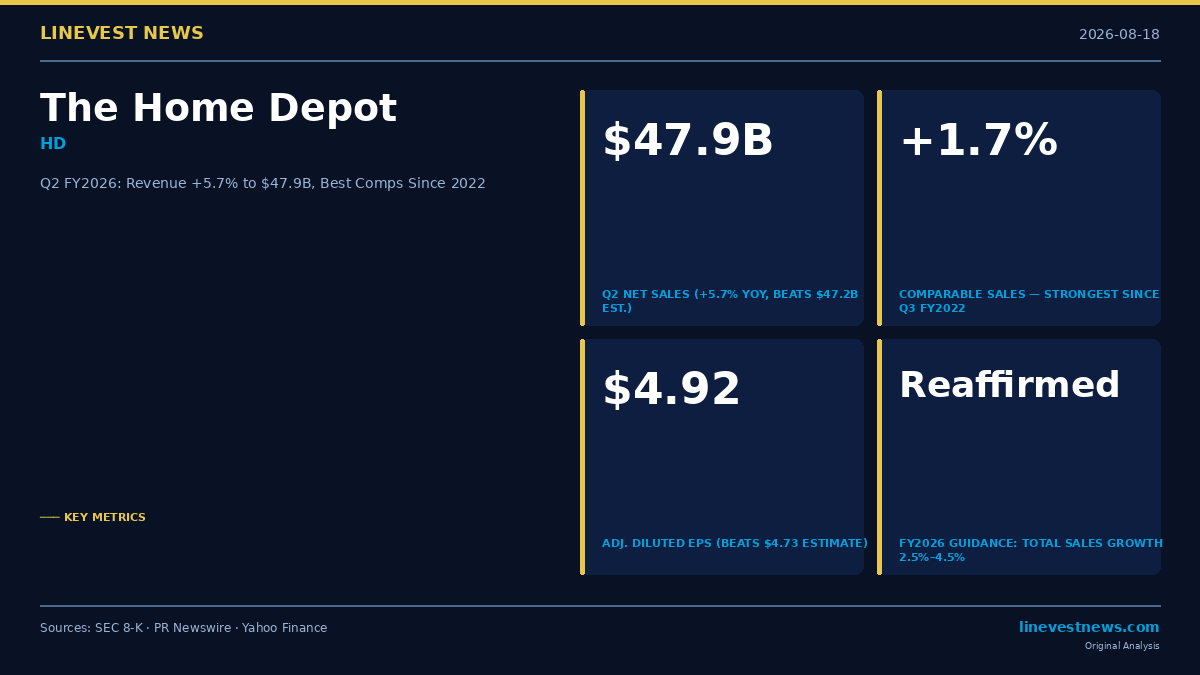
Home Depot Q2 FY2026 Earnings: Revenue Rises 5.7% to $47.9B, Best Comparable Sales Since 2022
TL;DR - Q2 net sales $47.9 billion (+5.7% YoY), beating Wall Street's $47.24B estimate - Comparable sales +1.7% (U.S. +1.3%) — strongest reading since Q3 FY2022 - Adjusted diluted EPS $4.92 vs. $4.73 consensus (+$0.19 beat) - Full-year FY2026 guidance reaffirmed: total sales growth 2.5%–4.5% - CEO Ted Decker on medical leave; Senior EVP Ann-Marie Campbell + CFO Richard McPhail co-leading
Part A — What the 8-K Says
The Home Depot, Inc. (NYSE: HD) filed an 8-K (Item 2.02, Results of Operations) with the SEC on August 18, 2026 (accession no. 0000354950-26-000145), disclosing results for the second quarter of fiscal 2026 — the thirteen weeks ended August 2, 2026.
Q2 FY2026 Income Statement Highlights
| Metric | Q2 FY2026 | Q2 FY2025 | Change |
|---|---|---|---|
| Net Sales | $47.9B | $45.3B | +5.7% |
| Comparable Sales — Total | +1.7% | — | — |
| Comparable Sales — U.S. | +1.3% | — | — |
| Gross Profit | $16.115B | $15.130B | +6.5% |
| Gross Margin | ~33.6% | ~33.4% | +~24 bps |
| Operating Income | $6.839B | $6.559B | +4.3% |
| Operating Margin | 14.3% | 14.5% | -20 bps |
| Net Earnings | $4.8B | $4.6B | +4.3% |
| Diluted EPS (GAAP) | $4.79 | $4.58 | +4.6% |
| Adjusted Diluted EPS | $4.92 | $4.68 | +5.1% |
| SG&A Expenses | $8.424B | $7.763B | +8.5% |
Transaction Metrics
| Metric | Q2 FY2026 | Change |
|---|---|---|
| Total Customer Transactions | 443.2M | -0.8% |
| Comparable Customer Transactions (comp-store basis) | — | -1.0% |
| Comparable Average Ticket (comp-store basis) | $92.50 | +2.8% |
Total customer transactions cover all stores; comparable transaction and ticket metrics apply to comparable stores only. Management-reported comparable sales of +1.7% reflects rounding in underlying component inputs.
Balance Sheet & Cash Flow Snapshot
- Cash: $2.085B | Short-term debt: $4.248B | Long-term debt: $43.951B
- H1 FY2026 operating cash flow: $11.4B (vs. $9.0B in H1 FY2025, +26.7%)
- CapEx guidance: ~2.5% of total annual sales
- Stores: 2,364 retail locations + SRS Distribution Pro-branch network
FY2026 Full-Year Guidance (Reaffirmed)
| Metric | FY2026 Guidance |
|---|---|
| Total Sales Growth | 2.5% – 4.5% |
| Comparable Sales Growth | Flat to +2.0% |
| Gross Margin | ~33.1% |
| Adjusted Operating Margin | 12.8% – 13.0% |
| Adjusted Diluted EPS Growth | Flat to +4.0% (from $14.69 FY2025 base) |
| New Store Openings | ~15 |
| Net Interest Expense | ~$2.3B |
Management noted that IEEPA tariff refunds are "expected to partially offset unplanned fuel, energy, and other product input costs throughout the fiscal year."
CFO Richard McPhail stated: "Our second quarter results exceeded our expectations. We saw broad-based demand across the business as customers continued to engage in smaller projects."
Senior EVP Ann-Marie Campbell added: "Our teams did an exceptional job executing throughout a dynamic environment."
Part B — What It Means for Investors
The Comp Sales Recovery Is Real — But Concentrated in Smaller Projects
The headline number that matters most for HD's bull case is the +1.7% comparable sales figure — the strongest reading since Q3 FY2022. After several consecutive quarters of negative or flat comps, returning to positive comparable sales represents a meaningful inflection signal for long-term investors.
But the composition matters. Comparable customer transactions declined 1.0% while comparable average ticket rose 2.8%. CFO McPhail explicitly attributed results to customers "engaging in smaller projects" rather than major renovations. According to GlobalData analyst Neil Saunders, smaller discretionary repairs outperformed year-over-year in Q2, while bigger-ticket remodel projects — the high-margin jobs that drove Home Depot's pandemic renovation supercycle — remained a drag due to elevated financing costs.
For long-term investors, the question is whether this quarter marks the start of a broad housing demand recovery, or a temporary lift from pre-tariff purchasing and seasonal factors.
The Housing Headwind Persists
Home Depot's guidance reaffirmation — rather than a raise — signals management's caution about H2. The structural headwind is unchanged: mortgage rates remain sharply elevated versus the pandemic-era record lows of 2020–21, and existing home sales continue to run near multi-year lows. Housing turnover is the single biggest lever for home improvement spending: buyers of existing homes historically spend significantly more on renovations within the first two years than long-term residents.
The "lock-in effect" — homeowners unwilling to trade a pandemic-era 3% mortgage for today's rates — continues to suppress the high-ticket professional and contractor segment. This is exactly the category HD is targeting through its SRS Distribution acquisition, whose Pro-branch network is now embedded within Home Depot's consolidated results. Until housing turnover recovers, the contractor spending surge that would drive meaningful comp acceleration above +2% remains constrained.
Tariff Uncertainty: The Headline Risk for H2
Home Depot's guidance acknowledges IEEPA tariff refunds that are expected to partially offset input cost increases over the balance of FY2026. However, the tariff landscape is evolving: new duties on Canadian goods, announced separately, are set to take effect August 19, one day after this earnings print. Canada is a meaningful supplier of dimensional lumber, oriented strand board (OSB), and other building materials critical to HD's Pro contractor business.
The actual rate and scope of the new Canadian duties, and how they interact with existing USMCA exemptions, will require close reading of the implementing executive order. Home Depot merchandising chief Billy Bastek has previously indicated that some products facing severe tariff-driven cost increases may be discontinued rather than repriced — a supply-side response that could suppress transactions without improving margins. Investors should watch Q3 disclosures for specific commodity cost pass-through data.
Leadership Overhang: A Known Unknown
CEO Ted Decker's medical leave, announced August 12, introduces a governance risk that financial models cannot fully price. Per Bloomberg, the leave is expected to last several months; a specific return date has not been disclosed. Senior EVP Ann-Marie Campbell oversees day-to-day operations; CFO Richard McPhail manages financial strategy and the Pro/SRS subsidiaries.
Both executives are capable operators, but the CEO's temporary absence during a complex macro environment — tariff evolution, housing stagnation, SRS integration — creates uncertainty around capital allocation priorities and long-term strategic direction. The board has not indicated whether succession planning is being accelerated. Until clarity emerges, this will act as a modest multiple compression factor even if operating performance holds.
Cash Flow Strength: The Underappreciated Metric
While operating margin compressed 20 basis points year-over-year (14.3% vs. 14.5%), the cash flow picture is substantially more constructive. H1 FY2026 operating cash flow of $11.4 billion — up 26.7% from $9.0 billion in H1 FY2025 — demonstrates that the business generates substantial free cash flow relative to reported earnings. The improvement partly reflects working capital timing, but also reflects pricing power embedded in Home Depot's dominant market position.
CapEx guidance of ~2.5% of total sales leaves meaningful room for shareholder returns through dividends and buybacks — even against $43.95 billion in long-term debt.
The Trade: What Investors Should Watch
Bull case triggers: - Mortgage rates decline meaningfully from current levels → housing turnover recovers → Pro spending accelerates - New Canadian goods tariffs are narrower in scope than feared; IEEPA refunds materialize as guided - Q3 comps sustain above +1.5%; CEO returns on schedule
Bear case triggers: - New Canadian lumber/building-material duties spike input costs faster than pricing pass-through - Comparable transaction counts deteriorate further as consumer confidence softens in H2 - CEO absence extends into Q4; board signals succession process - Pro segment growth disappoints relative to SRS integration costs
Home Depot's beat-and-reaffirm is the correct outcome for a stock trading at a premium to the Consumer Discretionary sector. But it is not yet the "housing recovery confirmed" signal that would justify meaningful multiple expansion. The next pivotal datapoints are Lowe's (LOW) earnings — typically reported within a week of HD's — and the September FOMC meeting, where any rate cut would reset the housing affordability calculus for both consumers and contractors.
This article is based on Home Depot's SEC 8-K filing (accession no. 0000354950-26-000145, August 18, 2026) and publicly available market data. It is journalism, not investment advice. LineVest News is not a registered investment adviser.
Sources: - SEC EDGAR 8-K Filing (0000354950-26-000145) - Home Depot Q2 FY2026 Press Release (PR Newswire) - StockTitan — Q2 FY2026 Summary - Yahoo Finance — Consumer Behavior - Bloomberg — CEO Medical Leave