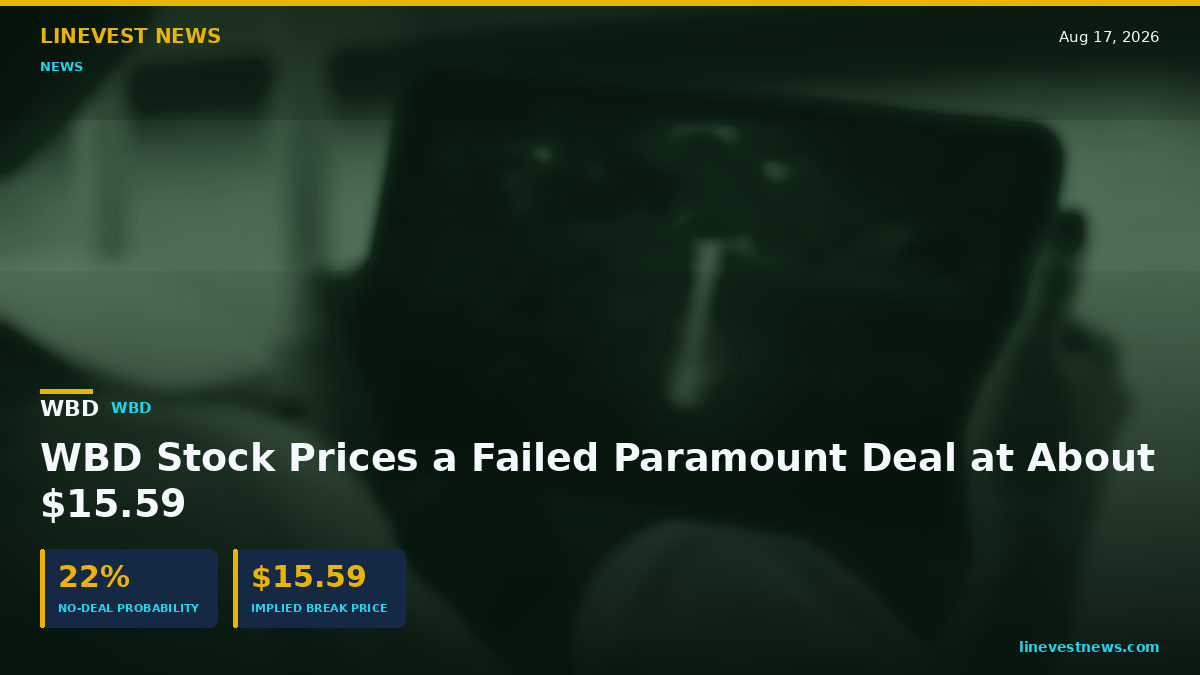
Prediction-market traders put roughly one-in-four odds on Paramount Skydance's takeover of Warner Bros. Discovery failing, CNBC reported Monday. Run that probability back through Warner Bros. Discovery's own share price and it pins down a figure the odds themselves never state: the market's implied value for a WBD share if the deal dies, about $15.59.
That number is not a forecast. It is what the arithmetic forces once two others are fixed. A merger spread is one equation with three terms — the price today, the payout if the deal closes, the price if it breaks. Quote any two and the third is determined.
Wire coverage of prediction markets quotes the first two and leaves the third unsaid. That is how two markets can look like they are answering the same question when only one has been asked the uncomfortable half of it — which is not whether the deal closes, but what a shareholder is holding on the morning it doesn't.
What the two markets are quoting
Traders on Kalshi, a U.S. federally regulated exchange for contracts on real-world events, put a 74% likelihood on Paramount acquiring Warner Bros. Discovery (NASDAQ: WBD) by July 2027, against 22% odds of no deal by that date, CNBC reported on August 17.
Before California and eleven other state attorneys general sued to block the merger in mid-July, the same market had Paramount's chances above 80%, per the same report. The lawsuit is the entire move. Nothing else in the deal's regulatory life cost it that much confidence, and nothing since has given it back.
The equity market has drifted the other way. WBD closed at $27.99 on Friday and traded near $27.79 at midday Monday, per Yahoo Finance price data.
Bloomberg, in coverage carried by Yahoo Finance last week, reported Kalshi and rival prediction market Polymarket both near 73% that day, with the cash spread narrowed to roughly $3 a share from more than $5 in July.
Those two quotes are not independent readings of the same thing. One is a probability, the other a price. Bridging them requires the payout — and the payout is not the headline offer, because the contract has a meter running on it.
The payout comes from the filing, not the press release
Paramount Skydance (NASDAQ: PSKY) agreed to pay $31.00 per WBD share in cash. Its Form 10-Q — the quarterly financial report U.S.-listed companies file with the Securities and Exchange Commission — for the period ended June 2026 layers a delay charge on top of that headline price.
The filing states the company will "pay WBD stockholders a per share 'ticking fee' of $0.00277778 for each day after September 30, 2026," subject to a stated quarterly maximum.
| Term | Figure | Source |
|---|---|---|
| Cash offer | $31.00 / share | PSKY Form 10-Q, Q2 2026 |
| Ticking fee | $0.00277778 / share / day after Sept. 30, 2026 | PSKY Form 10-Q |
| Stated cap | $0.25 / share per 90 calendar days | PSKY Form 10-Q |
| Regulatory termination fee | $7.0 billion, payable by Paramount to WBD | PSKY Form 10-Q |
| Termination date | March 4, 2027, one automatic extension to June 4, 2027 | PSKY Form 10-Q |
| Equity commitment | Up to $46.7 billion from the Ellison Parties and RedBird | PSKY Form 10-Q |
| Debt commitment | $54 billion, including a $49 billion bridge facility | PSKY Form 10-Q |
That cap deserves a second look, because it is not a cap at all. Ninety days at that daily rate comes to exactly $0.25. The ceiling and the accrual are the identical number.
So a clause that reads like a limit on Paramount's liability functions as a plain daily meter with no brake attached. It could only bind if the fee accrued faster than the schedule defining it, which it cannot. For anyone pricing the deal, the delay charge is simply linear for as long as the delay runs.
Working the equation backwards
Apply the meter to the calendar the parties have already agreed to. The date that governs here is not the one the companies would choose but the one the court has fixed, because the fee runs until closing and the closing waits on the verdict.
A single 12-day antitrust trial in the states' case is set to begin March 2, 2027 and run through March 19.
LineVest reported that schedule on August 6, and it is the calendar every figure below is built on.
Under the standstill reached after the July court order, Paramount agreed not to close until five days after the court rules on the merits of the states' claims, or June 1, 2027 — whichever comes first. That is a ruling clock, not a trial clock.
A trial that ends does not automatically produce a judgment, and the standstill releases on the ruling rather than on the last day of testimony. If a decision follows soon after testimony wraps, the earliest realistic completion falls in late March of next year, and everything before it accrues.
That timetable implies 175 days of ticking fee, or roughly $0.49 a share, for a payout near $31.49.
On WBD's roughly 2.51 billion shares outstanding, per Yahoo Finance, the meter costs Paramount close to $7 million a day — small against the size of the transaction, less small against the patience of a board.
Now all three terms are in hand. At Friday's close, with a $31.49 payout and Kalshi's 22% probability of no deal, the implied break price solves to $15.59.
That is some $12.40 below where the stock finished the week — a fall of about 44% in the scenario prediction markets assign one chance in four.
Note where that lands. It sits well above the $12.54 WBD traded at before Paramount's approach, a figure this publication reported in July. The market is not pricing a failed deal as a round trip back to the pre-bid price; it is pricing something better than that.
The equation says the two markets agree only if a collapse leaves WBD somewhere in the mid-teens. Anyone whose standalone estimate sits materially below that is looking at a probability and a price that contradict each other; anyone whose estimate sits above it is looking at the reverse. The disagreement, where it exists, is not about the courtroom — it is about what the assets are worth with no bidder attached.
There is a second way to run it that avoids guessing at the break price. Take the pre-approach $12.54 as the floor instead, and Friday's close implies an 81.5% chance of completion. Against Kalshi's 74%, the stock is the more confident of the two markets — a gap small enough to be noise, wide enough to notice.
Why It Matters: The Risk Now Sits in One Courtroom
The regulatory question is finished. Paramount announced on August 14 that it had satisfied all conditions under the merger agreement, having secured clearances in 68 countries. CEO David Ellison said competition authorities in "nearly 70 jurisdictions worldwide have independently and thoroughly reviewed this transaction and reached the same conclusion," and called the state litigation "the final obstacle."
By the company's own account, everything that was going to be cleared has been cleared. What remains is one lawsuit under the Clayton Antitrust Act and one trial date. That is an unusual shape for a deal this size: the residual risk sits not across many agencies in many countries but in a single courtroom, before a single judge, inside a three-week window.
Concentrated risk of that kind is harder to hedge and harder to handicap than diffuse risk. There is no partial clearance here, no phased approval, no gradual reduction in uncertainty between now and the verdict — which is reason enough for an event-contract market and an equity market to sit a few points apart.
Paramount used the August 14 statement to ask for a settlement, saying it had "offered commitments and concessions" and remained open to working with the state attorneys general. California Attorney General Rob Bonta had signaled three days earlier, at Politico's California Agenda conference in Sacramento, that there are "ways where the issue could be resolved with potentially structural remedies," while dismissing behavioral pledges as promises "typically not enforceable in the way that we like." He called Paramount's commitment to release thirty films a year "an old stale promise."
The contract is built so Paramount waits
The economics of delay and the economics of walking away are not close. Abandonment on antitrust grounds costs Paramount a $7.0 billion regulatory termination fee, per the filing.
Running the ticking fee to the outside date of June 4, 2027 instead — 247 days of accrual — costs roughly $1.7 billion.
Set those side by side and the incentive stops being ambiguous. The costliest delay available under the contract runs to about a quarter of what a break runs to.
Add financing already committed in writing and clearances banked in dozens of jurisdictions, and the picture is of a buyer that has arranged its affairs to outlast a trial rather than fold before one. That is an observation about the paperwork, not a prediction about the verdict.
Against what we wrote eleven days ago
LineVest covered this deal on August 6, when the UK's Competition and Markets Authority cleared it. WBD sat at $26.40 that day, 17.4% below the offer, and Paramount was reporting clearance or no challenge in 66 jurisdictions.
Eleven days later the gap to that same offer price is 10.8%, the jurisdiction count is 68, and all conditions are declared satisfied. The risk register has moved too. Our July 29 piece named the largest threat as the erosion of Larry Ellison's personal guarantee after a slide of roughly 50% in Oracle stock since early June.
The June-quarter filing now puts specific dollar amounts against both the equity and the debt commitments. Financing risk has not been argued away so much as documented. What is left is a courtroom in California.
What would make this reading wrong
The whole framework assumes the case reaches trial. It may not. Roy Behren, co-chief investment officer at Westchester Capital Management, a merger-arbitrage specialist, told Bloomberg that "we think a settlement is the most likely outcome" and that "there's a decent chance the deal will be settled before the end of the year."
A settlement before December would halt the ticking fee near its start, pull the payout back toward the headline offer, and leave the implied break price a scenario nobody ever tests. This arithmetic would then have measured something that never happened.
There is a narrower failure mode too. If Bonta means what he said about structural remedies — separating a cable suite, a streaming service, a news channel or a studio — then a settled deal is not this deal, and the payout being solved against changes. Divestitures would move the numerator while the odds stayed put.
Three dates settle which of these is happening. September 30 is when the ticking fee starts and delay stops being free. A settlement announcement between now and year-end is the outcome Behren describes. And March 2, 2027 is the day this stops being a probability quote and becomes a matter for a judge.
Segment-level breakdown of the combined entity, the four-quarter trend table for both companies, peer comparison across U.S. media conglomerates and the cash-flow bridge are in the full report.
This article is journalism, not investment advice. LineVest is not a registered investment adviser. Nothing here is a recommendation to buy, sell or hold any security. Figures are as of the dates cited and may have changed.