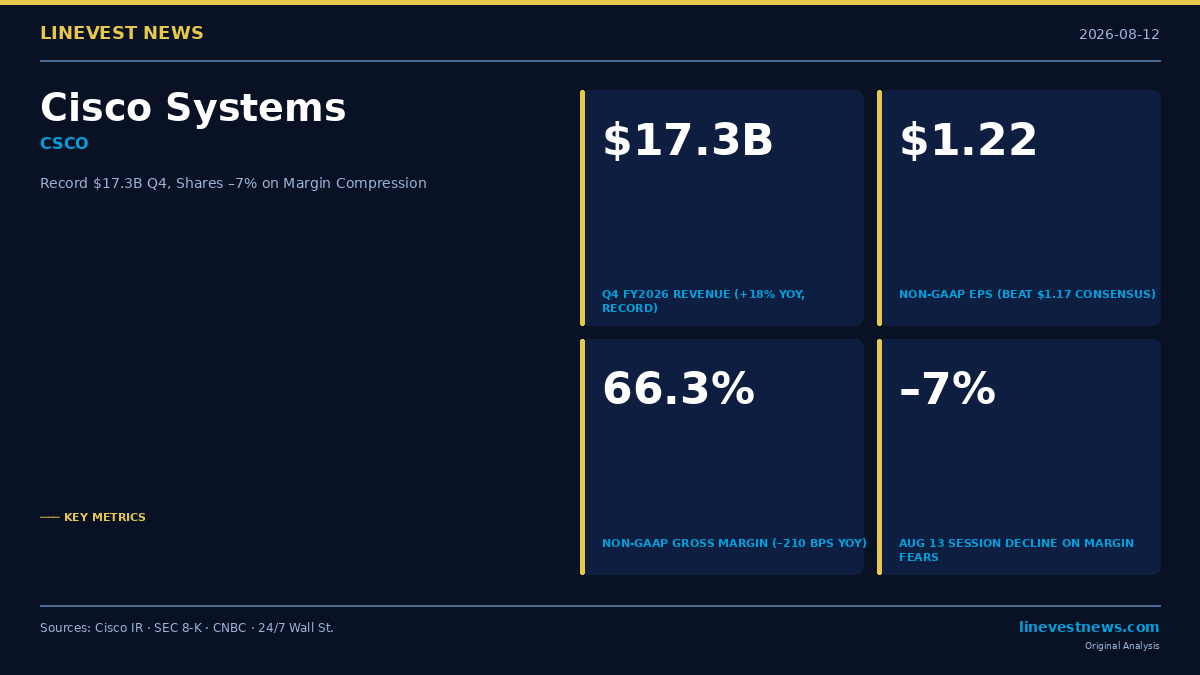
TL;DR - Cisco (NASDAQ: CSCO) Q4 FY2026 revenue reached a record $17.3 billion (+18% YoY), beating the $16.82B consensus; non-GAAP EPS of $1.22 topped the $1.17 estimate. - Non-GAAP gross margin fell to 66.3% (–210 basis points YoY from 68.4%); Q1 FY2027 gross margin guided at 65%–66%, signaling continued near-term headwinds. - Hyperscaler AI infrastructure orders totaled $9.3 billion in FY2026—approximately 4.5 times the prior-year level; FY2027 AI revenue target set at $7.5 billion. - Shares declined approximately 7% on August 13, partly unwinding a roughly 61% year-to-date rally, as investors focused on the gross margin compression narrative.
Q4 FY2026 Financial Results
Cisco reported fourth-quarter fiscal 2026 results on August 12, 2026, for the period ended July 25, 2026. Revenue of $17.3 billion was the highest quarterly total in company history.
| Metric | Q4 FY2026 | YoY Change |
|---|---|---|
| Revenue | $17.3B | +18% |
| Non-GAAP Net Income | $4.9B | +23% |
| Non-GAAP EPS | $1.22 | +23% |
| GAAP Net Income | $3.9B | — |
| GAAP EPS | $0.97 | — |
| Non-GAAP Gross Margin | 66.3% | –210 bps |
| Non-GAAP Operating Margin | 35.9% | — |
| Operating Cash Flow | $5.4B | +27% |
Non-GAAP YoY changes per Cisco's official Q4 FY2026 earnings press release (Form 8-K, August 12, 2026). GAAP YoY comparisons are omitted as Q4 FY2025 GAAP results included items that affect comparability.
For the full fiscal year 2026, Cisco posted revenue of $63.3 billion (+12% YoY), non-GAAP EPS of $4.33 (+14%), full-year non-GAAP operating margin of 34.8%, and GAAP net income of $13.3 billion (+30%).
Product Segment Revenue (Q4 FY2026)
| Segment | Revenue | YoY Growth |
|---|---|---|
| Networking | $9.8B | +28% |
| Security | $2.2B | +14% |
| Collaboration | $1.2B | +12% |
| Observability | $275M | +6% |
Product categories only; excludes Cisco's Services segment. Total Q4 revenue of $17.3B includes both product and services revenue.
Networking—Cisco's largest product segment by revenue in Q4—grew 28% as AI infrastructure build-outs accelerated demand for data-center connectivity. Total product orders increased 35% year-over-year, with networking product orders rising 40%, marking eight consecutive quarters of double-digit order growth in that category.
FY2027 Guidance
Cisco guided Q1 FY2027 revenue at $18.0–$18.2 billion with non-GAAP gross margin of 65%–66%.
For full-year FY2027, Cisco guided revenue at $72.2–$73.4 billion (approximately +15% YoY at the midpoint), with a full-year non-GAAP operating margin target of approximately 35%—above the FY2026 full-year figure of 34.8%—and AI infrastructure revenue from hyperscalers of $7.5 billion.
All guidance figures as stated in Cisco's official Q4 FY2026 press release.
AI Infrastructure Orders: The Long-Term Thesis
The most consequential metric in Cisco's FY2026 was the acceleration of AI-driven networking demand. Hyperscaler customers—major cloud providers building large-scale AI data centers—placed $4 billion in orders during Q4 FY2026 alone, bringing the full-year total to $9.3 billion, approximately 4.5 times the prior-year level.
Cisco's management described the network upgrade cycle as effectively non-discretionary. Companies deploying AI workloads at scale must migrate to new networking architectures—purpose-built Ethernet fabrics, high-speed interconnects, and AI-optimized switching—to handle the data throughput requirements of large GPU clusters.
For FY2027, Cisco guided AI infrastructure revenue from hyperscalers to $7.5 billion, a near-doubling from the approximately $3.8 billion recognized in FY2026. Notably, FY2026 AI orders ($9.3B) materially exceeded AI revenue recognized ($3.8B) in the same period, indicating a substantial conversion opportunity that extends into FY2027 and beyond.
Additional multi-year revenue visibility is provided by remaining performance obligations of $46.7 billion (+7% YoY) and deferred revenue of $29.8 billion (+3%).
Why Shares Fell ~7%: The Gross Margin Debate
Despite beating on both revenue and EPS, Cisco shares fell approximately 7% on August 13—erasing a portion of the roughly 61% year-to-date rally that had built into the stock before earnings. The sell-off was concentrated on gross margin compression.
Non-GAAP gross margin came in at 66.3% in Q4 FY2026, down 210 basis points from 68.4% in Q4 FY2025. Management attributed the decline to two factors:
- Product mix shift: AI infrastructure hardware—Ethernet switches, network interface cards, and data-center fabric gear—carries lower gross margins than Cisco's software subscriptions and services.
- Component cost inflation: Higher memory (DRAM/NAND) costs in AI-oriented hardware products increased cost of goods sold.
The concern was compounded by Q1 FY2027 gross margin guidance of 65%–66%, indicating compression was not yet stabilizing. Investors who had anticipated Cisco's hardware-to-software transition would protect margins were confronted with a near-term floor that remained unclear.
There is a partial offset embedded in the numbers. Non-GAAP operating margin reached 35.9% in Q4 FY2026, as operating expense discipline offset the gross margin headwind. CFO Mark Patterson indicated the full-year FY2027 non-GAAP operating margin would be approximately 35%—above the FY2026 full-year figure of 34.8%—suggesting that even as hardware mix compresses gross margins, Cisco's cost management allows overall profitability to improve year-over-year.
Five analyst firms raised their CSCO price targets following the results even as the stock sold off. The divergence between the analyst consensus and the market's daily reaction reflects a structural debate: does Cisco's AI order momentum justify the near-term margin trade-off, or does the compressed gross margin signal a more persistent shift in the company's profit profile?
Three Watch Points for CSCO Investors
1. AI Revenue Conversion Timeline
FY2026 AI orders of $9.3B materially exceeded AI revenue recognized of approximately $3.8B in the same fiscal year, indicating a substantial order-to-revenue conversion pipeline. Whether the $7.5B FY2027 AI revenue target is achieved on schedule depends on customer deployment pace—large data-center buildouts require permitting, power infrastructure, and physical construction that can extend timelines. Investors should track Q1 and Q2 FY2027 AI revenue actuals against the full-year $7.5B target as the primary leading indicator.
2. Gross Margin Recovery Window
Q1 FY2027's 65%–66% gross margin guidance leaves the floor unclear. The test window is Q2–Q3 FY2027: if software and subscription revenue grows as a proportion of the mix, and if memory costs moderate, gross margin recovery above 67% could serve as a meaningful re-rating catalyst. Conversely, if the compressed range extends for multiple quarters, the operating leverage argument becomes harder to sustain.
3. Splunk Security Integration
Cisco acquired Splunk for approximately $28 billion in March 2024, one of the largest enterprise software acquisitions in the technology sector. Security revenue grew 14% in Q4 FY2026—a solid rate, but one that has not yet demonstrated the acceleration the acquisition thesis implied. Cisco has positioned Splunk's observability and security intelligence platform as a driver of higher-margin recurring revenue. Investors will track whether multi-product bundling with Networking drives Security revenue growth through FY2027.
This article is based on Cisco's official Q4 FY2026 earnings press release (SEC Form 8-K, August 12, 2026) and publicly available analyst commentary. This article is for informational purposes only and does not constitute investment advice. LineVest News is not a registered investment adviser.
Sources - Cisco Q4 FY2026 Earnings Press Release — Cisco Investor Relations - SEC Form 8-K Exhibit 99.1 — Cisco Systems, Inc. - Cisco's Stock Drops Despite Earnings, Revenue Beat — CNBC - Cisco Drops 7% on Gross Margin Fears: Five Firms Raise CSCO Price Target — 24/7 Wall St. - CSCO Q4 FY2026 Earnings Call Highlights — BigGo Finance - Cisco Q4 FY26 Slides: AI Orders Surge 4.5x — Investing.com