
Cisco SystemsCSCO
About Cisco Systems
Cisco Systems designs, manufactures and sells networking hardware, software and services that move data across enterprise, service-provider and public-sector networks. The core franchise remains switching and routing — the campus and data-center switches, enterprise routers and wireless access points that form the plumbing of corporate IT — complemented by security products (firewalls, zero-trust and threat-detection tools), collaboration software built around the Webex platform, and observability assets acquired through Splunk. Revenue is disclosed in broad product families (networking, security, collaboration, observability) alongside a large services line covering technical support and professional services. Networking hardware historically drives the bulk of gross profit, while recurring software and support revenue increasingly shapes the margin trajectory.
Serious holders track the mix shift from perpetual hardware sales toward software subscriptions and annualized recurring revenue, since that transition determines both reported growth optics and the durability of margins. Customer concentration is diffuse but end-market concentration is not: hyperscale cloud operators build much of their own gear, so Cisco's exposure sits with enterprises, telecoms and governments whose capital-spending cycles are lumpy. Supply-chain dependence on contract manufacturers and specialty silicon, U.S. export controls on advanced networking equipment, and the integration risk from large acquisitions are recurring watch items. Governance is conventional for a mature U.S. large-cap: a single class of common stock, an independent board, and a long-standing capital-return policy weighted toward dividends and buybacks.
Cisco was founded in December 1984 by Leonard Bosack and Sandy Lerner, Stanford University staff who commercialized the multi-protocol router. It went public in 1990, and through the 1990s became the defining vendor of the internet build-out via a prolific acquisition programme that folded in switching (Crescendo, Kalpana), IP telephony, wireless and optical assets. The dot-com collapse forced a reset around enterprise IT, after which Cisco expanded into security (Sourcefire, Duo), collaboration (WebEx), silicon (Acacia) and, most consequentially, software and data with the 2024 acquisition of Splunk. The company remains a single Delaware-incorporated entity headquartered in San Jose, California, without material spin-offs of its core operating businesses.
Cisco sells predominantly through a two-tier channel of distributors and certified resellers and system integrators, with a direct sales force focused on the largest enterprise, service-provider and government accounts. Product transactions increasingly bundle hardware with multi-year software subscriptions and support contracts, producing deferred revenue that converts to recognized revenue over the term; large customers frequently sign enterprise agreements that consolidate licensing across the portfolio. Competitive position rests on installed-base lock-in, the breadth of the certified-engineer ecosystem, and integration across networking, security and observability. Principal rivals differ by segment — Arista and Juniper in switching and routing, Palo Alto Networks and Fortinet in security, and Microsoft and Zoom in collaboration. International markets contribute a meaningful share of revenue alongside the Americas.
Company profile by LineVest editorial. Journalism, not investment advice.
Order a report on Cisco Systems — $15Cisco Systems coverage
2 articles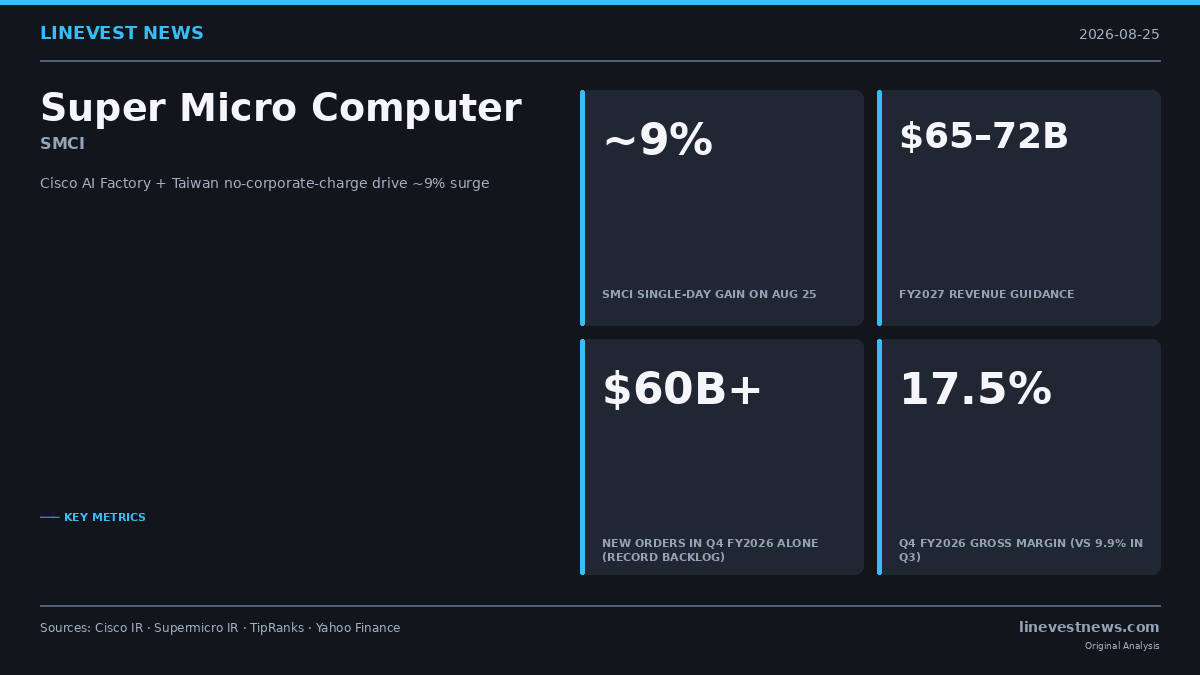
Super Micro Surges ~9%: Cisco AI Factory Deal and Taiwan Indictment Ease Two Key Overhangs
SMCI rose ~9% after Cisco added Supermicro to its NVIDIA AI Factory (Oct. launch) and Taiwan prosecutors charged nine individuals — not the company itself.
Cisco Systems (CSCO) Q3 FY2026: Networking +25%, Inventory +49%, Q4 Revenue +18%
Cisco Systems (CSCO) Q3 FY2026: Networking +25%, Inventory +49%, Q4 Revenue +18%
Go deeper than the headline
You just read what happened. Here's how to read what it means.
The day's reports, every morning — free
LineVest Daily lands in your inbox before the opening bell with the reports we published that day — what each company's latest 10-K or 10-Q actually says about the numbers, in plain English. Free, no card required.
This report, on any company you name
What you just read on Cisco Systems is the format. Name any U.S.-listed company and we do the same for it — its latest SEC filing read in full, financials under US GAAP, governance, and what it means for the stock. PDF in your inbox within 3 hours.
Which company should we read?
$15 · one-time · PDF within 3 hours
Pick a company to continueIndependent journalism based on primary SEC filings — not investment advice. No brokerage affiliation.