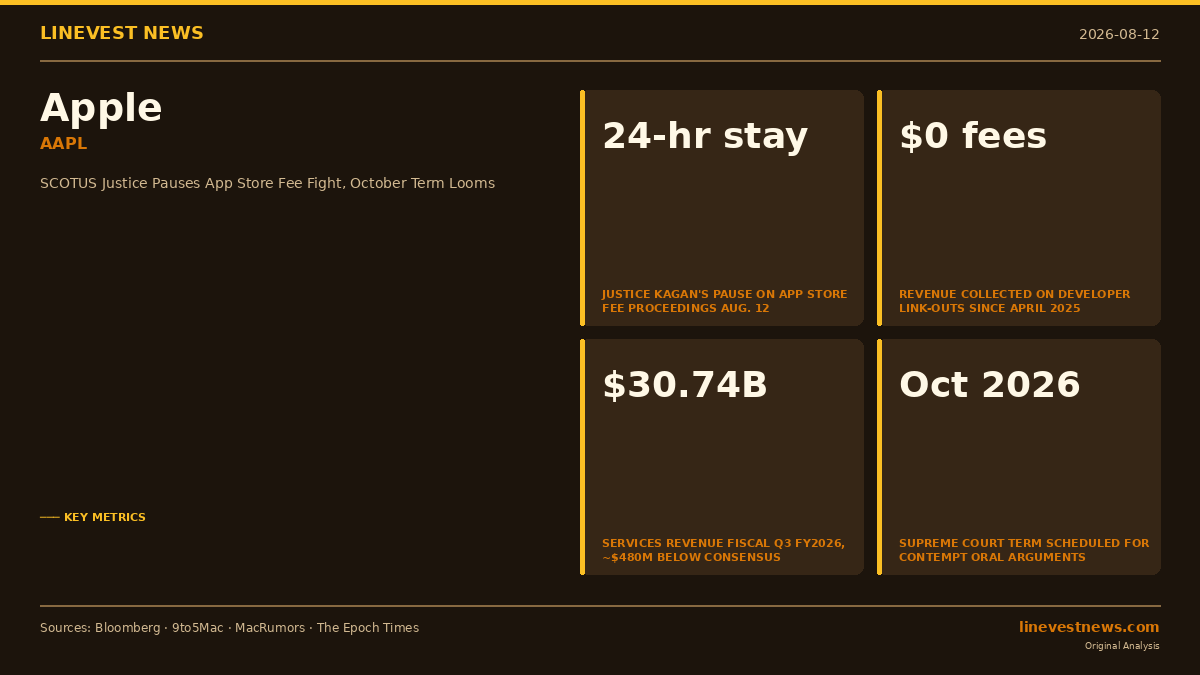
TL;DR - Supreme Court Justice Elena Kagan issued a one-day administrative stay on Aug. 12, pausing a California district court proceeding that was pressing Apple to submit a proposed fee for developer link-outs - Apple has collected zero fees on external purchases since April 2025, when Judge Gonzalez Rogers held it in civil contempt for imposing a 27% commission on link-out transactions - The Supreme Court agreed in June 2026 to hear the contempt case in its October 2026 term; the central question is whether contempt can rest on violating the spirit rather than the precise letter of an injunction - Services revenue of $30.74B in Apple's fiscal Q3 FY2026 missed Wall Street estimates by ~$480M; the App Store fee resolution could shift the trajectory of Apple's highest-margin business segment
Background: From Injunction to Contempt
The dispute traces to 2020, when Epic Games sued Apple alleging that the App Store's 30% commission on digital purchases violated antitrust law. Judge Yvonne Gonzalez Rogers largely sided with Apple on the antitrust claims in 2021, but issued an anti-steering injunction requiring Apple to allow developers to embed links directing users to external payment options.
Apple complied by enabling such links — but then imposed a 27% commission on any purchases made within seven days of a user clicking them. The company argued those fees compensated for developer tools, hosting, and other services, not just payment processing.
Judge Rogers disagreed. In April 2025, she found Apple in civil contempt for willfully defying her injunction, barred Apple from collecting any fees on link-out purchases, and referred the matter to federal prosecutors for possible criminal contempt consideration. Since that order, Apple has collected no revenue from developer link-outs.
The Ninth Circuit upheld the contempt finding in December 2025. Apple then petitioned the Supreme Court, which in June 2026 agreed to take up the case in its October 2026 term.
What Happened on August 12
With the Supreme Court review already scheduled, proceedings continued at the district court level. On August 11, Judge Rogers denied Apple's request for a stay and ordered the company to submit a proposed fee structure within 24 hours.
Apple immediately filed an emergency application with the Supreme Court. On August 12, Justice Elena Kagan — the circuit justice assigned to the Ninth Circuit — granted a brief administrative stay, pausing the district court proceedings until 5:00 p.m. Eastern on August 13. The stay is procedural: it gives the full Court additional time to consider whether to issue a longer-term halt while it deliberates on the contempt question.
The single legal question the Supreme Court will address: can a court hold a party in civil contempt for violating the spirit of an injunction, or does contempt require violation of an order whose terms are clear and unambiguous? Apple argues the injunction never specifically prohibited its fee model; Epic Games and Judge Rogers maintain Apple's conduct contradicted the order's plain purpose.
Part B: What the Outcome Means for AAPL Investors
App Store Revenue at Stake
The financial stakes are meaningful. Apple's commissioned analysis estimated the App Store ecosystem facilitated approximately $1.3 trillion in total developer billings and sales in calendar 2024. The subset most directly subject to Apple's commission — transactions involving digital goods and services — represents a fraction of that total. Apple's effective take-rate on those digital transactions is the revenue at risk in this proceeding.
The company has been candid about its strategy: it prefers to collect nothing on link-outs rather than allow courts to establish a reference rate that global regulators could adopt. Apple explicitly warned the Supreme Court that governments in the EU, UK, and elsewhere are monitoring the outcome to calibrate their own App Store enforcement. If a U.S. judge sets the permitted commission, overseas regulators may anchor their own proceedings to it.
Services Revenue Under Pressure
In Apple's fiscal third quarter of FY2026, Services revenue reached $30.74 billion — a June quarter record, up 12% year-over-year — but fell approximately $480 million below analyst consensus of $31.22 billion. The quarter overall was strong ($109.4 billion in total revenue, +16% YoY; EPS $2.02, +29%), but the Services shortfall was notable. Services carries the highest gross margins of any Apple segment — estimated above 70% — giving Services revenue an outsized contribution to overall profitability.
Apple's CFO has guided Services to grow at a pace consistent with FY2025 levels, implying continued double-digit expansion. A ruling in Apple's favor could restore revenue from link-out transactions that has been off the table since April 2025.
| Metric | Fiscal Q3 FY2026 | Analyst Est. | YoY Change |
|---|---|---|---|
| Total Revenue | $109.4B | — | +16% |
| Services Revenue | $30.74B | $31.22B | +12% |
| Net Income | $29.8B | — | — |
| Diluted EPS | $2.02 | — | +29% |
Two Scenarios After the October Term
If Apple wins the contempt question: The Supreme Court would overturn or significantly narrow the contempt standard, likely sending the case back to lower courts without an imposed fee structure. Apple could then redesign its link-out policy on its own terms. This is the outcome management is openly pursuing.
If Apple loses or the Court remands: Judge Rogers would proceed to determine what fee, if any, Apple may charge. A judicially set commission rate — likely lower than Apple's preferred 27% — would become the new ceiling for link-out transactions. More consequentially, it would serve as a global precedent that EU Digital Markets Act enforcers and UK CMA regulators could reference in their own proceedings against Apple.
Analyst Backdrop
Apple's stock has faced headwinds in recent sessions. On August 11, Jefferies downgraded AAPL to Underperform, citing supply-chain signals that an all-glass 20th-anniversary iPhone may face cancellation risk and trimming its 2028–2029 EPS estimates. AAPL was trading in the $302–$306 range ahead of the Supreme Court development.
Broad analyst consensus remains Moderate Buy, with an average price target near $322. The App Store contempt case is among several overhangs — alongside tariff impacts on device supply chains and questions around AI feature monetization — that have kept AAPL's near-term sentiment cautious.
Justice Kagan's administrative stay is temporary and procedural; it does not resolve the underlying contempt question. It does confirm that the Supreme Court views Apple's case as worthy of a pause before further lower-court action, which is a modestly constructive signal for investors who expect the October term to produce a ruling that restores some pricing latitude to Apple.
Sources - Apple App Store Rate Proceeding Halted by Supreme Court for Now — Bloomberg - Apple wins temporary Supreme Court pause in Epic proceedings — 9to5Mac - Supreme Court Lets Apple Delay App Store Fee Fight for 24 Hours — MacRumors - Supreme Court Will Hear Apple-Epic Appeal — MacRumors - Supreme Court Freezes Lower Court Action in App Store Lawsuit — The Epoch Times - Apple Q3 FY2026 Earnings Beat Estimates but Services Revenue Misses — Yahoo Finance
This article is for informational purposes only and does not constitute investment advice. All data as of publication. Consult a qualified financial adviser before making investment decisions.