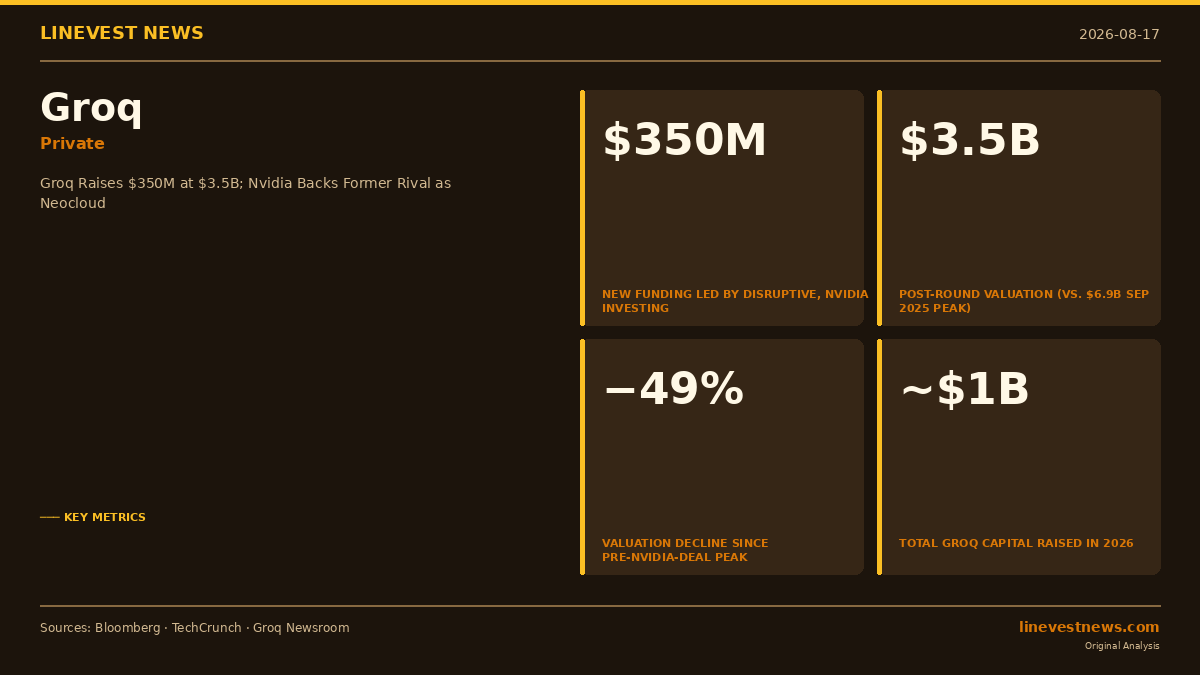
TL;DR - Groq raised $350 million at a $3.5 billion valuation, led by Disruptive; Nvidia is also participating as an investor - Valuation is down 49% from Groq's $6.9B September 2025 peak, before Nvidia's deal valued at ~$20B to license Groq's LPU chip architecture in December 2025 - Groq has raised approximately $1 billion in 2026 ($650M in June + $350M in August), pivoting from AI chip design to Nvidia-powered neocloud services - The company operates 13 data centers across North America, Europe, the Middle East, and Asia-Pacific, targeting 200+ megawatts of capacity by end-2027, up from roughly 54 MW today
Background: Nvidia's $20B "Not-Acqui-Hire"
In December 2025, Nvidia Corp. (NASDAQ: NVDA) entered an unusual arrangement with Groq: a non-exclusive licensing agreement for Groq's Language Processing Unit (LPU) architecture, in a deal valued at approximately $20 billion. Alongside the license, Nvidia hired Groq's co-founder and CEO Jonathan Ross, COO Sunny Madra, and much of its senior engineering talent — what the industry called a "not-acqui-hire," since no formal acquisition occurred and Groq retained legal ownership of its intellectual property.
With its founding engineering team now at Nvidia, Groq faced a pivotal question: what does the company become without the people who built its core technology? The LPU architecture has since been incorporated into Nvidia's LPX platform, debuted at GTC 2026. Groq was reconstituted with new leadership — Disruptive's Alex Davis serving as board chairman — and launched two consecutive capital raises in 2026 to fund a wholesale reinvention.
The August 2026 Round
On August 17, 2026, Groq closed a $350 million round at a post-money valuation of $3.5 billion, led by Disruptive and joined by Nvidia. Combined with the $650 million raised in June 2026, Groq has secured approximately $1 billion in capital in 2026 alone.
| Round | Amount | Valuation |
|---|---|---|
| June 2026 raise | $650M | Undisclosed |
| August 2026 raise | $350M | $3.5B |
| 2026 Total | ~$1.0B |
Groq's leadership explicitly rejected the "down round" label. In the company's framing, the $3.5 billion is a clean valuation baseline for the "post-Nvidia-licensing-deal version of Groq" — a company with a fundamentally different business model than the one that commanded $6.9 billion in September 2025.
Neocloud Pivot: From Chip Designer to Nvidia Customer
Groq has repositioned as a "neocloud" — a specialized cloud provider focused on AI inference and training workloads rather than general-purpose compute. The company now operates Nvidia GPU clusters on behalf of enterprise clients, making it a significant GPU procurement customer of the very company that licensed its LPU technology.
| Operational Metric | Figure |
|---|---|
| Data centers | 13 (North America, Europe, Middle East, Asia-Pacific) |
| Developers and enterprises served | 6M+ |
| Current power capacity | ~54 megawatts |
| 2027 capacity target | 200+ megawatts |
| Weekly AI token volume | Trillions |
The pivot is structurally significant. Groq's original value proposition was a proprietary LPU chip designed to outperform Nvidia GPUs for inference tasks. That competitive angle is now off the table. The company's differentiation in its new form rests on operational expertise in low-latency inference delivery and the institutional knowledge its reconstituted team carries — advantages whose commercial durability has not yet been demonstrated at scale.
Investor Analysis
Valuation Context: How $3.5B Compares
The $6.9 billion September 2025 valuation priced Groq's proprietary LPU technology and its potential to challenge Nvidia's GPU dominance in inference. Once the licensing deal was struck, that optionality was monetized and the valuation basis changed fundamentally. The $3.5 billion must be evaluated against neocloud comparables, not the former chip company.
The most relevant peer is CoreWeave (NASDAQ: CRWV), which priced its March 2025 IPO at $40 per share — approximately $22 billion in market capitalization. CoreWeave has since appreciated substantially, trading at approximately $106 per share with a market capitalization of roughly $58 billion by mid-August 2026. Against that benchmark, Groq's $3.5 billion implies a steep discount, reflecting its earlier stage, smaller infrastructure footprint (~54 MW vs. CoreWeave's substantially larger base), and absence of public revenue data.
Other neocloud operators — Lambda Labs, TensorWave, Vultr — have not disclosed comparable valuations, limiting further triangulation.
Nvidia's Equity Position: Ecosystem Logic
Nvidia's decision to invest in the August round is consistent with its broader portfolio strategy of backing infrastructure companies that drive GPU demand. Nvidia holds equity positions in CoreWeave and numerous other AI-adjacent businesses. Groq's case carries an additional dimension: its capacity expansion from 54 MW to 200+ megawatts represents a named, quantifiable pipeline of GPU procurement from a company in which Nvidia holds equity.
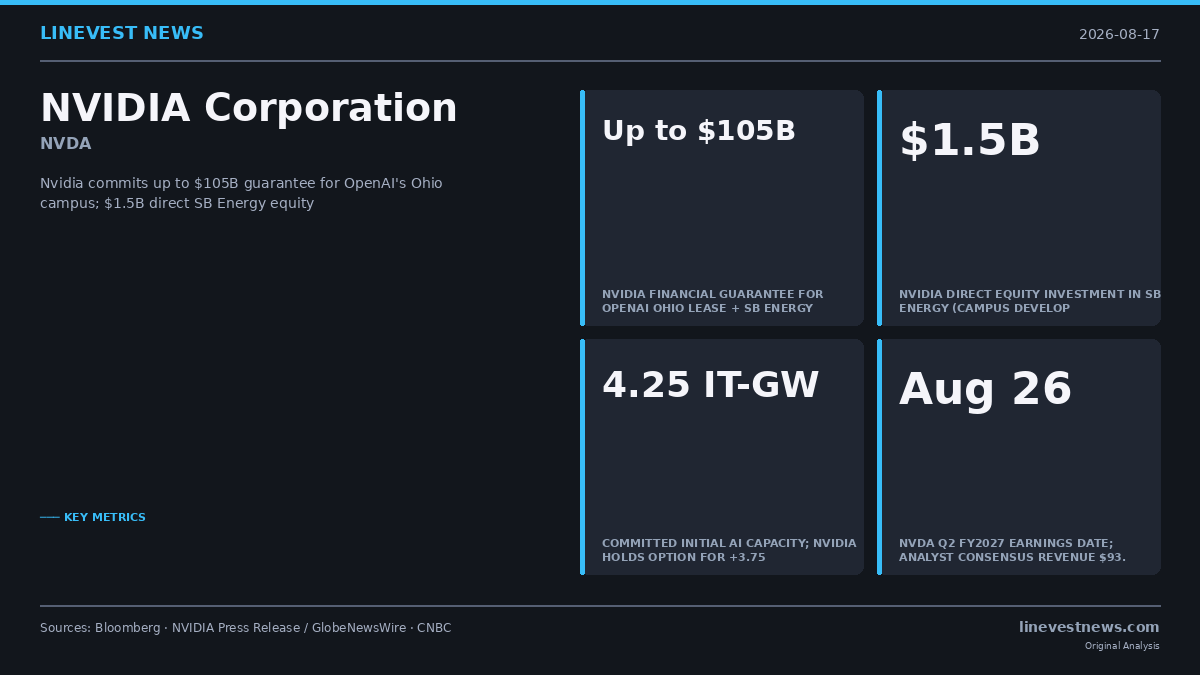
For NVDA shareholders watching the company's Q2 FY2027 earnings on August 26, Groq's stated scale-up plan is one concrete example of the long-cycle GPU infrastructure demand that Nvidia has cited as underpinning multi-year revenue growth in its Data Center segment.
Risk Factors
Groq has not disclosed revenue, customer concentration, or unit economics for its neocloud business. Three areas warrant monitoring:
| Watch Point | What to Track | Timeframe |
|---|---|---|
| Revenue transparency | Groq discloses ARR or quarterly revenue milestones | Q4 2026 onwards |
| Capacity execution | GPU procurement pace and MW ramp from 54 to 200+ | Through 2027 |
| Inference differentiation | Customer wins citing speed advantages vs. commodity GPU clouds | 6–12 months |
The neocloud market is crowded and capital-intensive. CoreWeave's appreciation from its $40 IPO to roughly $106 reflects strong AI infrastructure demand — but it also sets a competitive standard. Groq's $3.5 billion valuation will need demonstrable revenue milestones to sustain investor confidence in future capital raises or a potential liquidity event.
Groq is a private company; its shares are not publicly traded. This article is for informational purposes only and does not constitute investment advice.
Sources: Bloomberg (Aug. 17, 2026) · TechCrunch — August (Aug. 17, 2026) · TechCrunch — June (Jun. 22, 2026) · Groq Newsroom · Seeking Alpha (Aug. 17, 2026) · StockAnalysis — CRWV (Aug. 17, 2026)