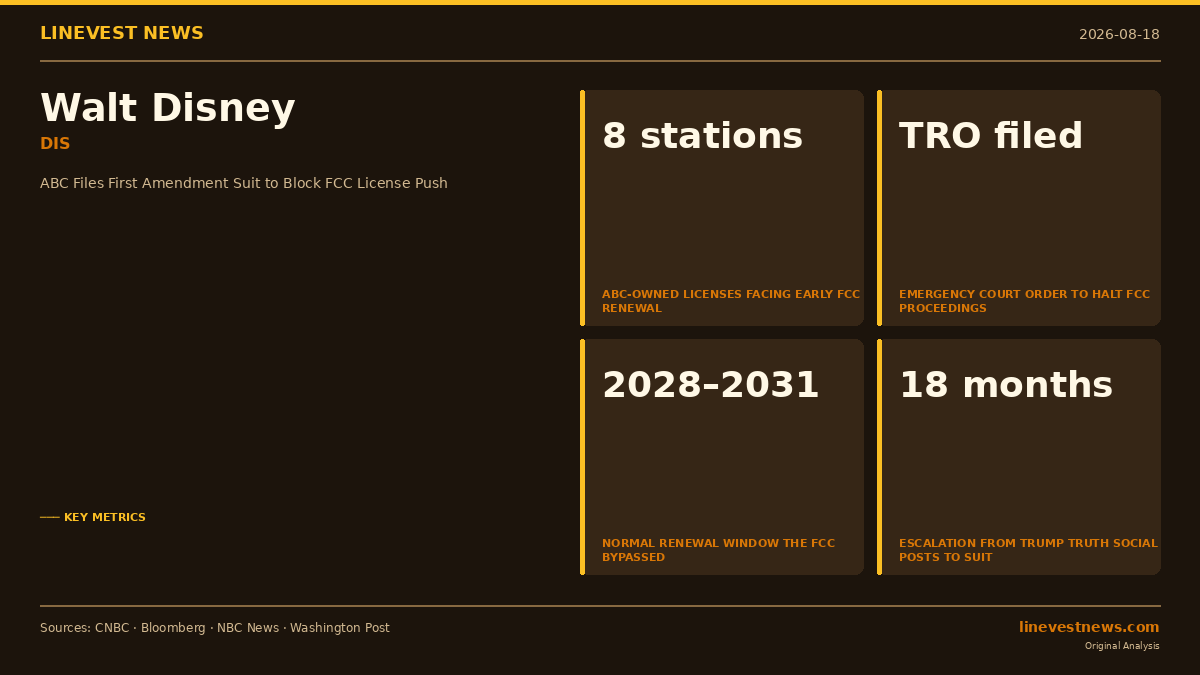
TL;DR - Disney and ABC filed a First Amendment lawsuit in U.S. District Court (D.C.) on August 18, seeking an emergency injunction to halt the FCC's early license renewal for eight ABC-owned-and-operated broadcast stations. - The FCC, led by Chairman Brendan Carr, ordered the early renewals in April 2026 — years ahead of the 2028–2031 normal schedule — citing probes into ABC's DEI practices and "The View" programming. - ABC calls it a "retaliatory campaign" for content critical of President Trump; Disney CEO Josh D'Amaro said ABC is "not going to be told how to run" its business; a Democratic FCC commissioner publicly backed the suit. - Broadcast license non-renewal is virtually unknown in modern FCC history; the near-term investor risk for DIS is regulatory distraction and programming uncertainty, not an actual loss of licenses.
The Lawsuit: What Happened
Disney and its broadcast subsidiary ABC filed suit against the Federal Communications Commission in the U.S. District Court for the District of Columbia on Tuesday, August 18, 2026. The complaint asks the court to grant a temporary restraining order and a preliminary injunction that would immediately halt the FCC's early license renewal proceedings for eight ABC-owned-and-operated television stations.
The action escalates a months-long regulatory confrontation — one that traces its origins to public statements President Trump made on Truth Social targeting ABC's programming — into full-scale federal litigation.
The FCC's Actions: An Extraordinary Early Review
Broadcast licenses issued by the FCC carry eight-year terms. ABC's eight owned-and-operated stations were not scheduled for renewal until 2028 at the earliest, with some licenses running through 2031. In late April 2026, Chairman Carr issued an order requiring those stations to file for early renewal immediately, granting the company only 30 days for a process the industry typically takes months to complete. The FCC had not exercised an early-renewal order of this kind in decades.
The agency cited two ongoing investigations as justification. The first examines ABC's diversity, equity and inclusion practices — a probe that ABC noted had not yet found any violation, making the early renewal order "unnecessary, premature, and punitive" in the company's view. The second reviews whether "The View," the network's long-running daytime program, qualifies for an equal-time exemption that applies to bona fide news programming. According to the complaint, an earlier FCC staff ruling had previously concluded that "The View" meets that exemption standard.
A third flashpoint was ABC late-night host Jimmy Kimmel, whose on-air comments critical of the president drew political backlash and contributed to the escalating FCC scrutiny.
What ABC Alleges: 'Cannot Regulate Content Directly'
The complaint asserts that the FCC's actions constitute a First Amendment violation. ABC argues that the agency conducted "pretextual regulatory investigations" and has weaponized the license renewal mechanism to coerce editorial choices the government cannot mandate directly.
"Acting through the Federal Communications Commission, the Administration has waged a retaliatory campaign against ABC for a single reason: it disapproves of what ABC broadcasts," the suit states. The complaint adds that "the Commission cannot regulate that content directly" and therefore "has used its review of the stations' licenses as an instrument to the same end."
Disney CEO Josh D'Amaro — who replaced Bob Iger earlier this year, departing from Iger's historically conciliatory posture toward Washington — has said ABC is "not going to be told how to run its business." The approach marks a shift: Iger's Disney had largely attempted to manage regulatory disputes privately rather than litigate them.
FCC Chairman Carr has defended the agency's actions as regulatory enforcement in the public interest, vowing to "follow the facts." Anna M. Gomez, the FCC's sole Democratic appointee, publicly backed the legal challenge as necessary pushback against what she described as "government intimidation." A coalition of former FCC chairs had already labeled the early-renewal order "an assault on free speech."
Investor Analysis: What This Means for DIS
The Broadcast Segment at Stake
Disney no longer separately breaks out ABC's broadcast revenue in its quarterly filings. The network operates within the company's broader Entertainment segment. In Q3 FY2026 — the quarter ended June 27, 2026 — Disney's company-wide revenue rose approximately 7%, driven by streaming profitability gains at Disney+ and Hulu alongside record parks performance. Linear television, which includes ABC and the eight owned-and-operated stations, has been a secularly declining contributor as cord-cutting accelerates across the industry.
The eight stations at the center of the lawsuit are in major U.S. metropolitan markets including New York, Los Angeles, and San Francisco. They generate local affiliate advertising revenue, retransmission consent fees paid by cable and satellite providers, and serve as the network's owned infrastructure for distributing prime-time, news, and sports content.
License non-renewal by the FCC is virtually unknown in the modern regulatory era. The process involves multiple procedural steps and judicial review, and courts have historically been protective of incumbent broadcasters on First Amendment grounds. The more realistic near-term risk for Disney is not losing the licenses — it is regulatory uncertainty affecting programming decisions and the management distraction of protracted litigation.
Three Scenarios for DIS Investors
| Scenario | Probability | DIS Impact |
|---|---|---|
| Court grants TRO; early renewal paused while case proceeds | Moderate to High | Mildly positive — reduces near-term regulatory pressure |
| Litigation drags without TRO; FCC continues early review | Moderate | Ongoing headline risk; limited direct financial impact |
| FCC denies renewal for any station | Extremely low | Precedent-breaking; material disruption, near-certainty of reversal on appeal |
The Broader Regulatory Playbook
For investors, the strategic significance of this lawsuit may exceed its near-term financial implications. By choosing to sue rather than negotiate further, D'Amaro's Disney is making an explicit bet that a federal court victory offers more durable protection than a quietly managed accommodation — and that the current administration's demands cannot be satisfied through compliance alone.
This posture carries its own risks: sustained litigation keeps regulatory uncertainty in the headlines and could affect advertiser and affiliate relationships. But it also signals that Disney under D'Amaro intends to draw lines that the Iger era did not.
DIS shares closed at approximately $103.70 on August 17, 2026, giving the company a market capitalization of roughly $186 billion. The company is scheduled to report Q4 FY2026 earnings in November; management commentary on the regulatory environment — and any court rulings on the TRO — will be closely watched in the coming months.
This article is for informational and journalistic purposes only. LineVest News is an independent publication and is not a registered investment adviser. Nothing herein constitutes investment advice.
Sources: - CNBC: "Disney-owned ABC files First Amendment lawsuit against FCC" (August 18, 2026) - NBC News: "Disney and ABC sue FCC, seeking to stop early license renewal process" - Bloomberg: "Disney's ABC Sues FCC Over 'Retaliatory Campaign' Tied to Broadcast Licenses" - Washington Post: "ABC sues FCC, claiming First Amendment violations, escalating months-long feud" - Hollywood Reporter: "ABC Sues FCC Over Threats to Broadcast Licenses In First Amendment Case" - Variety: "ABC Files First Amendment Lawsuit Against FCC" - CNN: "Disney sues Trump's FCC over 'retaliatory campaign' against ABC"