TL;DR - ULA (Boeing/Lockheed 50/50 JV) closed a $1.5B private bond offering on Aug. 18, tripling the $500M initially sought - Four tranches with 3–10 year maturities; proceeds to refinance existing debt; arranged by US Bancorp, Mizuho, and Wells Fargo - Vulcan Centaur has been grounded since a Q1 2026 booster anomaly (USSF-87 was last flight), derailing ULA's plan for 18–22 launches in 2026 - Lockheed Martin (LMT) disclosed a $500M bank guarantee for ULA borrowings in Q2 2026 (fair value recognized: $64M); both LMT and BA signaled readiness to provide more support - U.S. Space Force redirected four GPS III satellite launches from ULA to SpaceX, deepening SpaceX's grip on DoD launch contracts
Part A: What Happened
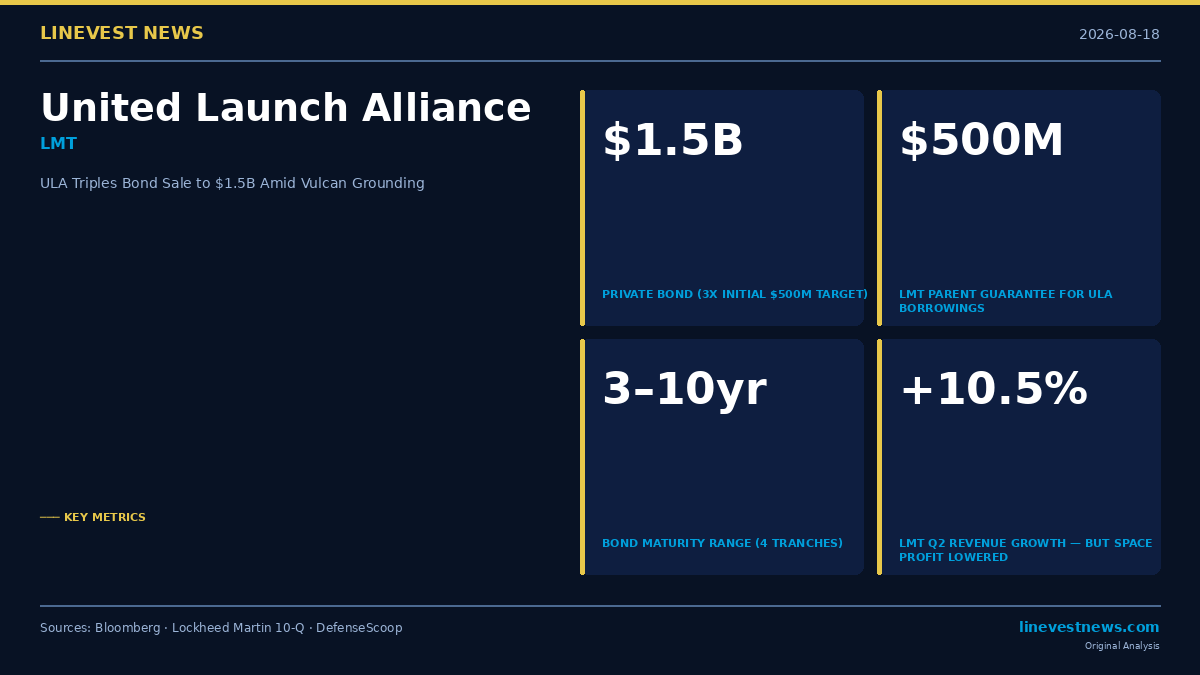
United Launch Alliance — the joint venture between Lockheed Martin Corp. (NYSE: LMT) and The Boeing Co. (NYSE: BA) — completed a $1.5 billion private bond offering on August 18, three times larger than the $500 million the company initially sought when Bloomberg first reported the deal on August 5.
The offering was structured as a true private placement, meaning it will not be registered with the SEC or offered in public markets, and was sold directly to institutional investors in four tranches with maturities ranging from three to ten years. US Bancorp, Mizuho Financial Group, and Wells Fargo arranged the transaction. ULA said proceeds will be used to refinance existing debt.
Vulcan Centaur Grounding
The bond deal comes as ULA faces its most acute financial stress since its founding in 2006. During the first quarter of 2026, ULA's Vulcan Centaur rocket — its next-generation launcher intended to replace the Atlas V — experienced a booster anomaly during the USSF-87 mission. The rocket has not flown since.
Northrop Grumman Corp. (NYSE: NOC), which supplies solid rocket boosters for Vulcan, took a $71 million charge in Q1 2026 tied to the anomaly. An investigation has kept Vulcan grounded for months, with no public return-to-flight date confirmed as of August 18.
ULA had entered 2026 expecting to conduct 18 to 22 launches — four on the legacy Atlas V and up to 18 on Vulcan. With Vulcan grounded indefinitely, the company is operating well below that cadence.
SpaceX Fills the Void
The U.S. Space Force, which relies on both ULA and SpaceX for its National Security Space Launch (NSSL) program, has redirected four GPS III satellite launches originally assigned to ULA to SpaceX's Falcon 9 while ULA's investigation continues. SpaceX has also closed out the NSSL Phase 2 spy satellite contract as the sole operational provider under the program.
ULA remains one of only two companies — alongside SpaceX — certified to launch the Pentagon's most sensitive payloads. But the window in which ULA can reclaim market share is narrowing with every grounded month.
New Leadership
The bond offering followed by one day the announcement of Mark Peller as ULA's new president and chief executive officer. Peller, who has been with ULA since its founding in 2006 and served as its chief operating officer, replaced interim CEO John Elbon. Peller was centrally involved in the development of the Vulcan rocket and now takes the helm as the company's future depends on the vehicle's return to service.
Part B: Investor Analysis — What LMT and BA Holders Need to Know
Lockheed Martin: ULA Is a Growing Drag on an Otherwise Strong Business
Lockheed Martin reported strong Q2 2026 results on July 22:
| Metric | Q2 2026 | YoY | |
|---|---|---|---|
| Revenue | $20.06B | +10.5% | |
| GAAP EPS | $7.94 | Beat est. $7.20 by 10% | |
| Free Cash Flow | $2.9B | — | |
| Backlog | $230B (record) | — |
Lockheed raised its full-year revenue guidance to approximately $80.75 billion and cited a $35 billion multiyear THAAD interceptor contract as a key backlog driver. On the surface, the quarter looked excellent.
However, Lockheed's Space segment — which includes its 50% stake in ULA — told a different story. Space segment sales grew 6% YoY, but profit grew just 2%, and Lockheed lowered its full-year 2026 Space segment profit outlook specifically due to reduced ULA equity earnings from the Vulcan anomaly investigation.
In its Q2 10-Q filing (July 23), Lockheed disclosed that it had agreed to guarantee certain ULA borrowings, with maximum potential future payments of $500 million. Lockheed recognized a fair value of $64 million for that guarantee obligation, recorded as an increase to its ULA investment. The filing warned: "We and Boeing expect to provide additional financial support to ULA to support its liquidity or ongoing operations and could incur impairment and operating losses if the Vulcan Centaur rocket does not perform consistent with ULA's assumptions."
The $1.5 billion bond offering announced Tuesday now layers a separate tranche of ULA debt on top of those guaranteed borrowings. For LMT investors, the combined picture — $500M guarantee plus ULA's growing bond load — represents a rising contingent liability on an already-stressed subsidiary.
At approximately $568.80 per share, LMT trades at roughly 24x forward earnings — a premium valuation that leaves little room for a Space segment negative surprise. If Vulcan's return to flight is delayed further, investors should expect continued downward pressure on Space segment profit guidance.
Boeing: A Secondary Exposure Amid Its Own Recovery
Boeing owns 50% of ULA and carries the same financial risk. However, Boeing is in the middle of a multi-year turnaround after years of delivery disruptions and cash burn. Management had set goals of turning free cash flow positive in Q4 2025 and delivering approximately $5.6 billion in free cash flow for 2026. ULA-related impairments could complicate those targets, adding another variable to an already complex recovery story.
The Institutional Bull Case: Orderly Bridge, Not Distressed Debt
The 3x upsize of ULA's bond offering — from $500 million to $1.5 billion — is a meaningful signal. Institutional investors willing to triple the book on a company with a grounded rocket are implicitly betting on the Boeing-Lockheed backstop and ULA's strategic indispensability to U.S. national security launches. A company the Pentagon cannot afford to lose will not be allowed to fail.
Mark Peller's appointment — a technologist with 20 years of ULA experience and deep Vulcan program involvement — suggests the parent companies are betting on an engineering resolution rather than a strategic exit or wind-down.
The Bear Case: SpaceX's Structural Lead Widens With Every Grounded Month
The competitive landscape has shifted materially since ULA's founding. SpaceX's Falcon 9 has proven itself as a workhorse for DoD payloads, and every GPS III launch redirected to SpaceX is mission revenue ULA does not collect. A longer grounding translates directly into a wider SpaceX competitive moat on NSSL mission experience and pricing leverage.
Amazon.com Inc. (NASDAQ: AMZN), a commercial ULA customer for its Project Kuiper broadband satellite constellation, could also seek launch alternatives if ULA's Vulcan cadence lags significantly behind schedule.
If Vulcan's return to flight slips into 2027 or beyond, the $1.5 billion bond proceeds may prove insufficient, and the language about "additional financial support" in Lockheed's 10-Q could become a material balance sheet event for both LMT and BA shareholders.
| Scenario | LMT / BA Implication |
|---|---|
| Vulcan return-to-flight by Q4 2026 | Space segment drag limited; bond provides bridge |
| Grounding extends to mid-2027 | Additional impairment likely; deeper Space margin pressure |
| Vulcan permanently grounded | $500M+ impairment on ULA investment; strategic review of JV |
Sources - Bloomberg, "Boeing-Lockheed's ULA Triples Bond Sale to $1.5 Billion" (Aug. 18, 2026) - Bloomberg, "Boeing-Lockheed Rocket Joint Venture Taps Private Bond Market" (Aug. 5, 2026) - Lockheed Martin Q2 2026 10-Q / Earnings Release (July 22–23, 2026) - Investing.com, "Boeing-Lockheed's ULA triples bond sale to $1.5 billion" (Aug. 18, 2026) - Investing.com / SpaceNews, "United Launch Alliance names Mark Peller as new CEO" (Aug. 17, 2026) - DefenseScoop, "Space Force mitigating impacts to programs amid grounding of Vulcan rocket" (Mar. 26, 2026) - KeepTrack / Northrop Grumman, "Northrop Grumman Books $71M Charge on Vulcan Booster Anomaly" (Apr. 22, 2026)
This article is for informational purposes only and does not constitute investment advice. LineVest News is an independent financial publication not affiliated with any brokerage or investment firm.