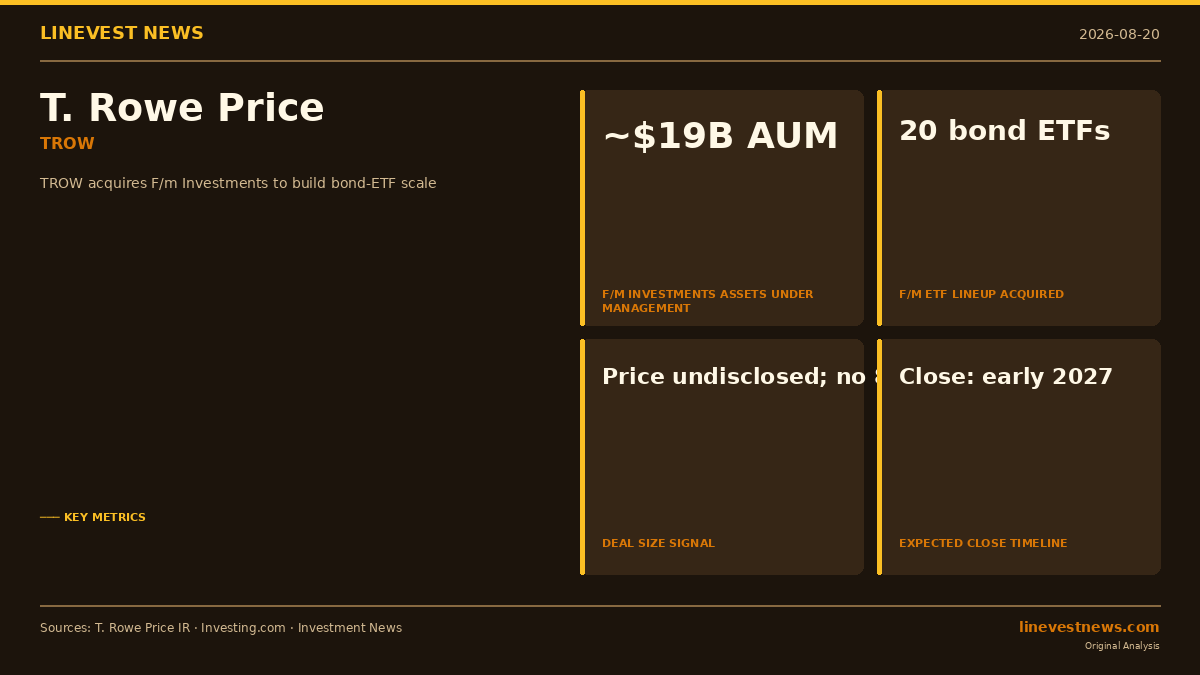
T. Rowe Price (NASDAQ: TROW) agreed on Aug. 20 to buy F/m Investments, a Washington, D.C. bond-fund manager whose exchange-traded funds hold more money than T. Rowe Price's own bond ETFs do. Neither side disclosed a price, and no 8-K followed — the current report a company files with the SEC (the U.S. securities regulator) when something material happens to it.
The clue in what was not filed
T. Rowe Price's filing index on SEC EDGAR shows no current report between its July 31 earnings 8-K and Aug. 21. The company's own announcement says only that financial terms were not disclosed. The filing record is therefore the only sizing signal an outsider has.
That silence is not a technicality. Materiality is the buyer's own judgement, made by its lawyers, at its own legal risk. Skipping the filing is a statement that the transaction will not meaningfully change the company's financial condition. It is worth holding onto that while reading the rest of the announcement.
What $19 billion buys
F/m managed about $19 billion at the end of July, T. Rowe Price said. More than $10 billion of that sits in a suite of 20 exchange-traded funds. The rest is in institutional accounts and separately managed accounts — portfolios of individual bonds run for one client rather than pooled with others.
Founded in 2019, F/m built its name on the US Benchmark Series. T. Rowe Price's release describes it as the first standardised suite of single-security U.S. Treasury ETFs. A buyer picks one maturity and holds it in fund form.
The business will keep its name, its leadership and its investment approach, operating as F/m Investments, a T. Rowe Price Company. Alexander Morris, chief executive and co-founder, will report to Arif Husain, T. Rowe Price's head of global fixed income. The deal is expected to close in early 2027.
Keeping the brand is a deliberate choice and a common one. Boutique managers carry client relationships that are personal rather than institutional. Absorbing the name too fast is the classic way to lose the people and the accounts you just paid for.
What it might have cost
There is one fresh yardstick. Eight days earlier, Goldman Sachs agreed to pay up to $2.25 billion for Neos Investments, an issuer of options-income ETFs with roughly $30 billion under management. That is as much as 7.5% of assets.
Apply the same ratio to F/m and you land near $1.4 billion. Treat that as a boundary, not an estimate. Options-income funds charge far more than Treasury funds do, so every dollar at Neos carries more revenue behind it. The honest reading is that F/m sits well below that line, and the missing 8-K points the same way.
The gap between those possibilities matters for a reason beyond curiosity. An undisclosed price removes the usual test of a deal, which is what the buyer paid against what it received. All a reader has instead is the strategic logic and the buyer's own disclosure behaviour. Both point the same way here: a small cheque for a specific capability.
Why It Matters: The Problem This Actually Solves
Price aside, the better question is what T. Rowe Price is fixing. The answer sits in its own quarterly numbers rather than in the acquisition release.
Clients pulled a net $6.5 billion from the firm in the second quarter, it reported on July 31. Equity strategies lost $13.5 billion. Fixed income took in $4.6 billion. The firm is shrinking where it is largest and growing where it is smallest.
Now set two figures beside each other. Only about $6.5 billion of T. Rowe Price's $220 billion in bond assets sits in its own ETFs, Investing.com reported. That is the same amount clients withdrew, on net, in a single quarter. The bond-ETF shelf the firm built for itself stands one quarter of leakage tall.
Chief executive Rob Sharps did not dress up the pressure. "While fundamental active equity remains under pressure, I am confident that the progress we are making positions us to deliver long-term value for clients and stockholders," he said in the quarterly release. He named the ETF and separately managed account businesses as where the firm is investing for growth. The F/m deal is that sentence turned into a cheque.
This is why the wrapper matters more than it sounds. An exchange-traded fund trades like a stock and prices throughout the day. Advisers assembling model portfolios increasingly want every component available in that shape. A manager without a credible ETF shelf does not get considered for those slots, however good its underlying research is.
There is a second reason, discussed less often than the fund wrapper. Separately managed accounts let one client's bonds be tailored for taxes and maturities in a way a pooled fund cannot. T. Rowe Price's release puts that capability alongside the ETF lineup as a reason for buying. It is acquiring two distribution shapes at once, not one.
The price of the fix
The shift carries a cost, and T. Rowe Price prints it every quarter. Fixed income produced $113.5 million of advisory fees in the second quarter on average assets of $219.0 billion. Annualised, that is a fee rate near 0.21%. Equity, on the same arithmetic, earns roughly 0.46%.
Both inputs come from the company's second-quarter release; the annualised rates are LineVest's own calculation. The gap explains the direction of the firm's headline fee rate. It slipped to 38.1 basis points — hundredths of a percentage point — from 39.6 a year earlier.
The company names the cause itself. Client flows and transfers, it wrote, "drove a mix shift in assets under management toward lower fee products and asset classes." Buying F/m accelerates that mix shift rather than reversing it.
None of which makes the deal a mistake. Lower-fee assets that arrive are worth more than higher-fee assets that leave. A dollar of Treasury-fund money also costs far less to run than a dollar of fundamental stock picking. But it does mean the revenue arithmetic here is modest.
Put a figure on it. At T. Rowe Price's own bond fee rate, $19 billion would generate roughly $39 million of advisory fees a year. Set against net revenues of $1.91 billion in a single quarter, that is a rounding error. Whatever this deal is for, it is not next year's revenue line.
Bought, not built
T. Rowe Price has run this play before. It agreed in 2021 to buy Oak Hill Advisors, a New York credit manager, for up to $4.2 billion. Oak Hill held $53 billion of capital at announcement, T. Rowe Price said at the time. Its own website now reports $112 billion.
The ETF story went the other way. T. Rowe Price debuted its first four active ETFs in August 2020, and all four held stocks. It now ranks 26th among U.S. ETF providers, with 80% of those assets in equity funds, Morningstar analyst Bryan Armour told Investing.com. Years of building produced a platform that is real but tilted the wrong way for a bond franchise.
The pattern says something about how this industry grows now. Investment skill can be hired. Shelf space, product structure and a record long enough to clear adviser screens cannot be conjured on a schedule. When a buyer already has the clients and lacks the product, buying the product beats waiting for its own funds to season.
F/m's appeal is not only its size. It was the first manager to use a recent SEC decision allowing one portfolio to be offered as both a mutual fund and an ETF, according to Investing.com. It has also asked regulators for permission to tokenize shares of its three-month Treasury bill fund. Those are product-engineering credentials, and they are far harder to hire than to buy.
Morris was direct about his side of the trade. "This is a scale game, and success for us wasn't going from managing $20 billion to $30 billion or $40 billion, it was boosting activity 10x or beyond," he told Investing.com. T. Rowe Price's distribution reach is the fastest available route to that.
The wider context is consolidation, and it arrived quickly. Independent ETF specialists that solved a product problem early are now worth more inside a large distributor than outside one. Both of this month's sellers reached that conclusion within weeks of each other.
LineVest has not covered T. Rowe Price before, so there is no earlier management statement to hold this one against.
What would make this reading wrong
F/m's signature line is single-maturity Treasury funds, which work as cash substitutes. Money of that kind swells when short-term rates are high and drains when they fall. If short rates decline through 2027, T. Rowe Price may find it bought a business that shrinks without anyone making a mistake.
The opposite case is just as testable. If those assets hold their ground as rates move, the purchase was about capability rather than balances. That is the cleanest way to judge it later.
What to watch
T. Rowe Price reported its past two quarters on April 30 and July 31, which places third-quarter results in late October or early November. Those numbers, and the monthly asset disclosures before them, will show whether fixed income kept absorbing money while equity kept losing it. The deal itself closes in early 2027.
The price may never be published at all. If it does surface, the likeliest place is a quarterly filing after closing rather than a press release.
Not covered here: segment-level expense detail, the four-quarter flow trend by asset class, F/m's individual funds and their expense ratios, a peer comparison against the ETF platforms at BlackRock, Invesco and Charles Schwab, and the buyback-versus-acquisition use of capital. Those sit in the full LineVest report.
Disclaimer: This article is journalism, not investment advice. LineVest is not a registered investment adviser and holds no position in the securities mentioned. Figures are attributed to the sources cited and were current as of Aug. 21, 2026.