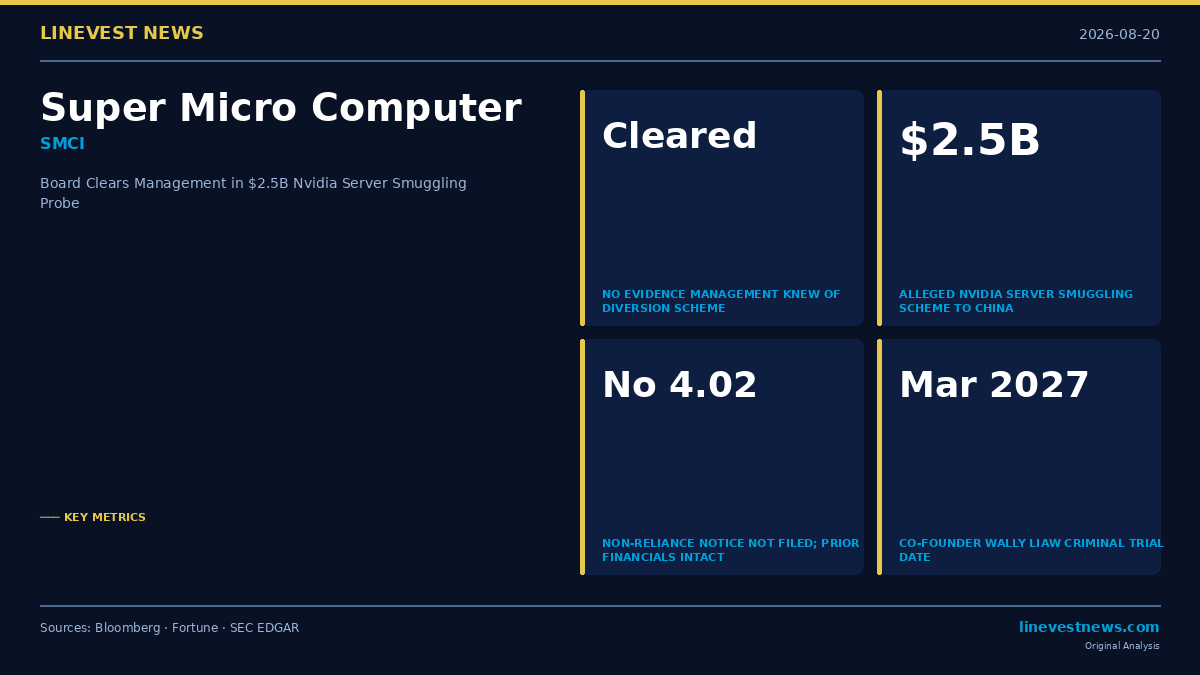
Super Micro Computer (NASDAQ: SMCI), a San Jose builder of AI servers, ended its export-control investigation this week. It closed without the one SEC filing the company's own history says to watch for. That filing is an 8-K, the current report a company files to announce major events between quarterly filings. The one to watch carries Item 4.02. That is the notice sent when previously issued financial statements can no longer be relied upon. Super Micro has sent one before. The episode around it ended with the stock off Nasdaq.
The board's independent directors announced their findings on Thursday. They reported no evidence that current senior management knew of the alleged scheme to divert Nvidia-powered servers to China, per Bloomberg and Fortune. They found no evidence the company sold export-controlled products directly to restricted parties. And they found no evidence that previously issued financial statements were unreliable. Only that third finding has a dollar figure behind it.
Why It Matters: the accounting question behind a smuggling case
A smuggling case does not obviously become an accounting case. It becomes one through revenue recognition. Suppose a server maker books sales to a customer that turns out to be a front for a banned buyer. The question then is whether that revenue should have been recorded at all. A second question follows: whether the goods can be reclaimed, or the unpaid bill ever collected. Auditors want to know how much of the reported top line rests on transactions that were not what they appeared to be.
That is why the third finding is the one a portfolio manager cares about. The first two findings are about people and about culpability. The third is about whether the numbers on the page survive contact with an auditor. Those are different risks with different remedies, and only one of them can force a restatement.
What the third finding is worth
Super Micro reported preliminary results for the fiscal year ended June 30 on Aug. 11. Net sales came to $39.1 billion and net income to $2.23 billion, according to the earnings release filed with the SEC. Those are the figures a non-reliance notice would have thrown open.
The first two findings clear people. The third one protects the income statement. And the earnings release said as much itself, in language the wire coverage skipped. "As the Company has disclosed, the Board is conducting an independent review of certain transactions in connection with export-control issues," it read. "The outcome of that investigation could affect our forecasts, these preliminary results and prior period results." Nine days later, that sentence is retired.
LineVest covered those results on Aug. 12. We flagged two open items alongside the strong headline figures: the board's export-control review, and the fact that the results were preliminary and unaudited. One of the two has now closed; the other has not. That distinction is the whole of what changed this week.
Who did the work
The investigation was led by two independent directors, Scott Angel and Tally Liu, per Fortune. Angel is the lead independent director and a former Deloitte audit partner. Liu chairs the audit committee. Outside counsel was Munger, Tolles & Olson, a Los Angeles law firm. Forensic accounting support came from AlixPartners, a restructuring and investigations advisory firm.
The team reviewed the customer transactions named in the federal indictment, plus a selection of other buyers of restricted products, Fortune reported. The company then took personnel actions in sales, technical support and business development, including terminations, for failure to follow company policy or the code of conduct. The board adopted the directors' compliance recommendations in full.
It is worth being precise about what such a review can and cannot deliver. A board investigation is not a regulator's conclusion and not a court's. It is the company's own directors, advised by outside counsel, telling shareholders what they found. Its authority rests on the independence of the people who ran it and on the auditor who has to live with the result. Prosecutors reach their own findings on their own schedule.
Why 2018 is the right comparison
Super Micro has filed an 8-K carrying Item 4.02 exactly twice, in 2008 and in 2018, per SEC full-text search. The later one is the relevant precedent, and its language is unambiguous.
The board determined in November 2018 that financial statements for several prior fiscal years should no longer be relied upon because of errors, according to the filing itself. The errors centered on the timing of revenue recognition and on the classification of inventory. Those are not exotic frauds. They are the ordinary mechanics of when a sale counts, which is exactly the mechanism a diversion case would attack.
The consequences were not confined to accounting. Trading in the shares had already been suspended on Nasdaq by then, effective Aug. 23, 2018. The formal delisting followed in March 2019, and the company traded over the counter until it returned to Nasdaq in January 2020. At this company, a non-reliance filing has a listing outcome attached to it, not merely a restatement.
There is a second, gentler precedent. Ernst & Young, one of the four largest audit firms, resigned as Super Micro's auditor in October 2024. A Nasdaq filing-deficiency notice followed. That scare ended differently. The company filed its overdue fiscal 2024 annual report in February 2025, regained Nasdaq compliance, and said it restated nothing.
Two prior scares, two different endings. The distinguishing variable both times was whether the numbers themselves had to move. Governance failures cost the company time, executives and credibility. Only the accounting errors cost it the listing. That is the frame this week's announcement fits into.
What the investigation did not look at
The compliance question now has an answer. The cash question does not, and it sits inside the same set of preliminary financials.
Super Micro used $6.81 billion of cash in operations during fiscal 2026. The year before, it generated $1.66 billion. That is a swing of more than eight billion dollars in the direction that consumes liquidity rather than creating it.
The cause is visible on the balance sheet. Inventories climbed to $12.90 billion from $4.68 billion, and receivables nearly tripled. A company can report billions in net income and still consume cash on that scale when it buys GPUs well ahead of the revenue they eventually produce. Growth of this shape is funded before it is earned.
The gap was closed with securities, not with operations. During the year Super Micro raised roughly $4.23 billion net from mandatory convertible preferred stock and about $1.41 billion net from common stock. Cash ended the year at $7.52 billion against $8.7 billion of bank debt and convertible notes.
Set those facts beside the investigation and the picture sharpens. A legal overhang came off a balance sheet that had been rebuilt, and considerably enlarged, while the review was running. The thing that was cleared and the thing that now carries the risk are not the same thing.
What the market did with it
Thursday's session is the cleanest read on what the clearance was worth. The shares closed at $36.58 on Wednesday, per Yahoo Finance data. On Thursday they opened higher and reached $38.74 during the day, a gain of roughly 5.9%. They closed at $36.50, a shade below the previous day.
Run that through the share count and the reversal becomes specific. With about 647 million shares outstanding, the distance from the intraday high to the close is near $1.4 billion of market value, surrendered inside a single session. The market took the news, priced it, then unpriced it before the closing bell.
Sessions like that resist a single explanation, and it would be wrong to insist on one. What can be said is narrower. Whatever buyers paid up for in the morning, they did not hold by the afternoon, on a day whose only company-specific news was good.
The document that settles it
One filing confirms or refutes all of this, and it is due shortly. Super Micro filed last year's annual report on Aug. 28, per EDGAR. A large accelerated filer owes that report within 60 days of the fiscal year end. This year's edition is therefore due at the end of this month.
Until it arrives, the full-year revenue figure remains unaudited by the company's own description. Two things are worth reading in it. First, whether the auditor signs off without flagging a material weakness, meaning a hole in internal controls wide enough that an error could pass through undetected, tied to export compliance. Second, whether the audited figures match the preliminary ones.
The criminal case is separate and unresolved. Yih-Shyan "Wally" Liaw, a Super Micro co-founder, was arrested in March 2026 and has pleaded not guilty, per Fortune. His trial has moved from November 2026 to March 2027. Super Micro is not a defendant in the case. But trials produce testimony and documents, and neither is under a board's control.
Here is what would make this reading wrong. The 10-K is the annual report that carries a company's audited financial statements. Suppose it lands on schedule, the opinion is clean, and the audited numbers match the preliminary ones. Then Thursday's flat close said nothing about compliance at all. It said something about working capital, the cash tied up in inventory and in bills customers have not yet paid. On that alternative, the clearance was simply priced in before it was announced.
What this article did not cover. The segment and customer-mix breakdown behind the fiscal 2026 margin move is in the full LineVest report. So are the four-quarter trend table, the inventory-to-revenue comparison against peer server builders, and the cash-flow bridge from net income to the operating outflow.
Disclaimer: This article is journalism, not investment advice. LineVest is not a registered investment adviser. Figures are drawn from SEC filings and the sources cited above and may be revised. Readers should conduct their own research.