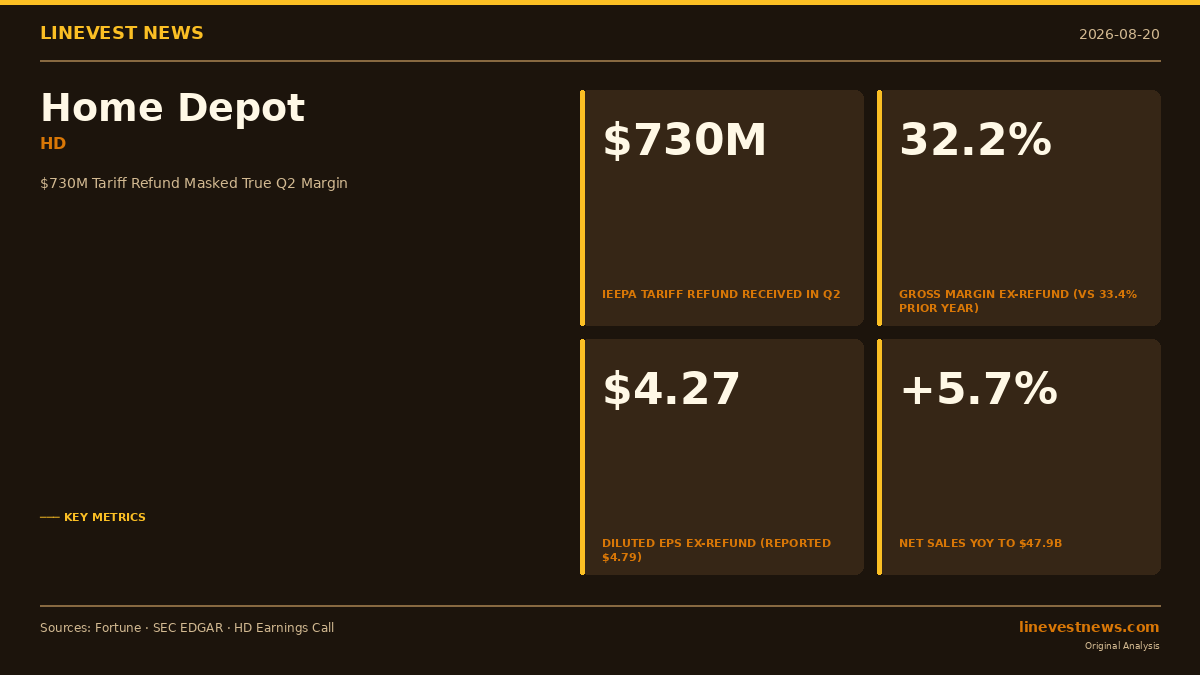
Home Depot (NYSE: HD) collected a $730 million refund of tariffs the Supreme Court struck down in February. Of that total, $685 million credited directly to cost of goods sold in Q2; the remaining $45 million is still sitting in inventory and will trickle through later quarters. Take that money back out of the cost of goods sold and the gross margin the company reported on Tuesday does not improve at all — it declines by more than a percentage point. The earnings exhibit Home Depot filed with the SEC says as much in a sentence that did not travel: full-year guidance, it notes, "includes IEEPA tariff refunds, which are expected to partially offset unplanned fuel, energy, and other product input costs throughout the fiscal year."
That line sits in the filing rather than in the headline of the press release, and it is the part a portfolio manager actually wants. The question after a beat like this one is never whether the refund was real — it was real, and it was legally owed. It is what the quarter looks like underneath, and whether the second half has anything left to lean on. Home Depot's own guidance answers the second question more candidly than the reaction to the quarter has.
Where the money went
On the call Tuesday morning, chief financial officer Richard McPhail split the refund in two. About $685 million attached to merchandise Home Depot had already sold, so it flowed straight through cost of goods sold and into the quarter's reported profit. The remaining $45 million is still sitting in inventory and will be released only as that merchandise clears. McPhail told analysts the refunds "are being used to offset unplanned and rising cost pressures throughout the year" — a description of a plug, not of a windfall.
The refunds themselves trace to the Supreme Court's February decision in Learning Resources, Inc. v. Trump, which held that the president lacked authority to impose broad global tariffs under the International Emergency Economic Powers Act, the 1977 emergency-powers statute the duties had been levied under.
U.S. Customs and Border Protection, the agency that collects import duties, stopped charging them and opened a claims process for importers of record during the spring, according to law-firm guidance from Holland & Knight and from Skadden tracking the ruling's implementation. Any company that paid those duties directly is entitled to have them returned, and the reimbursement runs back through the same line where the duties were originally expensed. That is why a court decision about presidential authority surfaces inside a retailer's cost of goods sold rather than as a separate credit further down the income statement.
Why It Matters
A refund is an event. A cost structure is a condition. What makes this particular disclosure worth more than a headline is that the two arrived inside the same line of the same statement, and that line does not distinguish between them.
For anyone reading the quarter as a signal about how the business is running, that distinction matters more than the size of the cheque. Reimbursed duties describe something that already happened and cannot happen again. The fuel, energy and input costs they offset describe something that is happening now and may keep happening. One reported margin figure contains both and reports only their sum.
Taking that sum apart is the whole of the exercise below — using the company's own figures, and the split management itself supplied on the record.
The same quarter, with and without
Here is what the plug covered. The left column is Home Depot's, from the earnings exhibit attached to its Aug. 18 filing; the middle column is this publication's arithmetic, subtracting the $685 million credit and nothing else.
| Reported Q2 FY2026 | Ex-refund | Q2 FY2025 | |
|---|---|---|---|
| Net sales | $47.861B | $47.861B | $45.277B |
| Gross profit | $16.115B | $15.430B | $15.125B |
| Gross margin | 33.7% | 32.2% | 33.4% |
| Operating income | $6.839B | $6.154B | $6.555B |
| Diluted EPS (GAAP) | $4.79 | $4.27 | $4.58 |
The per-share line needs one assumption, and it is the company's own: the quarter's effective tax rate of 24.5%, which is simply the reported tax provision divided by reported pre-tax earnings. At that rate the credit is worth roughly $517 million after tax, or about 52 cents a share.
A refund of this kind is neither an irregularity nor an aggressive choice. Duties paid in error are a receivable from the government, and when the government pays, the expense they created is reversed where it was booked. The mechanics are unremarkable. What makes the item worth isolating is that it is non-recurring by construction — duties cannot be refunded twice — while the costs it offset this quarter can persist indefinitely.
Nothing in that table is a restatement, and nothing in it contradicts the company. Every reported figure is Home Depot's, and the counterfactual column removes exactly one item — the one management itself identified, quantified and described on the record. The two columns separate a legal reimbursement of duties paid in earlier periods from the operating performance of the quarter itself. Only one of those repeats.
The operating income line changes character most. As reported, operating income grew 4.3% on sales growth of 5.7%. Strip out the credit and it declines roughly 6% against the year-ago quarter — a swing of about ten points in the growth rate, produced by one item.
Management's own bridge
None of this was concealed. McPhail walked analysts through the offsets, attributing roughly 60 basis points of margin erosion — a basis point is one hundredth of a percentage point — to costs that were never in this year's plan, and roughly another 60 to sales mix from acquisitions. Add the refund benefit, subtract those two, and the arithmetic lands within four basis points of the small improvement the company printed. Billy Bastek, executive vice president of merchandising, named the unplanned costs as fuel, energy and inputs including resin and metals, plus the switch from the expired tariff regime to Section 301 duties, the trade authority that survived the ruling.
The acquisition half of that drag deserves a word, because it is not a problem. The mix effect comes chiefly from GMS, a distributor of drywall, ceilings and steel framing that Home Depot's SRS Distribution subsidiary absorbed in September 2025, and Mingledorff's, a wholesale HVAC distributor in SRS's portfolio.
Wholesale distribution carries structurally thinner gross margins than a retail aisle, so folding those businesses in pulls the blended percentage down even while both grow. That portion of the drag is a deliberate reshaping of the company and should persist by design. The fuel-and-resin portion is neither deliberate nor planned.
Three retailers, three destinations
Home Depot is not the only large importer holding a cheque from Washington, and the three biggest disclosures so far have sent the same money to three different places.
- Walmart (NYSE: WMT) — CFO John David Rainey told analysts the company expects roughly $2.4 billion in refunds and would "definitely bias and try to prioritize" spending it on lower shelf prices. Walmart excluded any recovery from guidance.
- Amazon (NASDAQ: AMZN) — CFO Brian Olsavsky disclosed about $600 million in the June quarter and said Amazon would automatically refund shoppers wherever a specific import charge can be matched to a specific order, using the remainder to fund lower prices.
- Home Depot — the money went to the cost line, holding prices roughly where they were rather than cutting them.
None of the three is obviously wrong, and the differences say more about where each company is under pressure than about generosity. Walmart is fighting for grocery traffic. Amazon is managing a trust question over how import charges appeared at checkout. Home Depot is defending a gross margin against input costs it did not forecast, in a housing market that is not handing it volume. The instrument is identical; only the wound differs.
The last tariff shock
Home Depot has run this play before, in reverse. On its August 2019 second-quarter call, then-chief executive Craig Menear sized the China tariff exposure — "list one to four, four being at 10%, that's about a $2 billion or 2% of sales kind of cost impact."
Ted Decker, then head of merchandising and now chief executive, said the merchant team expected to cut that net impact to "something like 1%" by shifting sourcing to Taiwan, Vietnam, Thailand and Indonesia. Menear added that broad tariff-driven price increases had not been implemented, and that the company believed it could cover the impact through merchandising tools instead.
The instinct then was to protect the shelf price and absorb the strain internally. The instinct now, with money flowing the other way, is the mirror image: absorb the windfall and leave the shelf price alone. A retailer that neutralises both a cost shock and a cash windfall rather than passing either on is being consistent about price. Whether that consistency is a strength depends on what the costs do next.
What we wrote before, and what changes
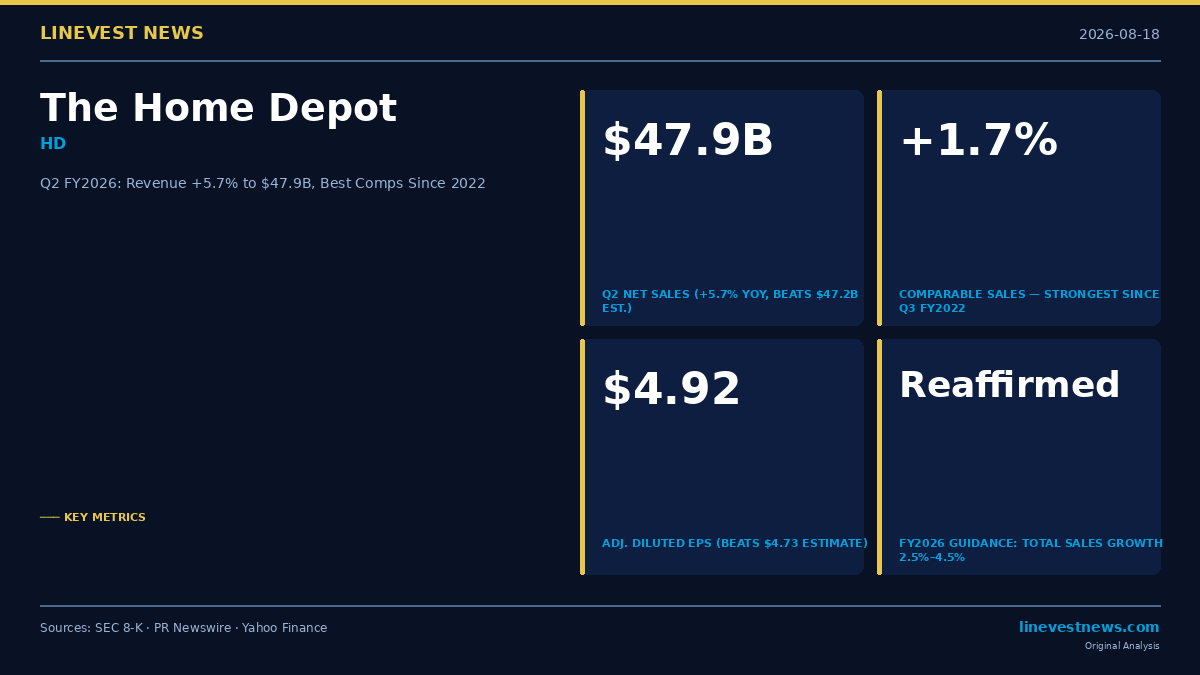
LineVest has covered both of the steps leading here. On Aug. 9 we wrote that February's dividend increase was the smallest in the dividend history the company publishes, and that the payout ratio rose anyway because per-share earnings declined while the dividend rose. On Aug. 18 we reported the quarter as filed — the sales beat, the strongest comparable-sales reading since 2022, the reaffirmed full-year guidance. Every figure in both pieces still stands.
What Tuesday's call added was composition. The $685 million portion booked to earnings equals about 10.9% of the quarter's pre-tax earnings, and it reimburses duties expensed in earlier periods. Read against the dividend piece, the picture is consistent rather than contradictory: a company whose per-share earnings, on an ex-refund basis, have been under real pressure met its numbers this quarter partly with a non-recurring credit tied to the February Supreme Court ruling: the remaining $45 million in inventory will trickle through H2, but no new IEEPA tariff refunds are expected once this pool is exhausted.
What would make this reading wrong
The interpretation above fails in one specific way, and it is worth naming. If the cost inflation Bastek described is a spike rather than a new level — if fuel, energy, resin and metals recede through the autumn — then the refund was a bridge across a temporary gap and the underlying margin was never impaired at all. In that case the second half holds up fine without it, and this quarter reads as good timing rather than as a mask.
Management's guidance points the other way. Full-year gross margin is guided to approximately 33.1%, below the 33.7% just reported, and McPhail said fourth-quarter gross margin should land roughly flat year over year — the prior-year Q4 FY2025 contained no IEEPA refund, and the small $45M inventory release will be immaterial at that scale. The confirming data point arrives with the third-quarter report in November. Only $45 million of refund remains in inventory — under ten basis points on a quarter of this size — so the next gross margin will be close to a clean read on whether the cost pressure is receding, holding or widening.
That report, not this one, settles the argument. Until then the honest description of the second quarter is the one the filing gives: a legal reimbursement arrived, and it was spent covering costs nobody had planned for. Both halves are true, and reading only the first half is how a quarter like this gets misfiled.
Segment-level detail, the four-quarter margin trend, the SRS and GMS contribution to Pro sales, the free-cash-flow bridge and a peer comparison against Lowe's are in the full LineVest report on Home Depot.
Disclaimer: This article is journalism, not investment advice. LineVest is not a registered investment adviser and makes no recommendation regarding any security. Figures are drawn from Home Depot's SEC filings, its second-quarter earnings call and the cited sources.