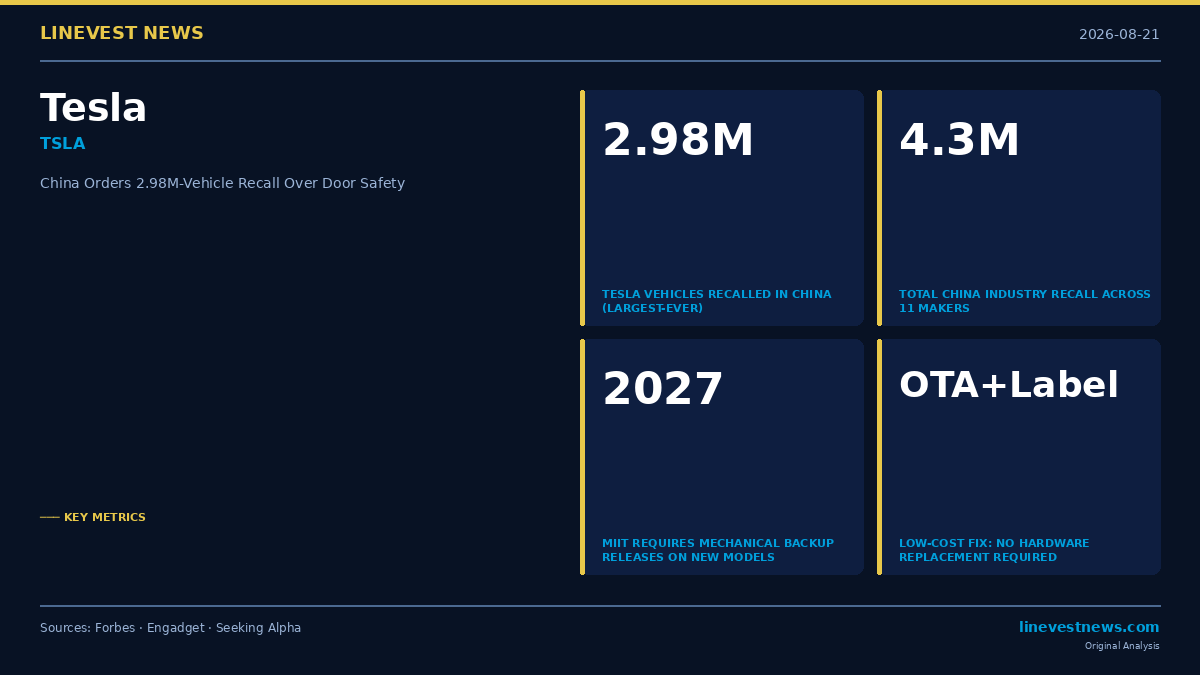
TL;DR - China's SAMR issued recall orders covering ~2.98 million Tesla vehicles — the automaker's single largest recall globally - Two overlapping defects: (1) flush door handles that first responders cannot quickly locate after a collision, and (2) driver-monitoring software that stops issuing eye-tracking alerts in a subset of those same vehicles - Remedies are low-cost: free warning labels on door panels and an over-the-air software update covering both issues; no hardware replacement required - China's MIIT is introducing a new vehicle standard requiring mechanical backup door releases on newly type-approved models from July 1, 2027 — adding medium-term redesign pressure - NHTSA has opened a parallel U.S. investigation into Tesla door-opening failures following 12V power loss
Part A: The Recall
China's State Administration for Market Regulation (SAMR) on August 21, 2026 issued recall orders covering approximately 2.98 million Tesla vehicles — the single largest recall in Tesla's global history. The action is part of a broader campaign affecting nearly 4.3 million vehicles across 11 manufacturers, with eight companies — including Tesla and Xiaomi — specifically cited for door-access fixes.
Two Overlapping Defects
Defect 1 — Door Emergency Access: Tesla's flush, recessed exterior door handles are nearly invisible against the door panel by design. After a collision, first responders cannot quickly locate or operate the emergency release points, particularly when a vehicle has been deformed or its 12V electrical system has been disrupted. SAMR determined this design does not adequately communicate emergency access to rescue personnel.
Defect 2 — Driver Monitoring: The driver-monitoring system, designed to issue eye-tracking alerts when driver attention drifts, has been found to malfunction in a subset of the recalled fleet. Approximately 2.74 million of the 2.978 million total vehicles are subject to this second notice — specifically, China-manufactured Model 3 and Model Y units built through December 2025. The driver-monitoring notice covers a shorter production window than the door-handle notice (which runs through April 2026), accounting for the ~190,000-unit gap between 2.74M and the 2.93M total China-manufactured Model 3/Y count. Because the 2.74 million driver-monitoring vehicles are entirely nested within the larger door-handle recall population, the headline figure of 2.978 million represents unique vehicles, not a summed total.
Scope by Model
| Model | Type | Approximate Units |
|---|---|---|
| Model Y | China-manufactured | ~1,960,000 |
| Model 3 | China-manufactured | ~973,000 |
| Model 3 | Imported | ~35,000 |
| Model X | Imported | ~8,000 |
| Model S | Imported | ~2,000 |
| Total (unique vehicles) | ~2,978,000 |
China-manufactured Model 3 production at Giga Shanghai began in late 2019; China-manufactured Model Y series production and deliveries began in early 2021. The door-handle recall covers vehicles produced through April 2026.
Remediation
- Door handles: Free warning labels installed on door panels to mark emergency release points; a software update will automatically lower windows post-collision to facilitate rescue access
- Driver monitoring: An over-the-air (OTA) software update
No hardware replacement is required under either notice.
Part B: What It Means for Tesla Investors
Immediate Financial Impact: Negligible
The chosen remediation — adhesive warning labels and OTA software patches — carries virtually no per-unit hardware cost. Tesla has resolved prior regulatory actions through OTA fixes at minimal direct expense, and this recall follows the same pattern.
At approximately 2.98 million vehicles, even a $20-per-unit label and inspection cost would total roughly $60 million — less than 0.1% of Tesla's annual revenue — and the actual outlay is likely lower still, given that OTA fixes for the driver-monitoring issue cost essentially nothing to distribute.
The 2027 MIIT Standard Is the Structural Risk
China's Ministry of Industry and Information Technology (MIIT) is introducing a new national vehicle standard requiring mechanical backup door releases on both interior and exterior doors, operable without electrical power. The standard takes effect July 1, 2027 for newly type-approved models; vehicles already on sale under existing type approvals receive a phased compliance timeline.
The requirement targets handle and release designs that lack mechanical redundancy — covering both the flush exterior panels on Tesla's Model 3 and Model Y (which rely on electronic presentation without a built-in mechanical fallback for exterior opening) and interior release mechanisms that require power to operate. Any future model revision or all-new model submitted for Chinese type-approval from mid-2027 onward will need to incorporate these mechanical backup elements on both door faces.
China is Tesla's largest overseas market. The company delivered approximately 657,000 vehicles there in 2024 — a record for China-only volume — with global deliveries that year totaling 1.79 million. Model 3 and Model Y account for the vast majority of that China volume. Any new China-bound model submission from 2027 will need to meet the mechanical backup requirement, adding hardware cost and likely requiring tooling changes at Gigafactory Shanghai.
Tesla Is Already Signaling a Design Pivot
Tesla Design Chief Franz von Holzhausen commented publicly that the company is exploring a hybrid mechanism: "The idea of combining the electronic one and the manual one together into one button, I think, makes a lot of sense." Combined with China's incoming standard, this suggests Tesla may integrate a mechanical backup into future door designs ahead of the July 2027 deadline — likely on new model versions entering Chinese type-approval before mid-2027.
The flush-handle design has been a Tesla aesthetic signature for over a decade. Incorporating a mechanical backup will change the appearance and tactile experience of that signature feature in China-market models.
NHTSA Is Watching
The National Highway Traffic Safety Administration (NHTSA) has separately opened an investigation into Tesla door failures following 12V power loss. The U.S. probe concerns situations where Model Y doors cannot be opened when the low-voltage system fails — affecting occupants in damaged or parked vehicles. While related to the Chinese recall's emergency-access concern, the U.S. investigation focuses on a different failure mode: power loss independent of collision damage.
NHTSA investigations do not automatically result in recalls, but a mandated U.S. remedy would extend Tesla's compliance costs into a second major market.
Broader Context: Industry-Wide, Not Tesla-Specific
The broader 4.3 million-vehicle campaign involves 11 manufacturers. A 2025 fatal crash involving a Xiaomi SU7 sedan — in which bystanders were unable to open the vehicle's doors to rescue three occupants, all university students — catalyzed the regulatory response across the sector.
The door-handle vulnerability is a consequence of a design trend shared across multiple automakers and EV platforms. Tesla is the largest single company affected by volume, but the regulatory action targets an industry-wide design philosophy, not Tesla-specific manufacturing quality.
Watch Points for Q3 and Beyond
| Trigger | Why It Matters |
|---|---|
| CPCA monthly China delivery data (September–October) | Will the recall announcement weigh on near-term demand? |
| Tesla product communications | Official timeline for mechanical backup integration in China-market models |
| NHTSA investigation outcome | Scope and timing of any U.S. recall notice |
| MIIT 2027 type-approval filings | Whether Tesla seeks exemptions or moves to early voluntary compliance |
Sources: China SAMR recall announcement (Aug. 21, 2026); Forbes (Tyler Roush, Aug. 21, 2026); Engadget (Aug. 21, 2026); Seeking Alpha (Aug. 21, 2026)
This article is for informational purposes only and does not constitute investment advice or a recommendation to buy or sell any security. LineVest News is an independent publication and is not affiliated with any brokerage.