Ross Stores (NASDAQ: ROST) raised its full-year profit forecast on Thursday afternoon, and the stock jumped the next morning. More than half of that raise is a one-time customs refund rather than better retailing. The money is real and it has already been collected. It is also not repeatable, and Ross's own quarter-by-quarter guidance quietly says so.
Why It Matters
The distinction matters because the two things point in different directions. A refund is a legal event. A guidance raise is supposed to be a statement about the business. This one is both, mixed together in a single number, and the release does not separate them for you.
For a reader trying to judge the retailer rather than the news cycle, that mixture is the whole problem. One part of the raise describes what Ross earns when it buys goods cheaply and moves them quickly. The other part describes what a court decided about a tariff program. The first can happen again next quarter. The second cannot, at least not by design.
Treating the two as one number flatters the business and hides the improvement that is actually there. That improvement is smaller than the headline, but it is the durable half. The rest of this piece separates them, using Ross's own disclosures.
Where the extra dollar comes from
Ross moved its full-year earnings range up by roughly a dollar a share at the midpoint. The company itself tells you how much of that is the refund. It does not do the subtraction.
- Prior full-year guidance, given May 21, 2026: $7.50 to $7.74 per diluted share
- New full-year guidance, given Aug. 20, 2026: $8.61 to $8.77
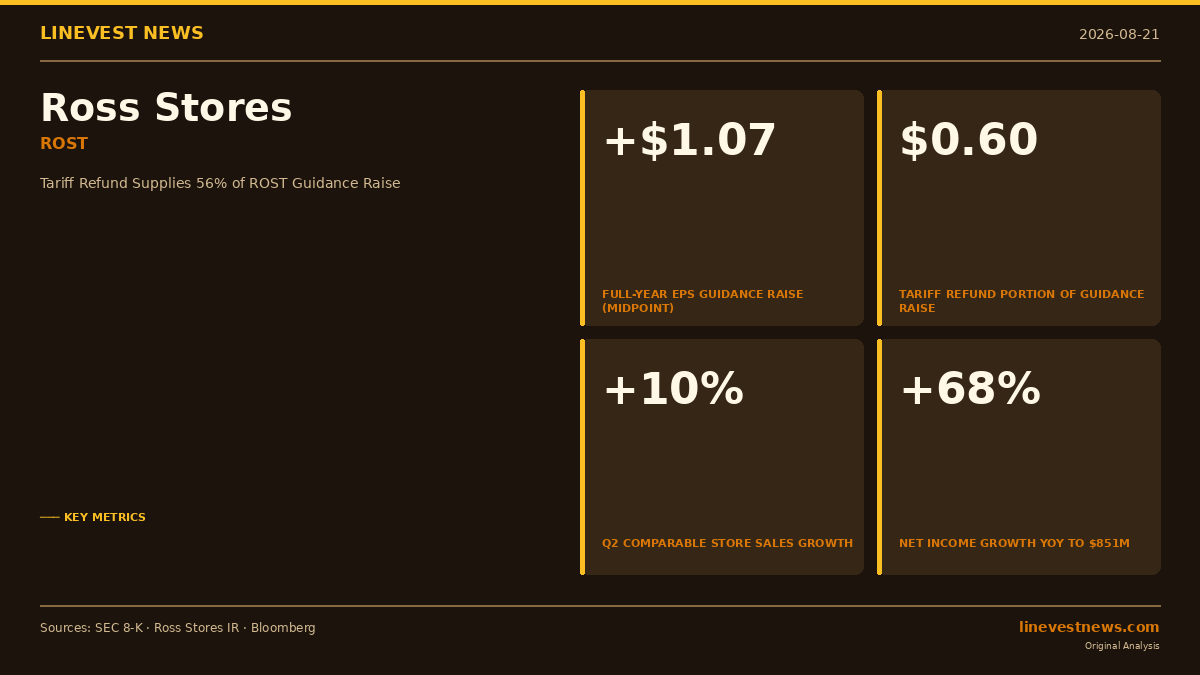
- Increase at the midpoint: $1.07 (LineVest calculation)
- Portion the company attributes to tariff refunds: about $0.60
- Remainder, from the operating business: about $0.47 (LineVest calculation)
So the operating raise is real but smaller than the headline. Roughly 56 cents of every dollar added to the forecast came from a courthouse, not a store. Both figures in that range trace to Ross's own earnings releases, filed with the SEC on Form 8-K — the short filing a public company uses to disclose a material event between quarterly reports. Results are furnished under its Item 2.02, the section reserved for financial performance.
What the refund actually is
IEEPA is the International Emergency Economic Powers Act, the 1977 law the White House used to impose broad import tariffs. In February the Supreme Court held that the statute grants no tariff authority, in Learning Resources, Inc. v. Trump. The Court of International Trade — the federal court that hears customs disputes — then ordered Customs and Border Protection to return the money. Law firm analyses of the ruling put the total refund pool at roughly $165 billion.
Refunds go to the importer of record, meaning whoever actually paid the duty at the border. Ross imports directly, so Ross collected. That is why the credit landed inside operating profit rather than in a tax line or a legal settlement, and it is why the quarter reads better than the underlying trade did.
The sum involved is not a rounding item. Ross's own second-quarter release puts the refunds at roughly $253 million, quarterly operating profit at about $1.1 billion, and quarterly sales at $6.3 billion. Set the refund against the other two and it equals close to a quarter of operating earnings, and about 4% of sales. Both ratios are LineVest calculations from those three company-reported figures.
The quarter underneath was still a beat
Strip the refund out and Ross still cleared its own bar. The company had guided second-quarter earnings to $1.85 to $1.93 a share. Excluding the refund, it earned about $2.06. The reported figure, refund included, was $2.66.
That adjusted number also beat the Street. Consensus sat at $1.95, per data compiled by StockStory. So the operating beat was about eleven cents — respectable, and roughly a sixth the size of the beat the headline implies.
Margins tell the same story twice. Ross said operating margin widened 610 basis points — that is 6.1 percentage points — and that the refund supplied two-thirds of the gain.
What remains once the refund is removed is a 2.05-point improvement in operating margin. Management had planned for 1.3 to 1.5 points. The business genuinely got better, and then a court handed it a windfall on top of that.
The engine underneath is foot traffic. Comparable store sales — sales at stores open at least a year — rose 10%, and Ross said the gain came primarily from customer traffic rather than from shoppers spending more per visit. Total sales rose 13%. The three-point gap between those two figures is new stores.
Traffic-driven growth is the version retail investors tend to trust. Growth that comes from a bigger average basket can simply be price increases working through, and those fade once the comparisons get harder. Traffic means more people walked in the door. For an off-price chain — a retailer that buys branded overstock and sells it below department-store prices — rising traffic is also the clearest available signal that shoppers are hunting for value.
Morningstar analyst Brett Husslein tied that directly to the tariff period. Ross, he wrote, "deliberately avoided being the first to raise prices and pass on tariff costs, even intentionally absorbing margin burdens last year." He called it a savvy move that cemented the chain's low-price reputation. On that reading, the refund and the traffic are two consequences of the same decision.
The shape the guidance describes
Here is the part the raise does not advertise. Ross's own comparable-sales path, reported and guided:
- First quarter, reported: +17%
- Second quarter, reported: +10%
- Third quarter, guided: +6% to 7%
- Fourth quarter, guided: +4% to 5%
Chief Executive Jim Conroy said the company "exited the second quarter with building momentum and are excited for the plans we have in place entering the Fall season." The guidance table describes a steady deceleration into the holidays. Both statements can hold at once — momentum describes an exit rate, guidance describes a whole period — but the gap between the language and the arithmetic is the thing worth tracking.
And here is what would make that reading wrong. Ross guided second-quarter comparable sales to 6% to 7% back in May. It delivered 10%. The third-quarter guide repeats that same range, unchanged. If the company is simply being conservative the same way twice, then the slowdown in the table is a planning assumption rather than a forecast, and this quarter's caution will look like last quarter's caution did.
One piece of arithmetic that is not in the release
Take the first-half result and add the two remaining quarterly guides. The sum reproduces the full-year range almost exactly:
- First half, reported: $4.69
- Third quarter, guided: $1.75 to $1.83
- Fourth quarter, guided: $2.17 to $2.26
- Sum of the low ends: $8.61 · Sum of the high ends: $8.78
- Stated full-year guidance: $8.61 to $8.77
The bottom matches to the cent and the top is within a cent. That is not a coincidence.
That identity has a consequence. The back-half guides contain no assumed tariff refund at all. The $0.60 sitting inside the full-year number is the same $0.60 already banked in the second quarter, carried forward. Ross is not projecting further windfalls into its outlook.
That is a cleaner disclosure than it first appears. The customs refund process is still running, and any additional recoveries would land outside the guide rather than inside it. It also means the $0.47 operating portion of the raise stands on its own, unsupported by anything a court might or might not do next.
Stores, buybacks, and the rest of the quarter
Ross opened 47 stores in the quarter and lifted its full-year opening plan to 115 locations, up from 110. Twelve of the new openings were dd's DISCOUNTS, the company's smaller-format chain aimed at lower-income shoppers. The rest carried the Ross banner.
The buyback is doing less work here than the profit growth might suggest. Ross repurchased 1.4 million shares during the quarter for an aggregate $319 million, trimming the diluted share count by about 1.7% from a year earlier.
The release states the year-over-year comparison directly. Net income was $851 million, against $508 million in the same quarter last year. Diluted earnings per share came in at $2.66, against $1.56.
Those are annual comparisons of reported profit, not stock-price moves. Net income grew about 68%, and per-share profit about 70%, both measured against the same quarter of 2025. The difference between the two growth rates is the smaller share count. It is a minor contributor next to everything else in the quarter.
Ross was not the only retailer lifting its outlook that morning. BJ's Wholesale Club (NYSE: BJ), a Massachusetts-based warehouse club chain, also raised full-year adjusted earnings guidance above the average analyst estimate, according to Bloomberg's Stock Movers summary. Value formats are having a good season.
LineVest has not covered Ross Stores before, so there is no prior statement of ours to hold this quarter against. The company's own May release fills that role. In it, Conroy said Ross "exited the first quarter with solid momentum, and our underlying business fundamentals remain very strong." Three months later the phrasing is nearly interchangeable — and so is the comparable-sales range guided for the following quarter.
Shares rose about 8.6% in premarket trading on Aug. 21, to $248.77, after an initial move of nearly 9%, according to Investing.com.
What settles it
The confirming data point is the third-quarter report, covering the period that ends in late October on Ross's 13-week fiscal calendar. Two things in it resolve the argument raised here. First, whether comparable sales land above the 6% to 7% guide the way they did last quarter, or inside it. Second, whether any further customs refunds appear in operating income, given that the current full-year outlook assumes none.
Until then, the honest description of Thursday's news is narrower than the headline number. Ross had a strong quarter on traffic. A court gave it a large one-time payment on top. The forecast for the rest of the year embeds neither more refunds nor a continuation of double-digit comparable-sales growth.
Not covered here: the segment and banner-level detail, the four-quarter margin trend table, the comparison against TJX and Burlington on traffic and inventory turns, and the cash-flow bridge showing where the refund cash actually went. Those are in the full report.
Disclaimer: LineVest is an independent publication and is not a registered investment adviser. This article is journalism, not investment advice, and nothing in it is a recommendation to buy or sell any security. Figures are drawn from Ross Stores' SEC filings and the sources cited inline.