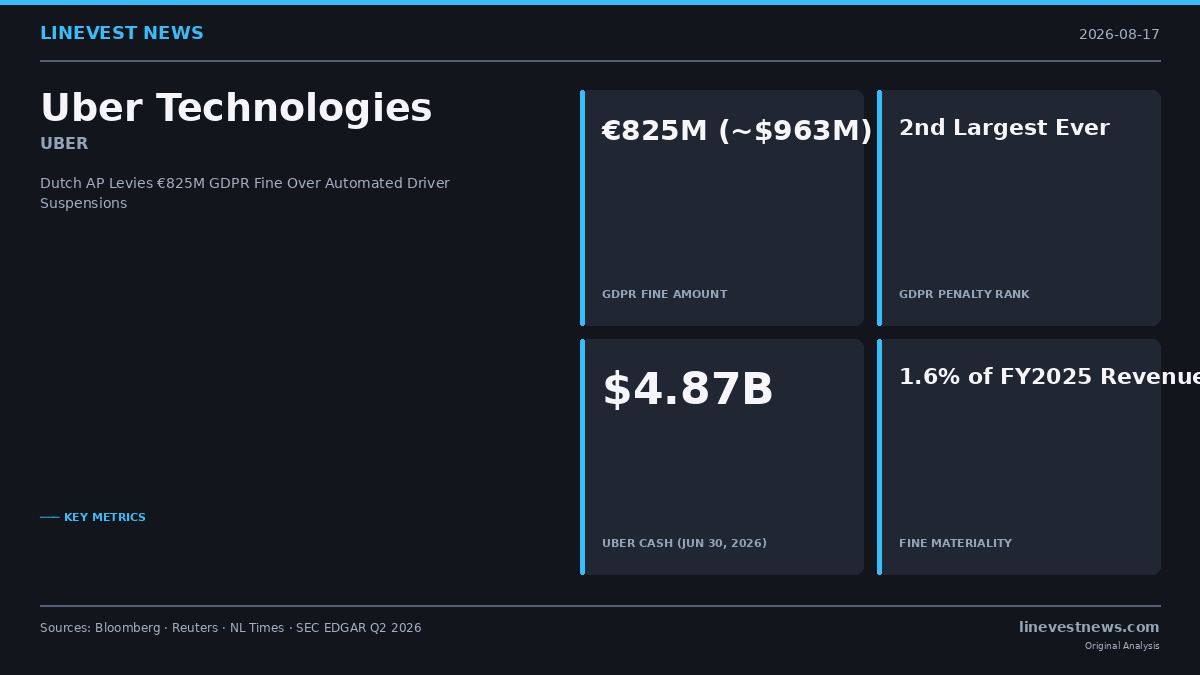
TL;DR - The Dutch Data Protection Authority (AP) fined Uber $963M (€825M) on August 17 — the second-largest GDPR penalty on record - Violation: GDPR Article 22, requiring safeguards around automated consequential decisions — including notification, contestation rights, and access to human review (driver suspensions 2020–2022) - Uber will appeal; all cited practices were discontinued before the decision - The fine equals ~1.85% of FY2025 revenue; Uber holds $4.87B in cash — manageable against $10B+ TTM FCF - Precedent: A sustained ruling forces all gig-economy platforms to overhaul algorithmic enforcement systems
Part A: The Ruling and What Uber Did Wrong
The Netherlands' Autoriteit Persoonsgegevens (AP) — acting as Uber's lead European privacy regulator because Uber's EU headquarters are in Amsterdam — issued an €825 million (~$963 million) penalty on August 17, 2026. The decision makes it Europe's second-largest fine ever under the General Data Protection Regulation (GDPR), behind only the €1.2 billion penalty imposed on Meta by Irish regulators in 2023.
The case originated with complaints from France. The AP investigated two automated enforcement systems Uber operated between 2020 and 2022:
1. Fraud waitlisting. Uber's algorithm temporarily suspended driver accounts flagged for suspected fraudulent activity with no human review required before the restriction took effect. This practice was discontinued in 2021.
2. Ratings-based deactivations. Drivers who fell below a customer satisfaction threshold faced permanent account deactivation driven entirely by algorithmic scoring — again with no prior human review or notification. This practice was discontinued in 2022.
Both practices violated GDPR Article 22, which restricts solely automated decision-making that produces legal or similarly significant effects on individuals. While Article 22(2) permits automated decisions in limited circumstances — such as when necessary for a contract or authorised by law — Article 22(3) requires companies to provide human review capability, allow individuals to express their view, and give them a meaningful opportunity to contest the outcome. The AP found that Uber triggered the Article 22 safeguard obligations and failed to meet any of them: affected drivers were not adequately informed and had no effective means to obtain human intervention or contest the outcome.
Uber contested both the ruling and the penalty size, calling it "disproportionate." The company stated it "strongly disagrees with this decision" and that the practices were discontinued years ago. An appeal will be filed in Dutch courts.
How This Fine Ranks in GDPR History
| Enforcement Action | Regulator | Fine | Year |
|---|---|---|---|
| Meta — EU-U.S. data transfers | Irish DPC | €1.2B | 2023 |
| Uber — automated driver suspensions | Dutch AP | €825M | 2026 |
| Amazon — behavioral advertising | Luxembourg DPA | €746M | 2021 |
| Uber — driver data transfer to U.S. | Dutch AP | €290M | 2024 |
| WhatsApp — transparency failures | Irish DPC | €225M | 2021 |
Part B: What the Fine Means for Investors
The Balance Sheet Math
At prevailing exchange rates, €825 million converts to roughly $963 million. Several comparisons put that number in context:
| Metric | Figure |
|---|---|
| FY2025 revenue | $52.0B |
| Fine as % of FY2025 revenue | ~1.85% |
| Cash and equivalents (June 30, 2026) | $4.87B |
| TTM free cash flow (as of Q2 2026) | $10B+ |
| Q2 2026 legal reserves | $141M |
One notable comparison: Uber added $141 million to legal and regulatory reserves in Q2 2026. If the full fine is eventually confirmed, the $963 million fine is more than six times that quarterly addition, and the total accrued balance across all periods may not be sufficient to absorb the full liability. Under ASC 450, a loss must be recognized when it becomes probable and reasonably estimable.
If management deems the fine reasonably possible but not yet probable, ASC 450 still requires disclosure of the estimated exposure or a statement that one cannot be determined. Investors should watch the Q3 2026 10-Q (due early November 2026, ~Nov 9 for large accelerated filers) to see whether Uber begins accruing or expands its contingent-liability disclosure.
Cash Is Sufficient — But the Buffer Shrinks
Uber held $4.87 billion in cash at June 30, 2026, down from $7.1 billion at year-end 2025. A full payment of $963 million would reduce that cushion to roughly $3.9 billion. That is a manageable reduction: trailing twelve-month free cash flow exceeded $10 billion for the first time in the company's history as of Q2 2026, meaning the fine represents approximately 35 days of cash generation at the current annualized run-rate. Cash declined $2.23 billion in H1 2026 as Uber invested in expansions and acquisitions, but the direction of earnings growth provides a substantial offset.
Appeals Delay the Clock — Possibly for Years
Uber's prior €290 million Dutch fine from 2024 (for transferring European driver data to the U.S.) remains under appeal. European GDPR enforcement appeals have historically taken two to four years to resolve at first instance. If that timeline holds, Uber may not face a final, unappealable payment obligation until 2030 or later, given typical timelines in the Netherlands. At that point, Uber will have generated $34–40 billion or more in cumulative free cash flow at its current $10B+ annualized run-rate.
The more immediate risk is not the fine itself but the uncertainty it creates around capital return plans. Uber repurchased shares and made acquisitions in H1 2026. Management's calculus on buyback authorization will need to account for the appeal outcome — even if the probability-weighted expected loss is well below $963 million.
The Gig-Economy Precedent Is the Real Story
Beyond Uber's own balance sheet, the AP's ruling establishes a legal standard that applies to every platform using automated enforcement systems against workers. Lyft (LYFT, which acquired FreeNow in July 2025), DoorDash (DASH, via Wolt), and any other gig-economy operator with European operations runs the same category of risk.
For all of these companies, the Dutch decision means affected workers must be meaningfully informed when automated enforcement systems act against them, and must have a genuine opportunity to obtain human review and contest the outcome. Failure to build those systems is now a quantifiably large risk.
The EU AI Act Adds a Second Enforcement Track
The AP's theory — that automated consequential decisions about workers require human oversight — directly mirrors provisions in the EU Artificial Intelligence Act (AI Act). The EU AI Act's Annex III classifies algorithmic systems used in employment and worker-management contexts as high-risk AI, and the compliance obligations for that category — conformity assessments, transparency requirements, human oversight mandates — became applicable on August 2, 2026 — roughly two weeks before this decision was published. That means the regulatory landscape for gig-platform enforcement algorithms has already changed.
Uber is now paying €825 million for practices discontinued in 2021–2022, under GDPR rules in force since 2018. The AI Act now creates a second, parallel enforcement track targeting the same category of behavior — this time under the explicit framing of artificial intelligence.
For investors in platform-economy companies with European footprints, the regulatory trajectory is unambiguously toward tighter algorithmic accountability.
Key Dates to Watch
- Q3 2026 10-Q filing (due early November 2026, ~Nov 9 for large accelerated filers): Contingent-liability reserve disclosure for the AP fine
- Dutch district court (Rechtbank) (est. 2028–2030): First-instance ruling on Uber's challenge — two to four years from the August 2026 decision; further appeals to the Raad van State could delay final resolution to 2030 or beyond
- EU AI Act Annex III obligations (applicable since August 2, 2026): Employment/worker-management algorithmic systems are now subject to conformity assessments, human-oversight requirements, and transparency mandates under the AI Act
This article is based on publicly available regulatory decisions, SEC filings, and earnings disclosures. It is intended for informational purposes only and does not constitute investment advice.