Phillip Securities cut Airbnb (NASDAQ: ABNB) to Reduce this month. It raised its target on the stock in the same note. That new number, $158, sits between two pre-earnings targets: Wedbush was at $152 and Susquehanna at $160 before the quarter was reported, per Bitget News and TipRanks respectively.
A downgrade that arrives with a higher target is not a contradiction. It is a statement about speed. Airbnb traded near $155 before the earnings report on Aug. 6; by the downgrade on Aug. 11, it was near $185 — a 19% move in five days. The analyst's price target went up roughly 16%, from $136 to $158. The share price went up faster. Everything below turns on that gap.
What the note actually says
Paul Chew of Phillip Securities, a Singapore-headquartered brokerage, moved Airbnb from Neutral to Reduce on Aug. 11. He lifted his target to $158 from $136, Investing.com reported. The stock traded near $185 that day, according to TIKR, putting his target approximately 14.6% below the market. Chew's objection was the multiple, not the business.
His argument is that recent share-price performance has pushed the stock to what he called a premium forward valuation. The downgrade is not based on a cut to his business estimates.
A word on the label itself. On Phillip Securities' five-tier scale (Buy/Accumulate/Neutral/Reduce/Sell), Reduce is the second-most-bearish tier — meaning Chew stopped short of the firm's outright Sell rating. Ratings of that kind are uncommon on large, widely held U.S. consumer names, which is part of why a single one gets picked up by the wires at all.
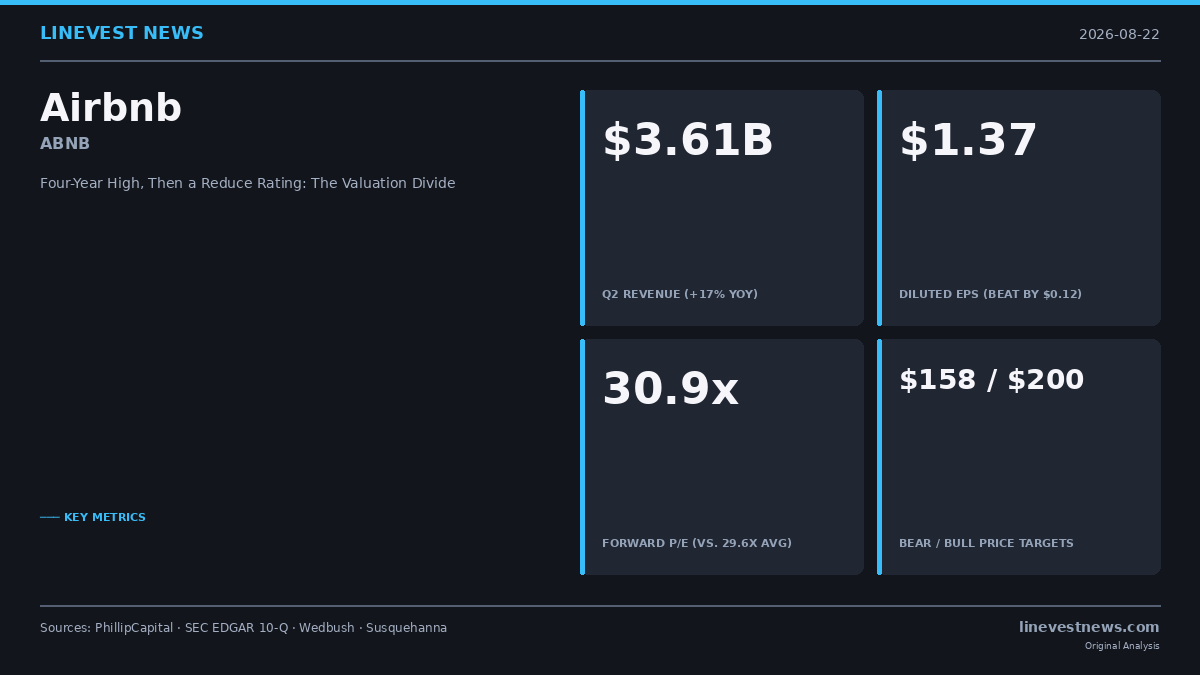
At the $185 level on Aug. 11, Airbnb traded at 30.9 times forward earnings, above a two-year historical reference of 29.6 times cited in the note. At Friday's $187.30 close, the same implied forward EPS of about $5.99 puts the multiple at roughly 31.3 times.
Why It Matters
What makes this call worth reading closely is that it does not accuse the company of anything. The analyst's forecast for the business went up, not down.
That leaves a narrower question on the table. When a stock and its own earnings estimates both rise, but at different speeds, which one is telling investors something? Nobody here can answer that from the filing. The filing does not contain the assumption the argument turns on.
So the value of the note sits in the framing rather than the verdict. It marks the point where the debate about Airbnb stopped being about travel demand. It became a debate about what a share of that demand should cost.
The target, recomputed
Chew's own figures can be turned around. At the roughly $185 price and 30.9 times forward earnings he cites, a $158 target works out to about 26.4 times.
At 26.4 times, his target implies a multiple beneath the 29.6x reference level — asking for a larger valuation compression than the note's stated objection would require.
How large is the gap
Airbnb closed Friday at $187.30, a fresh 52-week high, per 24/7 Wall St. The stock has set two of them since the downgrade.
Chew's target now sits $29.30 under the market. Spread across the 589.59 million shares stockanalysis.com counts, that gap is worth roughly $17.3 billion. Airbnb's entire revenue over the past twelve months was $13.16 billion on the same source's figures.
So the target implies that a sum larger than a full year of Airbnb's sales should not be in the share price. It does not imply the sales are at risk. That is the whole shape of this disagreement, and it is why the two sides can quote identical figures at each other.
Everyone is working from the same quarter
Airbnb reported second-quarter revenue of $3.61 billion, up 17%, and gross booking value of $27.2 billion, up 16%.
Net income was $816 million. Divide revenue by booking value and the take rate — the slice of each booking Airbnb keeps — comes to 13.3%, in line with the roughly 13.2–13.3% take rate cited in Chew's note, as reported by Yahoo Finance.
A nearly flat take rate is informative. It means Airbnb did not manufacture the top line primarily by charging hosts and guests a larger cut — the bulk of revenue growth came from more nights booked and higher nightly rates (currency tailwinds are also a factor — Airbnb flagged FX as a material contributor to recent reported growth). That is the part of the story nobody in this argument is contesting.
The spread between desks
The same quarter produced targets $42 apart. Here is where the desks landed:
- Wedbush (a Los Angeles-based brokerage) — upgraded to Outperform and raised target to $200 from $152 on Aug. 7 per Bitget News
- Susquehanna — raised target to $200 from $160, per TipRanks
- Phillip Securities — cut to Reduce Aug. 11; target $158, from $136
- MarketBeat consensus, Aug. 7 (pre-downgrade) — $164.26 across 39 analysts (25 buy or better, 13 hold, 1 sell)
- Friday's close — $187.30
Now line up the dates. Before Airbnb reported, Wedbush was at $152 and Susquehanna at $160. Phillip's post-earnings bear case landed between them, at $158.
That is the oddity worth carrying away. One quarter produced a $48 swing in Wedbush's target (from $152 to $200) and moved Phillip to Reduce. Neither side revised the business down. The gap between them is a multiple, and only a multiple.
This happens more often than the ratings themselves suggest. Analysts share a data set and differ on the discount rate and the exit multiple they apply to it. Those two inputs are assumptions, not disclosures, and they never appear in the filing. So a spread this wide is not evidence that somebody misread the quarter. It is evidence that the quarter did not settle the question the spread is about.
Phillip has made this call before
This is the firm's second Reduce rating on Airbnb in roughly 15 months. Phillip made the same Neutral-to-Reduce move on May 9, 2025, with a $112 target, Investing.com reported at the time.
The reasoning then was peer comparison. Airbnb traded near 34 times forward fiscal-2025 earnings, against Booking Holdings (NASDAQ: BKNG) at 24 times and Expedia (NASDAQ: EXPE) at 12 times, Phillip wrote. The firm later moved back to Neutral, per TipRanks.
Airbnb closed Friday 67% above that 2025 target.
That is not proof the current call is wrong. Valuation work is about level rather than timing, and a desk can be early instead of mistaken. But it does place the new target in a sequence. The same firm has twice concluded that Airbnb's price outran its earnings — first at 34x in May 2025, now at a lower 30.9x in August 2026. The first conclusion was followed by a period in which the stock significantly outperformed that target.
There is a longer memory here too. Airbnb's all-time high was $219.94, set on Feb. 11, 2021, per StockScan's price history.
The low in between was $81.91, reached in December 2022 on the same source's data. Friday's close sits between those two extremes and much closer to the top.
That range is why valuation arguments on this particular stock get loud. Airbnb has spent its short public life re-rating hard in both directions, and neither move was driven mainly by the bookings line. It is also worth noting what a two-year lookback can and cannot see. The window Chew measures against begins well after that round trip ended, so the band he calls normal was itself set during a recovery.
What LineVest wrote earlier this month
We covered the quarter that started all of this on Aug. 6. We noted then that the beat ended a run of three straight earnings misses, and that shares jumped about 12% after hours.
In our first-quarter coverage, published roughly three months earlier, we flagged the one cost line moving the wrong way. Sales and marketing widened by 3.3 percentage points of revenue as Airbnb bought international growth. Every other cost line improved.
The efficiency Chew credits in the second quarter shows up somewhere else entirely. His note points to customer support, where an AI assistant now resolves close to 45% of issues without a human and support cost per booking fell 16%, per Yahoo Finance's account.
So the savings arrived — just not on the line we identified as the pressure point. Support costs are a finite pool; there is a floor under how cheap a resolved ticket can get. Sales and marketing is the line that scales with the international expansion Airbnb is still paying for. Which of those two lines moves next quarter tells you more than the headline margin will.
What settles the argument
Airbnb guided third-quarter revenue to $4.69–$4.77 billion, a midpoint of $4.73 billion that Chew used in his model. Our coverage of the quarter noted that roughly 3 percentage points of that growth comes from currency moves against a weaker year-ago base, rather than from more travel.
That distinction will matter when the print arrives. Currency help flatters a growth rate without adding a dollar of durable earnings, and it reverses when the comparison base catches up. A quarter that clears guidance primarily on exchange rates would leave this argument exactly where it is now.
Chew's full-year model calls for continued revenue growth, per Investing.com.
If earnings grow sufficiently, the multiple at which the stock currently trades can decline toward Chew's reference threshold — which is where the argument loses its urgency without the share price necessarily declining.
That is the quiet resolution most valuation disputes actually get. Neither side is declared right. The earnings catch up, the argument loses its urgency, and the ratings drift back toward the middle without anyone writing a note about it.
The honest risk to this reading sits in the same report. If nights-and-experiences growth, which ran at 10% in Q2, slips back under double digits, or the full-year adjusted EBITDA margin target of at least 35.5% slides, then the dispute stops being about the multiple and becomes about the business. In that case, Phillip would have been correct on the fundamentals, not merely early on the timing.
Until that report lands, the scoreboard is unambiguous and slightly awkward. Airbnb has made two new 52-week highs since the downgrade, and the gap to Chew's target has widened: at the $185 downgrade price it stood at approximately 14.6%; at Friday's $187.30 close, it is roughly 15.6%.
Not covered here: the segment-level revenue build, the four-quarter margin trend, a peer multiple table against Booking and Expedia on current estimates, and the cash-flow bridge behind that $816 million of net income are in the full report.
LineVest is an independent publication and is not a registered investment adviser. This article is journalism, not investment advice, and nothing in it is a recommendation to buy or sell any security. Analyst ratings and targets cited above are the views of the issuing firms, not of LineVest.