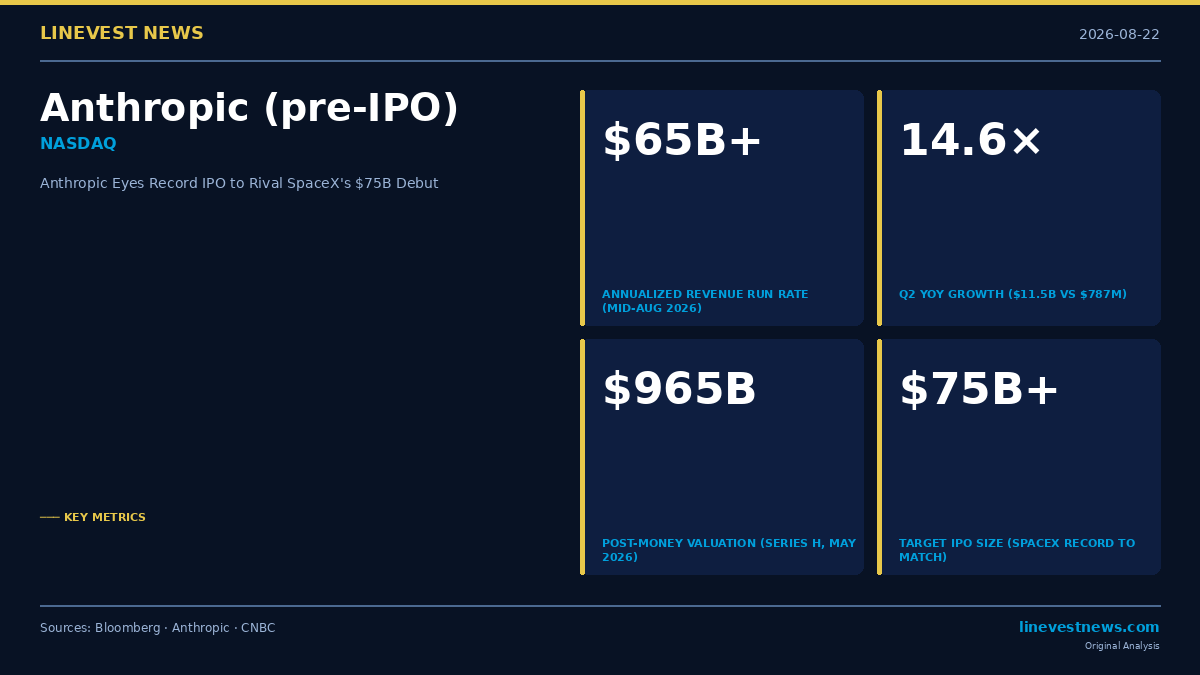
TL;DR - Anthropic plans a public S-1 filing as early as end of August 2026, targeting an October Nasdaq listing - The Claude developer aims to match or beat SpaceX's $86.2 billion record from June 2026 (base offering: $75 billion; overallotment: +$11.2 billion) - Q2 2026 quarterly revenue hit $11.5 billion, reaching 14.6× the $787 million recorded in Q2 2025; the annualized run rate reached $65 billion by mid-August, according to Bloomberg - Amazon (AMZN, $8B committed) and Alphabet (GOOG, up to $40B committed) are the largest hyperscaler backers; Broadcom (AVGO) is arranging at least $90 billion in AI chip financing for Anthropic and other AI companies
Part A — The Deal Taking Shape
Less than three months after SpaceX raised $75 billion in the largest initial public offering in history, Anthropic is preparing to file publicly for what could become an even bigger debut. Bloomberg reported on August 20, 2026, that the San Francisco–based artificial intelligence company — whose Claude chatbot competes directly with OpenAI's ChatGPT — is "running the numbers" ahead of a public S-1 registration as early as the end of this month.
The company confidentially filed a draft S-1 with the Securities and Exchange Commission in June 2026. The public version, once submitted, triggers the standard SEC review period before an institutional roadshow and a targeted Nasdaq listing, which market participants expect in October 2026, barring adverse market conditions.
Goldman Sachs, JPMorgan Chase, and Morgan Stanley are leading the offering. Bloomberg reported on August 20 that Citigroup is also set to join the syndicate in a top-tier role. Banks are competing aggressively for any position: to secure a place in the revolving credit facility that is expected to exceed its $10 billion initial target, institutions are committing between $750 million and $1.25 billion each — with the understanding that facility participation strengthens their case for IPO underwriting roles.
Key IPO Parameters
| Metric | Detail |
|---|---|
| Confidential S-1 filing date | June 2026 |
| Public filing target | As early as end of August 2026 |
| Exchange | Nasdaq |
| Expected listing | ~October 2026 (market-dependent) |
| IPO size target | Match or exceed SpaceX's $86.2B final total ($75B base + $11.2B overallotment) |
| Pre-IPO valuation (Series H) | $965 billion (May 2026) |
| Pre-IPO credit facility | Targeting $10B+; expected to exceed |
| Lead underwriters | Goldman Sachs, JPMorgan, Morgan Stanley |
| Additional underwriter | Citigroup (reported to be joining) |
Revenue Snapshot
| Period | Metric | Figure |
|---|---|---|
| Q2 2025 | Quarterly revenue | $787 million |
| Q2 2026 | Quarterly revenue | $11.5 billion |
| Q2 2026 vs Q2 2025 | Year-over-year growth (= 14.6× year-ago level) | +1,361% |
| Mid-August 2026 | Annualized run rate (Bloomberg est.) | $65 billion+ |
| 2028 | Company revenue projection | $190–200 billion |
Note: The $11.5 billion quarterly figure implies roughly a $46 billion annualized rate for Q2 2026. Bloomberg separately reported by mid-August that the annualized run rate had risen to $65 billion — indicating a sharp revenue acceleration entering Q3, consistent with the ramp-up of Anthropic's enterprise supply agreements.
Part B — Analysis for US Investors
1. Amazon and Google: Paper Gains vs. Structural Exposure
Amazon (AMZN) and Alphabet (GOOG) are the two largest hyperscaler backers of Anthropic, but their exposure structures differ materially.
Amazon's total publicly announced commitment to Anthropic is $8 billion: Amazon signed an agreement in September 2023 to invest up to $4 billion, funding $1.25 billion immediately with the remaining $2.75 billion deployed through March 2024, followed by a further $4 billion commitment in November 2024. A portion flows as cash investment; the remainder comprises Amazon Web Services cloud compute credits. At Anthropic's May 2026 post-money valuation of $965 billion, Amazon's equity portion has appreciated significantly in nominal terms. That position will become liquid once the IPO's lock-up period expires, typically 180 days after listing.
Google's position is more complex. Alphabet has committed up to $40 billion to Anthropic, with $10 billion funded immediately as part of the Series H. Much of Google's commitment is structured as Google Cloud computing credits rather than pure equity. For Alphabet shareholders, this creates dual optionality: if Anthropic succeeds, Google benefits both as an equity investor and as a cloud revenue source (Anthropic's compute draw becomes Google Cloud revenue); if Anthropic scales more slowly, Google's remaining commitment stays undrawn or not yet deployed.
For investors holding AMZN or GOOG as proxies for AI infrastructure exposure, Anthropic's IPO crystallizes a valuation that has been an off-balance-sheet paper gain since 2023. The stock response on IPO day for both companies will depend on where the offering ultimately prices relative to the $965 billion Series H benchmark.
2. Broadcom's Chip Financing Play: At Least $90 Billion at Stake
Broadcom (AVGO) emerged this week as the central financing intermediary for Anthropic's AI accelerator chip buildout — a role that adds a new and quantifiable dimension to AVGO's already significant AI business.
According to Bloomberg (August 20), Broadcom is seeking more than $60 billion in a senior-secured debt tranche, plus a junior tranche of roughly $30 billion, for a combined total of at least $90 billion. This capital, arranged jointly with Blackstone and Apollo Global Management, would fund the supply of AI chips to Anthropic and other hyperscale AI companies.
The financing structure builds on an earlier arrangement: Broadcom established an "AI XPU financing" platform with Apollo and Blackstone in June 2026 at approximately $35 billion in initial scale. The August discussions represent a roughly 2.6× expansion of that facility as Anthropic's compute requirements have grown in line with its revenue acceleration.
For AVGO shareholders, the implication is potentially significant. Broadcom's custom XPU business for AI customers represents a long-cycle, high-visibility revenue stream. The debt arrangement effectively pre-finances years of chip delivery, giving Broadcom demand certainty that traditional semiconductor contracts do not offer. Broadcom's Q3 FY2026 results, expected in September, will be the first opportunity for management to quantify the Anthropic pipeline in guidance commentary.
3. Anthropic's Revenue Trajectory and What the S-1 Will Reveal
Anthropicʼs revenue has grown from less than $800 million per quarter in mid-2025 to $11.5 billion in Q2 2026 — growing to 14.6× its year-ago level (+1,361% year-over-year) — with the annualized run rate reaching $65 billion by mid-August 2026. The companyʼs own projection of $190 to $200 billion in 2028 revenue implies roughly 3× the current $65 billion run rate over approximately two years — a demanding but not unprecedented trajectory for an enterprise software business at this scale.
What the public S-1 will reveal — and what investors should wait for before forming a view — is the cost structure behind that growth. AI model training and inference at Claudeʼs scale consumes massive AI accelerator chip capacity, and Anthropicʼs arrangements with its cloud providers (Amazon Web Services and Google Cloud) are simultaneously its biggest operating expenses and its key competitive moats. Whether enterprise gross margins are above or below 50% will be the critical disclosure for IPO valuation.
If the 2028 projection holds and investors apply a 10× to 20× revenue multiple at that time, the then-current implied market cap range would be roughly $1.90 trillion to $4.0 trillion — well above the $1.04 trillion post-money valuation that would result from a $75 billion IPO at the current $965 billion pre-IPO base. These are 2028 scenarios, not day-one IPO estimates.
4. Super-Voting Shares: The Corporate Governance Question
Anthropicʼs leadership is considering adopting a dual-class share structure that would give CEO Dario Amodei — who holds approximately 2% of the company — and fellow co-founders enhanced voting control over the public entity. Such structures are common in technology IPOs: Google's 2004 Class A/B split and Metaʼs multi-class architecture granted founders lasting board control despite minority economic stakes.
For institutional investors accustomed to engaging with boards on capital allocation and strategy, dual-class structures limit leverage. For retail investors who believe in Amodeiʼs technical vision and want a founder-led AI company with a long-term orientation, they provide continuity. The final ratio of super-votes to ordinary votes — and whether any sunset provisions apply — will be disclosed in the S-1.
5. The SpaceX Benchmark: Precedent and Context
SpaceXʼs June 2026 IPO raised $75 billion at a $1.77 trillion valuation — the largest public offering in market history. With overallotment options exercised, the deal reached $86.2 billion. Anthropic has explicitly told investors it expects to match or exceed that benchmark, Bloomberg reported.
At Anthropicʼs Series H post-money valuation of $965 billion, a $75 billion raise would bring the post-IPO market cap to approximately $1.04 trillion — narrowly above the $1 trillion mark on a post-money basis, though the exact figure depends on dilution from employee share programs and the pre-IPO credit facility conversion terms.
Moving first before rival OpenAI — which is targeting its own IPO in 2027 at approximately $852 billion — would give Anthropic the benefit of anchoring investor expectations for the entire AI company IPO cycle of 2026–2027.
What to Watch
- Public S-1 submission date (August): A late-August filing puts an October listing on track; a slip into September compresses the roadshow window.
- Revenue mix in the S-1: Enterprise API vs. consumer Claude subscriptions vs. compute-credit-funded contracts with Amazon and Google — the mix determines gross margin quality.
- Cost structure: Operating expenses, training compute costs, and any details on hyperscaler credit agreements that cross-net against Anthropicʼs revenues.
- Lock-up structure: AMZN and GOOG stakeholders will want to understand when equity positions and compute-credit arrangements become fungible.
- Broadcom Q3 FY2026 guidance (September): First opportunity to quantify the XPU order pipeline tied to Anthropic.
This article is for informational purposes only and does not constitute investment advice. LineVest is not a registered investment adviser. All figures are sourced from Bloomberg, company announcements, and SEC filings unless otherwise noted.
Sources - Bloomberg: Anthropic Expects to Match SpaceX's Record IPO Size or Top It (Aug 20, 2026) - Bloomberg: Anthropic's Annualized Revenue Tops $65 Billion Before IPO (Aug 17, 2026) - Bloomberg: Anthropic Pre-IPO Credit Facility Set to Climb Past $10 Billion (Aug 18, 2026) - Bloomberg: Broadcom Seeks More Than $60 Billion in Latest AI Debt Deal (Aug 20, 2026) - Bloomberg: Anthropic Set to Add Citigroup to Top IPO Banks (Aug 20, 2026) - CNBC: SpaceX raises $75 billion in record-setting IPO (Jun 11, 2026) - Anthropic: Series H Announcement (May 2026) - Yahoo Finance: Anthropic Expects to Match SpaceX's Record IPO (Aug 20, 2026)