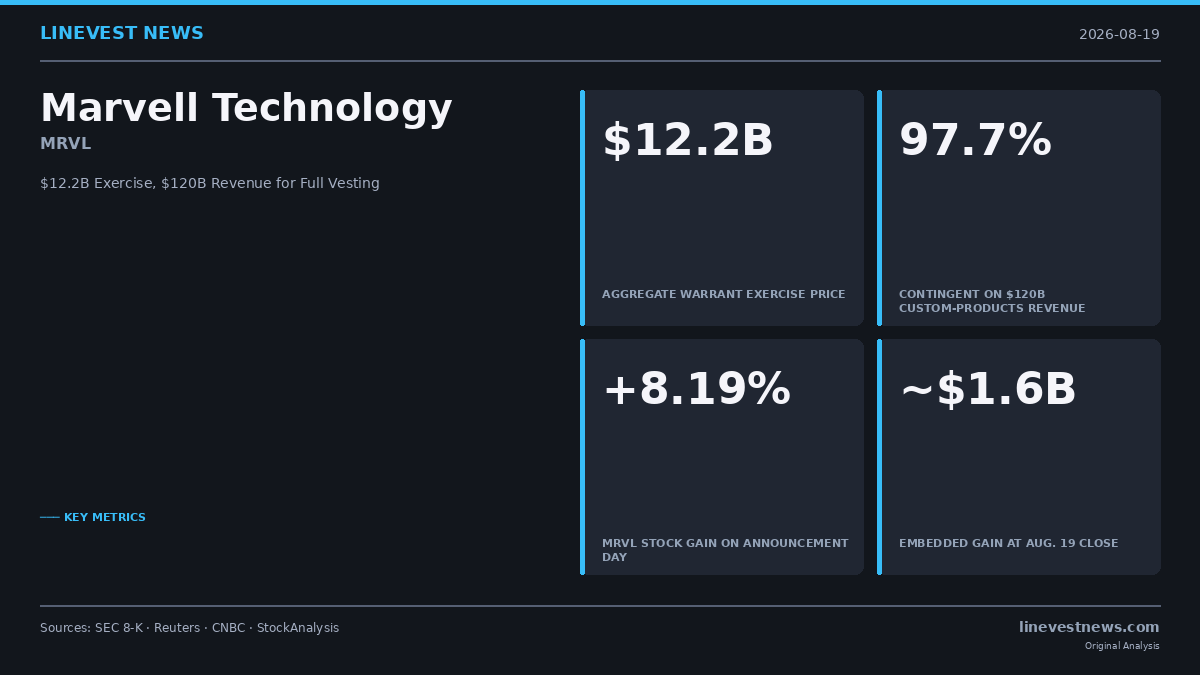
TL;DR - Marvell Technology issued Google a warrant covering 58.97M shares at $206.58 each — a $12.2B aggregate exercise price — tied to a new custom-chip supply agreement disclosed Aug. 19. - 97.7% of the warrant vests incrementally: one tranche per $500M of custom-chip revenue Marvell books from Google, with full vesting requiring $120B in such revenue over roughly 6.5 years. - At Marvell's Aug. 19 close of $233.68, the warrant carried roughly $1.6B in embedded gain — about one-eighth of the aggregate exercise price. - A 2.3% time-vested block (1.36M shares) vests in quarterly installments over year one regardless of purchases; the remaining 97.7% depends entirely on Marvell's revenue from Google.
The $12.2 billion figure in Marvell Technology's expanded chip agreement with Google is the aggregate exercise price — what Google would pay in total to acquire all 58.97 million shares the warrant covers. At Wednesday's close the embedded gain was roughly $1.6 billion, and nearly all of it accumulates in proportion to how much custom-chip revenue Marvell books from Google, up to a ceiling of $120 billion.
Marvell Technology (NASDAQ: MRVL), a Santa Clara, California-based designer of custom data-center, networking and storage silicon, disclosed the arrangement in a Form 8-K — the filing public companies use to report material events between quarterly reports — submitted to the SEC on Wednesday. Wire coverage led on the size of the headline figure. The filing leads on something else: a vesting schedule that ties equity delivery to revenue milestones, making the package a conditional rebate rather than an upfront payment.
The distinction matters because the two readings imply different things about who conceded what. An outright stock grant is a cost the supplier bears immediately. A right to buy stock at a fixed price is a cost the supplier bears only if its own shares appreciate, and appreciation here would be driven largely by the revenue that triggers the vesting.
What the filing actually says
Marvell and Google LLC signed the commercial agreement on July 29 and issued the warrant three weeks later, on Aug. 19, according to the 8-K. The instrument covers up to 58,970,907 shares at an exercise price of $206.58 each.
Multiply the two and the product is the number the wires rounded off — an aggregate exercise price, not a valuation of anything Google now owns. A warrant is a contractual right to buy newly issued shares at a fixed price. Whatever it eventually proves worth is the difference between that fixed price and wherever the shares trade on the day it is exercised.
The vesting schedule is where the story sits, and the filing splits the warrant in two.
First, a block of 1,360,867 shares (2.31% of the total) vests in approximately equal quarterly installments over the first year — unconditionally, regardless of any purchases by Google. Each quarterly installment is approximately 340,217 shares, subject to minor rounding in the underlying agreement.
Second, the remaining 57,610,040 shares (97.69%) constitute the contingent block. This portion vests "in 240 equal tranches, with one tranche vesting for each $500 million in Custom Products revenue," the filing states — meaning revenue that Marvell itself books from Google and its affiliates, not merely orders placed. Each tranche covers approximately 240,042 shares, subject to rounding.
That vesting window runs from Marvell's third fiscal quarter of 2027 through the end of fiscal 2033. Full vesting of the contingent block therefore requires 240 × $500M = $120 billion in qualifying custom-products revenue. Reuters put the same figure at "roughly $120 billion" in its coverage.
Vesting is incremental, not binary: at $60B of cumulative qualifying revenue, 120 tranches — representing approximately 28.8 million shares, or 48.8% of the full warrant — would have vested. The $120B figure is the point of full vesting, not a minimum threshold that must be crossed before any contingent shares vest.
None of that revenue is committed. The filing calls the qualifying purchases "discretionary." Google has acquired an option on a phased discount, not signed a binding order book, while Marvell has issued equity against a schedule whose pace Google alone sets. That asymmetry is the substantive term here.
Key figures at a glance
| Metric | Value | Source |
|---|---|---|
| Warrant shares | 58,970,907 | SEC 8-K |
| Strike price | $206.58/share | SEC 8-K |
| Total exercise price | ~$12.2B | LineVest calc. |
| Time-vested block | 1,360,867 shares (2.31%) | SEC 8-K |
| Contingent block | 57,610,040 shares (97.69%) | LineVest calc. |
| Revenue trigger per tranche | $500M custom-products revenue | SEC 8-K |
| Total contingent tranches | 240 | SEC 8-K |
| Full-vesting revenue milestone | ~$120B | Reuters/LineVest calc. |
| Vesting window | Q3 FY2027 – end of FY2033 | SEC 8-K |
| MRVL close Aug. 19 | $233.68 (+8.19% vs Aug. 18) | StockAnalysis |
| Embedded gain at close | ~$1.6B | LineVest calc. |
Whether $120 billion is a stretch depends on the denominator
It is a large number for a company of Marvell's size. Marvell reported $8.19 billion of total revenue in fiscal 2026, per its Form 10-K filed with the SEC. Full vesting therefore requires roughly fourteen and a half times the company's entire most recent annual revenue — from one customer, in one product family.
Spread across a vesting window of about six and a half years, that is on the order of $18 billion a year of Google custom-product revenue alone. Marvell's most recent quarter produced $2.42 billion of revenue in total, per the company's May results release (Q1 FY2027). The schedule implies Marvell building a Google business roughly twice the size of everything it currently sells.
But Marvell's revenue base is the wrong yardstick for a deal like this. Google's spending is the right one. Alphabet (NASDAQ: GOOGL) raised full-year capital-expenditure guidance in July to $195–205 billion and told investors roughly 60% of that money goes to servers. Against server spending on that scale, the implied $18B annual pace works out to roughly one dollar in six or seven — at this year's budget, which Alphabet said on the same call would rise significantly next year.
What each $500 million in revenue actually buys
Divide the contingent shares by the number of tranches: every $500 million of qualifying revenue earns Google the right to buy approximately 240,042 shares at the fixed strike.
Marvell closed Wednesday at $233.68, up 8.19% from the Aug. 18 prior close of $216.00, per StockAnalysis. At that price a single tranche carries roughly $6.5 million of embedded gain — a little over a penny on the dollar against the revenue that triggered it.
Run the same arithmetic across the whole warrant and the embedded gain at close comes to roughly $1.6 billion, against the $12.18 billion Google would have to pay to collect it all. The headline and the present economics differ by nearly a factor of eight.
None of this makes the warrant trivial. Its value is a geared claim on Marvell's own share price, and the instrument runs for years. What it is not is a discount on today's invoice. A buyer seeking a price concession takes it on the invoice; a buyer taking it in warrants accepts that the concession only materialises if the supplier's stock does well — which tends to happen when the buyer keeps buying.
Equity-linked supply agreements have become the standard grammar of AI infrastructure procurement, because both sides are short of something. The buyer wants guaranteed capacity and a supplier with reason to prioritise its roadmap. The supplier wants a demand signal large enough to justify the engineering headcount a custom program consumes. Neither gets that from a purchase order alone.
AMD wrote the template ten months ago, at a very different price
On October 5, 2025, Advanced Micro Devices (NASDAQ: AMD) issued OpenAI a warrant for 160,000,000 shares at an exercise price of $0.01 per share, according to the warrant agreement filed as an exhibit to AMD's current report with the SEC. That warrant also vests against purchase milestones.
Exercising the entire AMD instrument costs $1.6 million. Exercising Marvell's costs $12.18 billion. Both deals tie vesting to purchases; only one also asks the customer to pay something close to market price for the shares.
Marvell's strike of $206.58 sits about 4.4% below the Aug. 18 prior close of $216.00 — a discount, but a narrow one. In the equity-for-revenue deals that have defined the past year of AI supply agreements, the customer has more often been compensated in near-free stock. Marvell asked for close to full price.
The partner count just changed
Five weeks ago, LineVest described Google's Tensor Processing Units as designed "with Broadcom" — a single silicon partner. The Aug. 19 filing places Marvell inside the same TPU ecosystem, spanning AI inference accelerators, storage controllers, network interface controllers, memory interface controllers and near-memory compute.
Whether that is displacement or expansion is the live disagreement. Morningstar analyst William Kerwin called the deal "a big win for Marvell" but framed it as "a growing pie at Google for new sources, rather than a competitive displacement of Broadcom," in comments reported by Reuters. Broadcom (NASDAQ: AVGO), which co-designs Google's TPUs, fell on the day; Alphabet was little changed.
There is a straightforward reason the two chipmakers moved in opposite directions while the customer barely moved at all. A custom-silicon program of this scope is close to the whole story for a company of Marvell's size, a fraction of the story for Broadcom, and for Google a procurement decision inside a budget that dwarfs both.
Two further terms bound what Google can do with the position. The warrant "may not be transferred other than to controlled affiliates without the Company's consent," and while the underlying shares are freely tradeable, the filing subjects them to "specified trading volume restrictions" and, for the time-vested block, "certain lock-up limitations."
What would make this reading wrong
The view that the milestones are demanding could be mistaken. If Alphabet's capital spending compounds at anything like the pace its own guidance implies, a target set against today's budget stops being a stretch and becomes a schedule — the tranches would vest on the arithmetic of a growing denominator rather than on any competitive win by Marvell. In that case the warrant is not a performance hurdle. It is a pre-agreed transfer priced to look like one.
The specific thing to watch is narrow. The milestone clock does not start until Marvell's third fiscal quarter of 2027, which began in August 2026, so no purchase-linked tranche can vest before the results covering that period are reported. The question for that report is whether Marvell discloses "Custom Products revenue" as a separate line.
The second unresolved item is on Marvell's own books. The 8-K describes at length what Google receives and says nothing about what the warrant costs Marvell in reported results. That disclosure belongs in a quarterly filing — the same document class that will also contain the first revenue figures against which the tranche schedule runs.
The pattern across this year of announcements is that the release states the ceiling and the filing states the conditions. Both are accurate; only one is contingent, and it is the ceiling that travels. Anyone weighing what a supply agreement is worth is better served by the vesting schedule.
Sources: SEC 8-K (Marvell Technology, filed Aug. 19, 2026); Marvell Form 10-K FY2026 (SEC EDGAR); Marvell Q1 FY2027 earnings release (BusinessWire, May 27, 2026); Alphabet Q2 2026 earnings call (Investing.com transcript); AMD–OpenAI warrant agreement (SEC Exhibit 4.1); Reuters; CNBC; Yahoo Finance; StockAnalysis.
This article is journalism, not investment advice. LineVest is not a registered investment adviser and does not recommend the purchase or sale of any security.