TL;DR
- The SEC on August 21, 2026 charged Jason Satsky, former co-head of Bank of America's Americas power and renewable energy banking, and his friend Gavin Wolfe of Evergreen Capital with insider trading in South Jersey Industries stock.
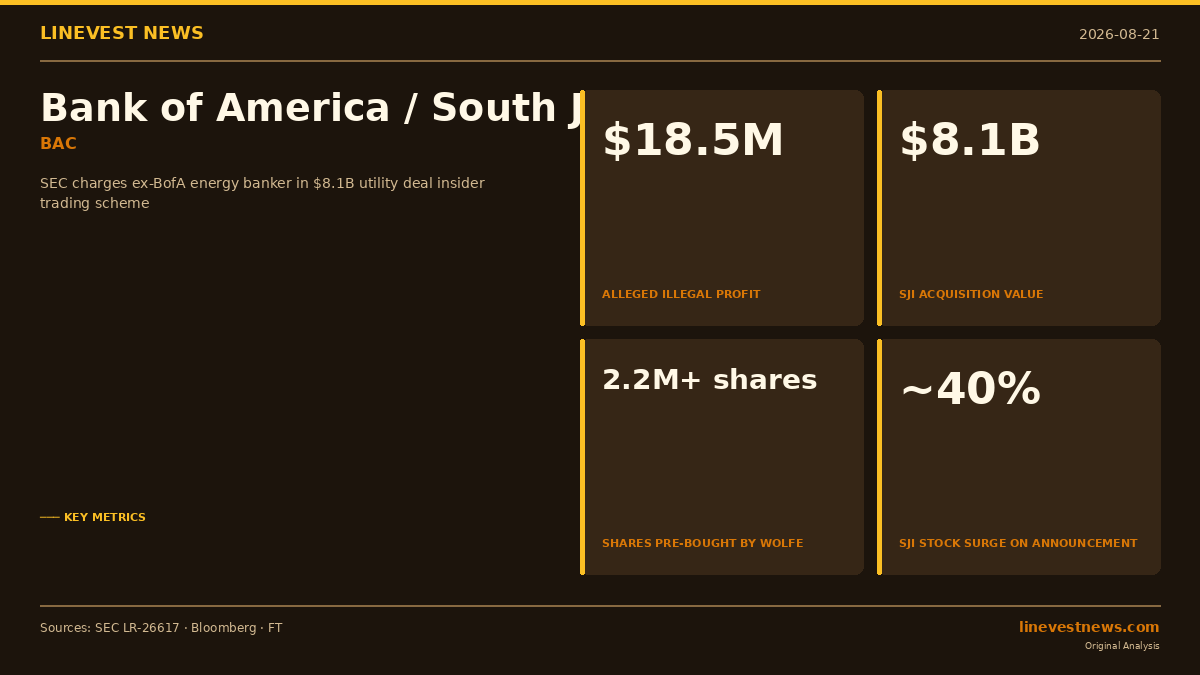
- Wolfe bought over 2.2 million SJI shares — a $53 million bet — after Satsky allegedly tipped him about a pending $8.1 billion acquisition; the stock surged sharply on announcement, with Wolfe allegedly netting approximately $18.5 million in profits.
- Wolfe also tipped associates who pocketed an additional $515,000; eight Wolfe-affiliated entities are named as relief defendants in the Southern District of New York complaint (1:26-cv-07132).
- Bank of America terminated Satsky in March 2025 and faces no accusations itself; the SEC seeks permanent injunctions, civil monetary penalties, and officer-and-director bars against both defendants; disgorgement of profits is sought against Wolfe and the eight relief-defendant entities.
Part A — What the SEC Filed
On August 21, 2026, the Securities and Exchange Commission filed a civil fraud complaint in the U.S. District Court for the Southern District of New York (Case 1:26-cv-07132) against two former Wall Street investment bankers: Jason Satsky and Gavin Wolfe.
The Defendants
| Name | Role | Background |
|---|---|---|
| Jason Satsky | Defendant / Tipper | Ex-Co-Head, Americas Power and Renewable Energy Banking, Bank of America; lead banker on the SJI deal |
| Gavin Wolfe | Defendant / Tippee | Founder and principal of Evergreen Capital LP; former Credit Suisse power and renewable energy banker; longtime friend and former colleague of Satsky |
The two shared a long professional history in energy banking. Satsky joined Bank of America in 2012; Wolfe had previously worked at Credit Suisse before founding Evergreen Capital.
The Deal Behind the Trades
In 2021, Bank of America was advising South Jersey Industries (SJI) — a New Jersey-based energy holding company serving natural gas customers — on a potential privatization transaction. The buyer was the Infrastructure Investments Fund (IIF), a vehicle managed by J.P. Morgan Asset Management.
On February 24, 2022, SJI and IIF publicly announced the acquisition: IIF would take SJI private at $36 per share in cash, representing an enterprise value of approximately $8.1 billion. The deal cleared all regulatory hurdles and closed on February 1, 2023.
The Alleged Scheme
According to the SEC complaint, Satsky — as the lead banker on the SJI transaction — possessed material nonpublic information (MNPI) about the pending deal. The SEC alleges that in November 2021, Satsky disclosed that information to Wolfe during a basketball game.
Armed with that tip, Wolfe moved quickly. Between November and December 2021, he purchased more than 2.2 million shares of SJI stock at a total cost of approximately $53 million — an enormous concentration bet on a single mid-cap utility stock — spread across eight affiliated entities he controlled.
When SJI's acquisition was announced on February 24, 2022, the stock price surged sharply on the news of the $36-per-share deal. The SEC alleges that Wolfe's trades generated a profit of approximately $18.5 million. The complaint does not specify Wolfe's exact exit timing or price; the $18.5 million gain on a roughly $53 million position implies an average exit price well below the $36 per-share deal price, consistent with a sale shortly after the announcement rather than at deal close.
Wolfe is also alleged to have tipped his own associates, who earned additional profits of approximately $515,000.
SEC Charges and Remedies Sought
The complaint charges both defendants with violating Section 10(b) of the Securities Exchange Act of 1934 and Rule 10b-5 thereunder — the foundational antifraud provisions that prohibit trading on material nonpublic information.
- Against both: permanent injunctions, civil monetary penalties, and officer-and-director bars (as stated in the SEC complaint)
- Against Wolfe: disgorgement of ill-gotten gains plus prejudgment interest
- Against Satsky: a conduct-based injunction restricting future advisory activities
Eight Wolfe-affiliated entities are named as relief defendants and are subject to disgorgement: Evergreen Capital LP, Evergreen Financial LLC, Empire Property Management LLC, GAW Holdings LLC, SA 1055 LLC, SA 1057 LLC, SA 1082 LLC, and SA 1083 LLC.
Bank of America was not accused of any wrongdoing. The bank terminated Satsky in March 2025.
Part B — What This Case Means for Investors
1. The Anatomy of an Advisory-Room Leak
This case fits a recurring template in SEC enforcement: a senior M&A banker with access to board-level deal information passes that information to a close friend who can trade. The key legal elements are clear:
- Satsky owed a duty of confidentiality to Bank of America and its client, SJI.
- Wolfe knew or should have known that the tip originated from a breach of that duty.
- The trades were made on the basis of the MNPI.
The SEC's tippee-liability theory traces to Dirks v. SEC (1983) and Salman v. United States (2016): a tippee — an outsider who trades on information received from an insider — is liable when he knows or has reason to know that the insider disclosed the information in breach of a fiduciary duty. Under United States v. O'Hagan (1997), the misappropriation theory additionally holds that a person who trades on confidential information taken from the person or entity to whom he owes a duty of confidentiality — here, Bank of America and its client — violates Section 10(b). The SEC complaint charges both defendants under Exchange Act Section 10(b) and Rule 10b-5.
2. A Nearly Five-Year Gap Between Trading and Charges
The alleged trades occurred in late 2021; the SEC complaint was filed in August 2026 — nearly five years later. This lag is characteristic of how insider trading investigations unfold:
- Detection — The SEC's market surveillance flags unusual equity or options activity ahead of major corporate events.
- Document subpoenas — The agency issues subpoenas to brokerages, requiring trading records and communications.
- DOJ coordination — Parallel criminal investigations frequently run alongside civil SEC proceedings, slowing disclosure timelines.
The long gap also explains why bank termination preceded charges: BofA terminated Satsky in March 2025, while the formal SEC complaint followed more than a year later.
3. BofA's Exposure: Limited but Real
Bank of America (BAC) faces no charges in this matter. However, the case has reputational dimensions that investors should consider:
- Adviser banks bear reputational risk when insiders trade on deal information, even when the institution is cleared.
- Clients evaluating financial advisers now have reason to scrutinize how information security walls are enforced in practice.
- BAC's stock is not materially impacted by this enforcement action. The bank reported net income of $9.1 billion in Q2 2026 (per its Q2 2026 earnings release), and its regulatory exposure here is limited to the reputational dimension of having had a senior banker named in an SEC complaint.
4. Implications for Utility Sector M&A Investors
The SJI transaction was one of the larger U.S. utility privatizations of the early 2020s. Infrastructure private equity interest in regulated rate-base utility assets has remained strong through 2025-2026, underpinned by energy transition capital needs and predictable cash flows. Recent large-scale utility privatizations and mergers — where regulated rate-base assets change hands — follow similar patterns.
For investors trading in or around utility M&A situations, this case offers several signals:
| Signal | What It Suggests |
|---|---|
| Unusual volume spikes in utility stocks before announcements | Possible MNPI leakage; monitor SEC litigation releases |
| Shell-company trading structures | SEC uses relief-defendant mechanism to pierce entity barriers |
| Long regulatory approval timelines | Extends deal-risk period post-announcement (MNPI itself ends at public announcement; post-announcement risk is deal-break risk, not MNPI) |
| High acquisition premiums | Larger spreads between pre-announcement and deal price incentivize front-running attempts |
The SJI deal illustrates this dynamic: originally expected to close in Q4 2022, it required New Jersey Board of Public Utilities approval not granted until January 25, 2023. However, the period during which Wolfe held MNPI — from the alleged November 2021 tip through the February 24, 2022 public announcement — was approximately three months. Bank of America had been advising SJI earlier in 2021, so the bank's own MNPI obligations began before the tip; but Wolfe's insider-trading exposure was bounded by when he received the tip. After the public announcement, the information was no longer nonpublic, though deal-break risk remained until closing in February 2023.
5. The SEC's 2026 Enforcement Posture
The Satsky-Wolfe complaint comes against a broader enforcement backdrop. Earlier in 2026, the SEC brought charges against multiple defendants in a separate wide-reaching insider trading scheme (SEC press release 2026-44), signaling that market surveillance and enforcement activity has not diminished. The agency has integrated options-market scanning with equity surveillance to detect pre-announcement positioning more efficiently.
The consistent message: capital market integrity enforcement remains active regardless of shifts in broader agency priorities.
6. The Relief Defendant Structure: Piercing the Entity Veil
The use of eight legal entities as relief defendants is instructive. Wolfe channeled his trades through Evergreen Capital LP and a constellation of LLC vehicles — a structure that spreads positions across multiple legal entities and may have been designed to fragment the visible size of the overall bet.
The SEC's decision to name all eight as relief defendants signals that it will pursue disgorgement from every entity that received proceeds, regardless of whether that entity itself made the trading decision. Courts have held that relief defendants — parties with no legitimate independent claim to the funds they received — must disgorge ill-gotten gains even without a finding of primary liability.
For investors, this reflects how sophisticated financial actors use entity structuring to manage legal exposure — and why the SEC increasingly uses the relief-defendant mechanism to pursue full disgorgement across the entire proceeds chain.
Based on: SEC Litigation Release LR-26617 (August 21, 2026); Civil Complaint 1:26-cv-07132, SDNY; and reporting from Bloomberg, the Financial Times, and Reuters. The charges are allegations; no defendant has been adjudicated guilty. This article is for informational purposes only and does not constitute investment or legal advice.