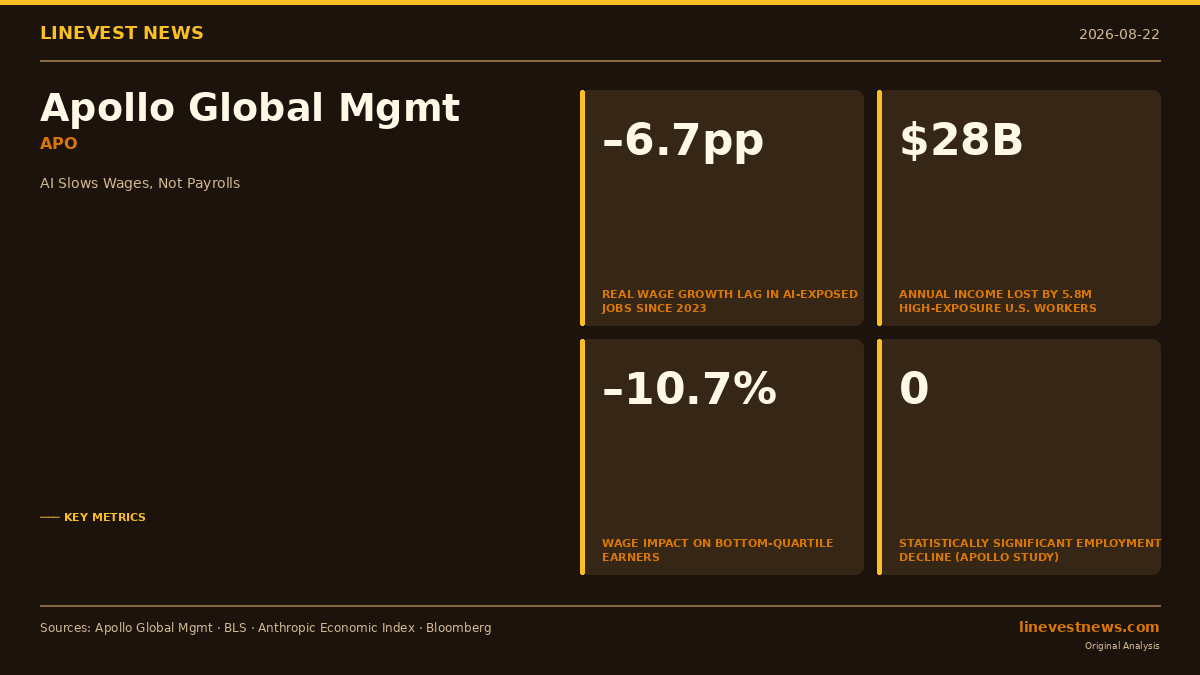
TL;DR - Apollo Global Management published research on July 30 showing AI suppresses wage growth in high-exposure jobs, with no statistically significant employment decline - Workers in high AI-exposure roles saw real wage growth come in 6.7 percentage points lower than less-exposed peers in the post-2023 period — a differential measured across the full post-2023 period - Apollo estimates approximately 5.8 million workers in 11 high-exposure occupations have collectively missed roughly $28 billion in annual pay versus pre-2023 wage trends — a figure Apollo derives from the accumulated 6.7pp gap applied to the cohort's annual wage base - The burden falls disproportionately on lower-income workers within affected occupations; service workers show the sharpest relative decline; top-quartile earners show no statistically significant effect
Part A — The Research
On July 30, Apollo Global Management Chief Economist Torsten Slok and Sania Edlich published a white paper — "The Impact of AI on the U.S. Labor Market" — examining 321 U.S. occupations to quantify AI's early labor-market footprint. The headline finding: artificial intelligence is suppressing wage growth in exposed jobs, not eliminating positions.
Using a difference-in-differences methodology with occupation and year fixed effects applied to Bureau of Labor Statistics (BLS) wage data from 2015 to 2025, the authors matched occupations to the Anthropic Economic Index (AEI), which classifies anonymized Claude conversation logs against O*NET occupational task descriptions to estimate AI usage intensity by occupation.
Key Findings
After 2023 — when generative AI adoption accelerated sharply — occupations with the highest AI usage saw real wage growth come in 6.7 percentage points lower than less-exposed occupations, measuring the total cumulative differential in the post-treatment period. Employment levels in those same occupations showed no statistically significant decline; the model could not detect a measurable headcount reduction, though this finding does not distinguish between stable hiring and slower hiring growth that would not appear as a headcount level decline.
The study covers 11 high-exposure occupations including computer programmers, customer service representatives, and financial analysts. Apollo's estimates for the affected cohort:
| Metric | Apollo Estimate |
|---|---|
| Workers in high-exposure occupations | ~5.8 million |
| Annual foregone pay vs. pre-2023 trend | ~$28 billion |
| Real wage growth lag vs. peers (post-2023) | –6.7 percentage points |
Note: Apollo derives the $28 billion annual shortfall by applying the accumulated 6.7pp wage growth gap to the affected cohort's wage base — meaning wages in these occupations are now approximately 6.7% below where pre-2023 trend growth would have placed them, and that shortfall amounts to roughly $28 billion per year across 5.8 million workers.
Who Bears the Brunt
The wage growth slowdown concentrates at the lower end of the income scale within affected occupations. Workers in the bottom income quartile experienced a substantially larger slowdown than those in higher-pay tiers, while workers in the top income quartile of the same affected occupations showed no statistically significant wage growth differential. Among occupation sub-groups, service workers showed the sharpest relative decline, though Apollo notes this sub-group carries a small sample size.
Diane Gherson, former Chief Human Resources Officer at IBM, was quoted in Bloomberg's August 22 coverage of this research noting that companies are deciding whether to capture AI-driven efficiency gains through "layoffs, slower hiring, or reskilling." The Apollo employment data does not resolve which path companies have taken — it only establishes that existing headcount levels have not fallen by a statistically detectable margin.
Part B — Investment Analysis
Who Captures the Productivity Gain?
The Apollo findings describe a structural dynamic: companies deploying AI are capturing productivity gains as profit rather than distributing them to workers through higher wages. For equity investors, this is the core takeaway — AI adoption is a potential margin event for high-adopting firms, not (yet) a meaningful headcount reduction story.
High-exposure occupations are concentrated in enterprise technology, financial services, and large customer-service operations. Firms in those sectors stand to accumulate the labor-cost benefit the Apollo model describes, compounding quarter over quarter as AI adoption deepens. The appropriate investor test is whether these firms are reporting labor cost outperformance relative to peers — a check most visible in operating margin commentary during earnings calls.
Federal Reserve Implications
The BLS reported nominal average hourly earnings (AHE) grew +3.2% year-over-year in July 2026. In real terms, average hourly earnings declined 0.2% from July 2025 to July 2026 after adjusting for inflation — broadly consistent with a labor market where AI-exposed workers are losing ground in real purchasing power. The Fed's 2% target is anchored to headline PCE; real AHE and PCE move on different deflators but the directional signal is similar.
The September 15–16 FOMC meeting will be the next scheduled policy decision, informed by the August jobs report due September 4. Further softening in either nominal or real AHE would add to the data case for a 25-basis-point cut at September or at the subsequent October 27–28 or December 8–9 meetings.
Sector Investment Read-Through
Beneficiaries: AI-intensive employers
Technology companies and financial services firms with high AI usage in programmer, analyst, and customer service roles are best positioned to capture the labor-cost suppression the Apollo study describes. Slower real wage growth for these roles translates directly into potential operating income outperformance versus lower-adoption peers. Watch Q3 2026 earnings commentary on wage trends and AI deployment progress for real-world validation of the model.
Risk: Lower-income consumer spending
Workers in the bottom income quartile of high-exposure occupations bear the sharpest real wage slowdown. This cohort drives a substantial share of spending on discount retail, fast-casual food, and essential services. A structural drag on lower-income real wage growth — separate from cyclical consumer softness — may weigh on same-store sales trends in those categories.
Workforce friction risk
A survey by Writer and Workplace Intelligence, conducted in April 2026 among 1,200 U.S., U.K., and European employees (and 1,200 C-suite executives), found that 29% of employees admitted to actively sabotaging their company's AI strategy — rising to 44% among Gen Z workers. Reported behaviors included refusing mandated tools, opting out of AI training, and tampering with performance metrics. For companies projecting AI cost savings to investors, adoption friction at this scale is a material execution risk.
Partial offset: Business formation
Slok and Edlich note that AI adoption is also facilitating new business formation, as entrepreneurs can now launch ventures at lower capital cost. Any employment offset from new venture creation, however, remains a lagging development not yet visible in aggregate payroll statistics.
Three Watch Points for Investors
- September 4 Jobs Report (AHE): Sustained softening in real AHE would reinforce the AI wage compression thesis and add to the case for a rate cut at the September 15–16 meeting or at the subsequent Q4 October 27–28 or December 8–9 meetings.
- Q3 2026 Earnings — Labor Cost Commentary: Management commentary on wage trends in programmer, analyst, and customer service roles will provide a real-world check on whether the Apollo model's wage suppression is appearing in actual corporate cost structures.
- AI Adoption Data: Updates to corporate AI adoption surveys and commentary on workforce uptake. A rising sabotage or non-compliance rate would signal execution friction that could limit the productivity gains companies have modeled.
Sources: Slok, T. & Edlich, S., "The Impact of AI on the U.S. Labor Market," Apollo Global Management (July 30, 2026); Bureau of Labor Statistics — Employment Situation Summary July 2026; BLS — Real AHE July 2025–2026; Anthropic Economic Index; Bloomberg (August 22, 2026); Writer / Workplace Intelligence survey (April 2026), via Fast Company (April 2026).
This article is for informational purposes only and does not constitute investment advice.