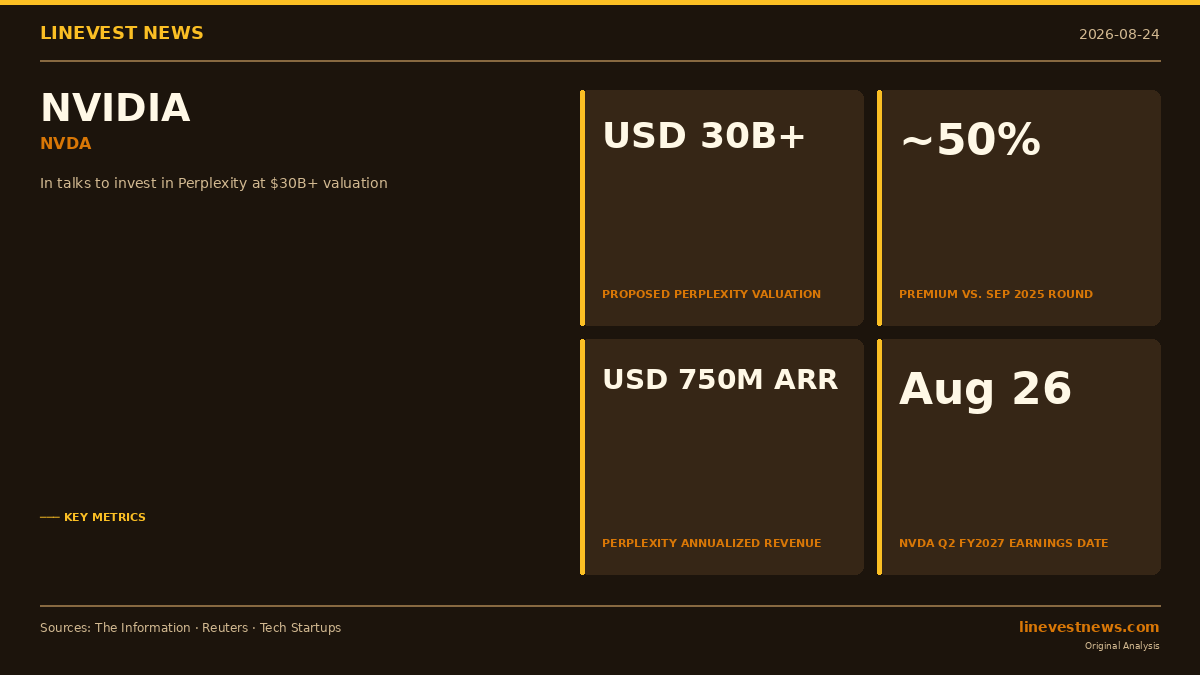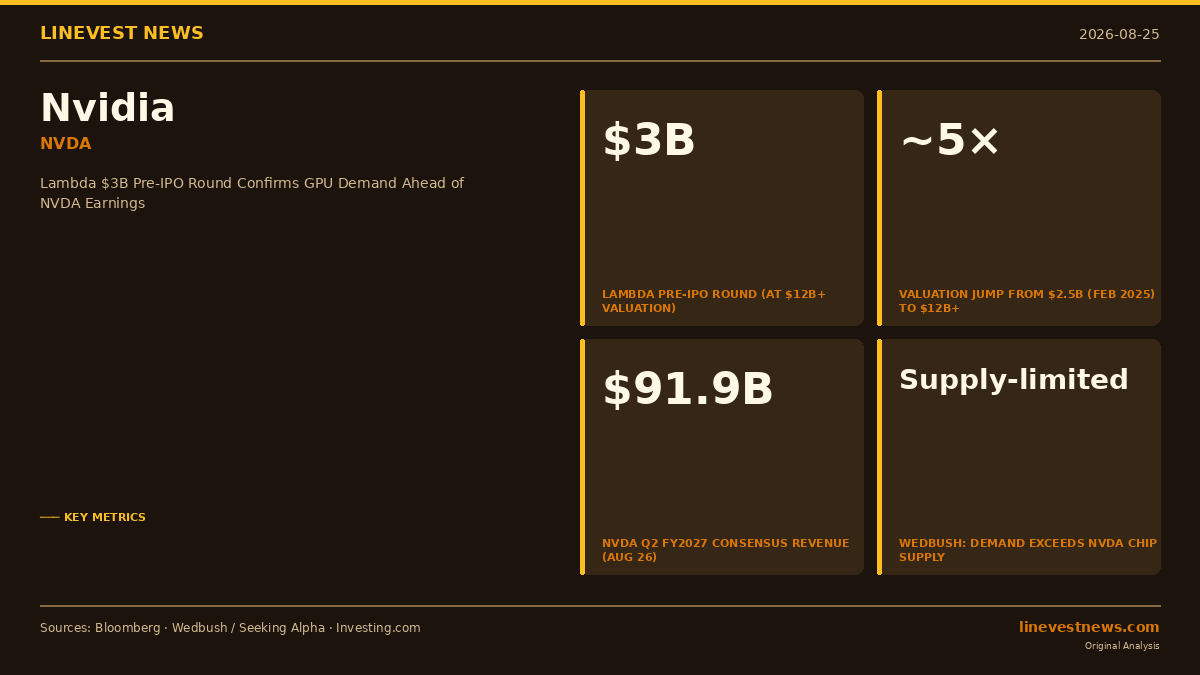
TL;DR - Lambda, an NVIDIA-backed AI cloud provider, is in talks to raise $3 billion in a pre-IPO round that would value the company at $12 billion or more, per Bloomberg (Aug. 24) - That $12 billion figure is nearly 5× Lambda's $2.5 billion valuation from its Series D round in February 2025 — an 18-month re-rating that tracks the AI infrastructure build-out - Lambda's total revenue is on track to exceed $1 billion in FY2026, up from $505 million annualized as of May 2025 - NVIDIA reports Q2 FY2027 earnings on August 26 — two days after the Lambda announcement — with consensus expecting $91.9 billion in revenue and $2.08 EPS; Wedbush says supply, not demand, is the only constraint - Lambda's fundraise at a high revenue multiple is independent evidence that AI GPU demand remains structurally undersupplied — the core bullish thesis for NVDA heading into Wednesday's print
Lambda's $3 Billion Bet on the GPU Cloud Race
Lambda Inc., one of the largest independent providers of GPU-based AI cloud infrastructure in the United States, is in advanced discussions to raise as much as $3 billion in a pre-IPO financing round, Bloomberg reported on August 24. The deal is being structured to support Lambda's planned public offering, which the company is targeting for 2027 with Morgan Stanley, JPMorgan Chase, and Citigroup serving as underwriters.
The round would value Lambda at $12 billion or more — a figure that stands in stark contrast to the $2.5 billion post-money valuation the company commanded during its Series D in February 2025. That nearly 5× re-rating in approximately 18 months is not simply a function of market exuberance. Lambda's underlying revenue has grown in tandem.
Lambda's total annualized revenue stood at $505 million as of May 2025, according to Sacra research, up from $425 million at end-2024. For FY2026, the company projects total revenue surpassing $1 billion. The company operates clusters of 16,000 or more GPUs across data centers powering AI training and inference workloads, with a current power footprint of approximately 47 megawatts and a long-term target of 3 gigawatts by 2030.
NVIDIA as Customer — and as Proof of Concept
Lambda's single largest customer is NVIDIA itself. The chip giant has signed two major infrastructure agreements with Lambda: a four-year, $1.3 billion lease for GPU server capacity, plus a separate $200 million agreement for additional Blackwell-generation server capacity. In total, NVIDIA has committed roughly $1.5 billion in GPU-cloud leaseback arrangements with Lambda — using Lambda's data center capacity to fulfill demand it cannot serve directly.
That arrangement is notable not just for its size, but for what it signals. NVIDIA, the world's leading GPU manufacturer, is renting back capacity from a company it supplies. This dynamic — a supplier becoming a major customer — underscores how supply-constrained the AI cloud market remains.
Lambda is also a launch partner for NVIDIA's Vera CPU platform and Blackwell Ultra GPU systems, announced at NVIDIA GTC 2025. Other major cloud computing companies including Microsoft and Amazon are also significant Lambda customers.
Lambda vs. CoreWeave: A Valuation Spread Worth Watching
| Metric | Lambda | CoreWeave (CRWV) |
|---|---|---|
| Valuation | ~$12B (target, pre-IPO) | ~$35B (public) |
| IPO Date | Targeted 2027 | March 2025 |
| FY2026 Revenue (est.) | >$1B | ~$11–12B |
| Gross Margin | ~61% | ~74% |
| Forward Revenue Multiple | ~12× | ~3× |
CoreWeave went public in March 2025 at a $23 billion valuation and has since appreciated to approximately $35 billion. At roughly $11–12 billion in FY2026 consensus revenue, CoreWeave trades at approximately 3× forward revenue. Lambda's $12 billion target against approximately $1 billion in FY2026 revenue implies a 12× forward multiple — four times CoreWeave's multiple.
That premium is not justified by relative growth rates: CoreWeave has expanded at a faster pace than Lambda in recent years. Lambda's case for a higher multiple rests instead on its significantly lower net losses relative to revenue. CoreWeave reported net losses of approximately $314 million in a single quarter around its IPO period; Lambda's comparable losses have been substantially smaller, suggesting a more capital-efficient operating model at its current scale.
What Lambda's Round Means for Nvidia's August 26 Print
Lambda's fundraising announcement arrives 48 hours before NVIDIA reports fiscal Q2 2027 results. The timing is coincidental, but the signal is not.
The consensus setup: Wall Street expects NVIDIA to report approximately $91.9 billion in Q2 FY2027 revenue, against the company's own guidance of $91 billion (±2%). Non-GAAP EPS is forecast at $2.08. For Q3 FY2027, analysts are modeling $103.96 billion in revenue. The prior-year comparable — Q2 FY2026 (May–July 2025) — came in at $46.74 billion, putting the year-over-year growth implied by consensus at approximately +97%.
| Quarter | Revenue | YoY Growth |
|---|---|---|
| Q2 FY2026 (Actual) | $46.74B | — |
| Q2 FY2027 (Consensus) | $91.9B | ~+97% |
| Q3 FY2027 (Consensus) | $103.96B | ~+82% |
Wedbush's view: Wedbush has stated publicly that NVIDIA will exceed its guidance — but the limiting factor is supply, not demand. A supply-constrained business is one where pricing power is structurally preserved: whatever NVIDIA ships finds immediate buyers at existing prices. That dynamic supports gross margin stability, which is the real swing factor heading into Wednesday.
The gross margin moat: NVIDIA's gross margin has stabilized near 73–74% even as Blackwell production ramps. Analysts have flagged 73.5% as the key monitoring level: compression toward or below that threshold would signal that hyperscalers are negotiating harder or that NVIDIA GPU alternatives — including AMD's MI-series and custom silicon from Broadcom and Marvell — are beginning to erode pricing power. Lambda's willingness to raise at a 12× revenue multiple — with NVIDIA as its largest customer — is an implicit vote of confidence that GPU pricing remains firm enough to generate returns on that capital.
Three things to watch on August 26:
Data center revenue — NVIDIA's data center segment has accounted for approximately 88% of total revenue in recent quarters. Watch for any acceleration or deceleration in this segment as a share of the revenue mix.
Gross margin — The key threshold is 73.5%. A move materially below that level would be the headline number investors scrutinize most.
Q3 guidance — The consensus of $103.96 billion represents a high bar. Guidance meaningfully above that figure would be the bullish signal; a miss versus the consensus level could trigger profit-taking despite a Q2 beat.
China risk: Analysts remain focused on H20 export restrictions and whether the Trump administration's trade policy will tighten or loosen. NVIDIA's commentary on China will be closely parsed, as H20 exports represent an incremental revenue stream not visible in most demand forecasts.
The Structural Picture
Lambda's $3 billion fundraise is one data point in a broader pattern. Over the past 18 months, AI cloud providers have raised capital at valuations that have increased faster than revenue. That gap between valuation appreciation and revenue growth typically raises a yellow flag.
In Lambda's case, the higher valuation multiple versus CoreWeave requires scrutiny. Lambda is priced at roughly 4× CoreWeave's forward revenue multiple while growing more slowly and at smaller scale. The implicit argument is that Lambda's lower net losses per dollar of revenue translate into superior long-run economics — an argument that becomes testable only as the company approaches profitability at scale. The incoming $3 billion in fresh capital will either validate that thesis by funding profitable expansion, or it will be consumed by the same infrastructure spending that has driven losses at every GPU cloud provider.
For NVDA investors, the key takeaway is simple: a company that rents NVDA chips is raising $3 billion at a significant premium in order to rent more NVDA chips. That is a demand signal, not a valuation exercise.
Sources: Bloomberg (August 24, 2026), Sacra Research, Investing.com, Wedbush Securities via Seeking Alpha, TradingKey, NVIDIA GTC 2025 Announcements.
This article is for informational purposes only and does not constitute investment advice. Past performance does not guarantee future results.