Meta Platforms (NASDAQ: META) settled a child-safety case brought by state attorneys general on Wednesday, Aug. 26, and the headlines put the price near $17 billion. The amount Meta is actually committed to paying is $12.1 billion.
The difference is not a rounding artifact. It is a contingency, and Meta does not control it. The remainder is released only if two rival companies make decisions of their own, on their own timetable. That makes a large share of the headline penalty something closer to a conditional promise than a debt.
New Jersey's Attorney General's office described the agreement in its own announcement as "a minimum of $12.1 billion, and up to $17.1 billion." The roughly $5 billion gap is unlocked only if TikTok and Google's YouTube adopt matching youth safeguards and pay comparable penalties, according to Fortune's breakdown of the terms. Almost three of every ten dollars in the headline figure sit behind that condition.
Why every outlet printed a different number
Wednesday's coverage could not settle on a figure, and the state counts disagreed just as sharply. Reporters were pulling different slices from a deal that contains more than one number, and the announcements themselves emphasized different slices.
Three separate things were being counted:
- Floor versus ceiling — reported totals ran from $16.68 billion to $18 billion, because outlets counted different components of the deal rather than anchoring on the $12.1 billion floor.
- States' share versus the whole package — the participating states receive about $12.7 billion, roughly 74% of the total payment, per California Attorney General Rob Bonta's office. That share is measured against the ceiling; it is larger than the committed floor itself.
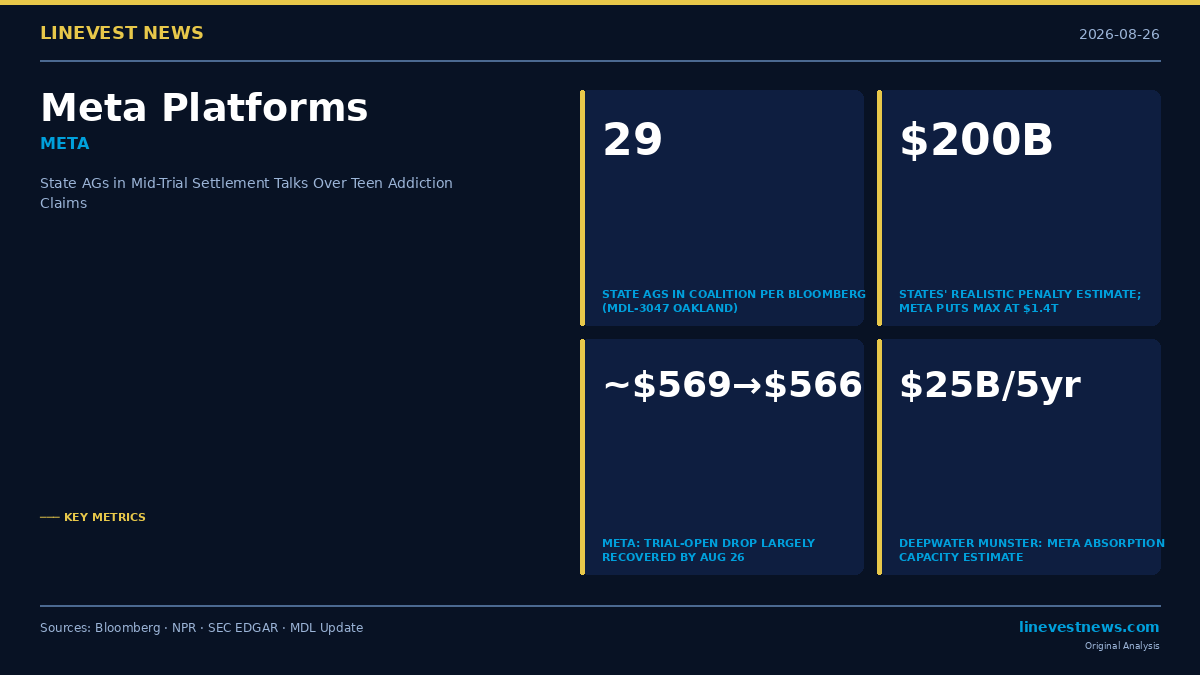
- Which coalition — 29 states took Meta to trial in Oakland, as The Verge reported, but the settlement resolves the claims of 51 jurisdictions.
That last distinction explains much of the confusion in the headlines. The trial plaintiffs were not the same group as the signatories.
The 51 jurisdictions break down as 47 states plus the District of Columbia, Puerto Rico, American Samoa and the Northern Mariana Islands, per the list published by the New Jersey Attorney General's office. Four states led the litigation: California, Colorado, Kentucky and New Jersey, according to NPR. Outlets writing "48 states" were counting those 47 states plus D.C.
Why it matters
Strip away the competing totals and one structural fact remains. Meta has bought certainty about its floor while leaving its ceiling to competitors it does not control.
That is an unusual design for a penalty. Most settlements fix a sum and a schedule, then let the defendant plan around both. This one leaves the final cost, and the final product rules, to decisions made in other boardrooms.
So no single headline number describes this liability. There is a committed obligation and a conditional one, and they resolve on different timetables. The states have built an instrument that tries to move an industry by making one company's terms contagious. Whether it works is an answer TikTok and YouTube will give, not a court.
What the committed number looks like against the income statement
Meta reported revenue of $200.97 billion and net income of $60.46 billion for 2025, figures Fortune cited in its own sizing of the settlement. Measured against those results, the guaranteed payment is smaller than the headline suggests, mostly because it is spread across a decade.
| Measure | Committed ($12.1B) | Maximum ($17.1B) |
|---|---|---|
| Share of 2025 revenue | 6.0% | 8.5% |
| Share of 2025 net income | 20.0% | 28.3% |
| Share of market value (~$1.47T) | 0.8% | 1.2% |
| Average annual payment over 10 years | $1.21B | $1.71B |
LineVest calculations from the figures cited above. Fortune published maximum-case versions of the revenue and profit rows: "about 8.5% of annual revenue" and "roughly 28% of one year's profit."
The market-value row is our own arithmetic, not Fortune's. It measures against the roughly $1.47 trillion capitalization stockanalysis.com recorded for Meta that day.
The final row is the one that reframes the event. Just over a billion dollars a year is close to 2% of a single year's profit at last year's rate. That is a real cost and a manageable one, which is roughly what the trading session concluded.
Meta shares were up about 2.2% at 11:30 a.m. in New York after fluctuating earlier, Insurance Journal reported. The stock held that gain into the close, finishing near $577, per stockanalysis.com.
A modest gain on a day carrying a headline penalty this large says the market priced the floor rather than the ceiling. Investors saw a company escaping a trial at a cost the income statement can absorb. The choppiness earlier in the session suggests that reading took time to form.
The restrictions carry the same contingency as the money
The non-cash terms are the more consequential half of this agreement. Meta agreed to a default daily limit of two hours for users under 18 across Facebook and Instagram, an overnight block from midnight to 6 a.m., and suppressed notifications during school hours on weekdays.
It also agreed to stop showing likes and reaction counts to minors, and to drop cosmetic-procedure filters for younger users, per Bonta's office. The company must offer a feed that is not personalized, build age-assurance measures to find and remove children under 13, and submit to an independent auditor. TechCrunch reported that the daily time limit can be switched off only with a parent's permission.
Here is the part that did not travel in the wire copy. Those limits tighten on exactly the same trigger that releases the extra money. Bonta's office states the daily cap falls from two hours to one if competitors adopt similar terms, and the overnight block widens from midnight–6 a.m. to 10 p.m.–7 a.m. under the same condition.
So the two variables move together, in the same direction, on the same switch. If TikTok and YouTube sign comparable deals, Meta pays more and operates under tighter rules. If they refuse, Meta pays the floor and keeps the looser settings.
Set those two facts side by side and the shape of the deal becomes visible. The cheaper outcome for Meta is also the commercially easier one. That is an unusual way to build a penalty, because it means the least painful branch for the defendant is the branch where its product changes least.
Meta's chief legal officer described the arrangement in public terms. The framework's "success depends on all other social media platforms following Meta's lead," the executive said in remarks reported by NPR, naming TikTok and YouTube directly. Read against the payment schedule, that sentence is doing more than one job.
What we wrote this morning, and what changed
LineVest covered these settlement talks earlier on Wednesday, before any terms were known. That piece reported that state lawyers had told the court $200 billion was a realistic penalty target, and that Meta's own legal team had calculated the states' theories implied $1.4 trillion of maximum exposure.
Against what the states themselves named in court, the committed sum is about 6% of the $200 billion target. Even the full amount reaches only about 8.5%. Measured against Meta's internal worst case, the guaranteed payment is just under 1%.
None of that makes the earlier figure dishonest. Opening demands are not forecasts, and a deal struck in the middle of a trial almost never lands near the number a plaintiff argues for in front of a jury. The distance is worth recording anyway, because that larger figure circulated this month as though it were an estimate rather than a bargaining position.
Precedent, and the machinery still running
The closest precedent is Meta's own. The Federal Trade Commission — the U.S. antitrust and consumer-protection agency — fined the company $5 billion in 2019 over privacy violations, a penalty Fortune cited in its comparison. The committed portion here is roughly 2.4 times that. Fortune separately described the $12.1 billion floor as more than twelve times the second-largest big-tech privacy settlement of the past four years.
Meta admits nothing. In the filing, the company denied the allegations against it and said the deal "did not constitute an admission of liability," per Insurance Journal. NPR reported that those allegations included claims under COPPA, the federal law governing data collection from young children.
Pressure on the companies that control Meta's contingent money has not eased. Pennsylvania Attorney General Dave Sunday sued Snap (NYSE: SNAP), the parent of Snapchat, over child-safety and compulsive-use claims, his office announced Wednesday; the same announcement notes he brought a similar action against TikTok about two weeks earlier. Snap fell roughly 7% on the day, according to Yahoo Finance's market coverage.
Snap is not one of the two companies named in Meta's escalation clause. But the direction of travel matters for whether that clause ever fires. State attorneys general are still filing against Meta's competitors, and every new case changes the arithmetic a rival performs when it decides whether to settle.
What would make this reading wrong
Treating the committed sum as the real number assumes TikTok and YouTube stay out. That assumption could fail quickly. Both companies watched a jury get seated in Oakland, then watched Meta buy its way out in the middle of the trial. A template now exists that did not exist last week.
If either signs a comparable agreement, the floor stops being the operative figure and the teen time limit halves. Anyone anchoring on the lower number should hold it loosely. They should also accept its corollary: the inexpensive outcome is the one in which the product restrictions stay at their weakest.