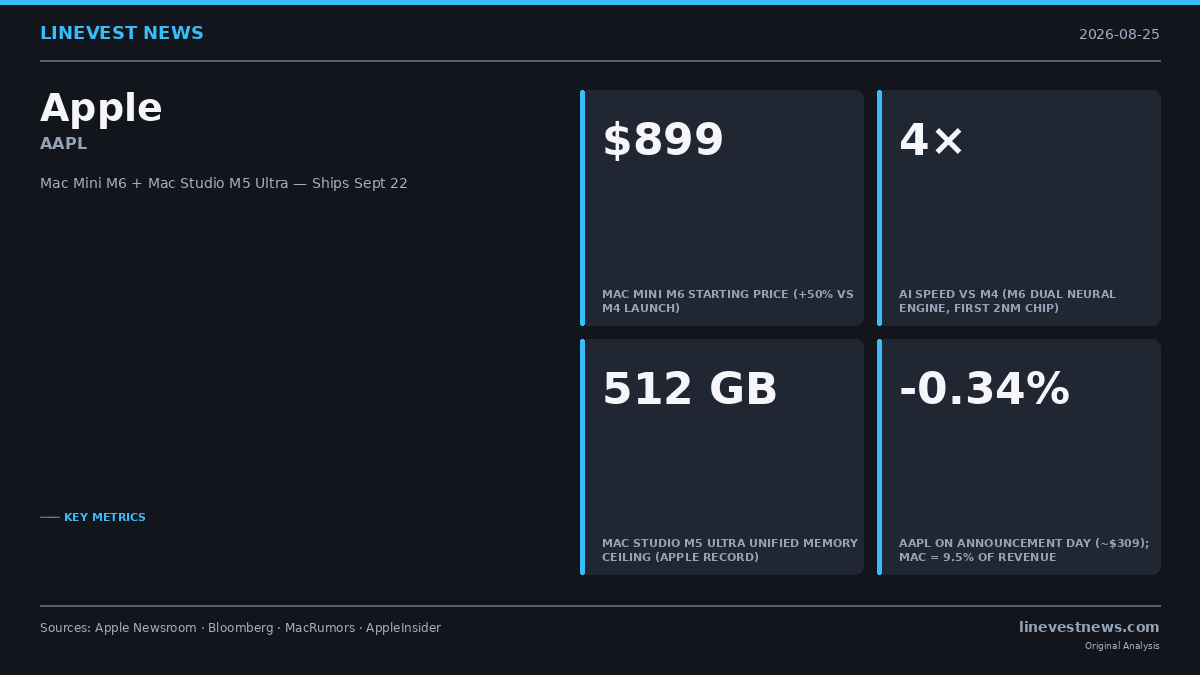
TL;DR - Apple announced Mac Mini (M6, first 2nm chip) and Mac Studio (M5 Max/Ultra) on August 25, 2026; both ship September 22 - Mac Mini starts at $899 — up 50% from the M4 model's original $599 launch price in November 2024 - M6's dual Neural Engine delivers 4x faster on-device AI than the M4, positioning the Mac Mini as Apple's entry-level AI workstation - Mac Studio with M5 Ultra offers up to 512 GB of unified memory, Apple's highest ever; the M5 Ultra is Apple's most powerful chip to date - AAPL dipped 0.34% to roughly $309.30 on the day; Mac accounts for roughly 9.5% of quarterly revenue, limiting near-term earnings impact — but the announcement opens Apple's broadest fall product cycle in years
Part A — What Apple Announced
Apple on Tuesday unveiled two refreshed desktop computers ahead of the iPhone 18 event expected in September: a new Mac Mini and a new Mac Studio.
Mac Mini — M6 and M5 Pro
The Mac Mini's base model now runs on the M6, Apple's first chip manufactured on TSMC's 2-nanometer N2 process node. The M6 features a 12-core CPU, 12-core GPU, and a dual 16-core Neural Engine — Apple's first chip with two Neural Engines — with 170 GB/s memory bandwidth. A higher-end configuration uses the M5 Pro chip (15- or 18-core CPU, 16- or 20-core GPU, 307 GB/s bandwidth, up to 64 GB of unified memory and 8 TB of SSD).
The Mac Mini skipped the M5 at the base tier. The previous generation launched in November 2024 with M4 and M2 Pro options; the M2 Pro variant is now replaced by M5 Pro, spanning three chip generations.
| Spec | M6 | M5 Pro (high-end) |
|---|---|---|
| CPU cores | 12 | up to 18 |
| GPU cores | 12 | up to 20 |
| Unified memory | up to 32 GB | up to 64 GB |
| SSD | up to 2 TB | up to 8 TB |
| Memory bandwidth | 170 GB/s | 307 GB/s |
| Starting price | $899 | $1,699 |
Apple claims the M6 is 40% faster at CPU tasks, 2x faster for graphics and storage, and 4x faster for AI workloads than the M4. For LLM inference, the M6 is up to 4.8x faster than M4 and 13.5x faster than M1.
New connectivity includes Wi-Fi 7, Bluetooth 6, an N1 networking chip, and standard 2.5 Gigabit Ethernet (10 Gigabit optional). The M6 model carries three Thunderbolt 4 ports; the M5 Pro carries three Thunderbolt 5 ports.
Pre-orders opened August 25; in-store availability and delivery begin September 22.
Mac Studio — M5 Max and M5 Ultra
Apple also updated the Mac Studio with M5 Max and M5 Ultra options. The M5 Ultra — Apple's most powerful chip to date — supports up to 512 GB of unified memory, doubling the previous ceiling and targeting AI model developers who need large parameter weights on-chip.
Part B — Investment Analysis
Stock Reaction: Muted but Understandable
AAPL traded near $309.30 on Tuesday, down roughly 0.34% — a reaction that is small relative to the scope of the announcements. The subdued move reflects a structural reality: Mac generated $10.4 billion in Apple's fiscal Q3 2026, or about 9.5% of the $109.4 billion in total revenue. Even one million incremental Mac Minis at a $100 higher average selling price would add only about $100 million to the top line — roughly 0.09% of a single quarter's revenue.
The market is right to look past the product announcement itself and focus on the broader fall cycle it signals.
Pricing Power and Margin Math
The Mac Mini's price trajectory tells an interesting margin story. The M4 model launched in November 2024 at $599, was later repositioned to $799, and is now succeeded at $899. That is a 50% increase from the M4's original price in roughly 22 months.
Apple has historically used each chip generation to nudge desktops toward higher average selling prices, and the jump to a 2nm process (M6) provides the most compelling product justification yet. At $899, the Mac Mini now occupies a tier previously held by entry-level Mac Studio configurations, which compresses the lineup toward higher margin configurations.
The AI Workstation Pitch
The M6's dual Neural Engine — the first dual-engine design in Apple silicon — and the M5 Ultra's 512 GB unified memory are positioning moves aimed at the on-device AI workstation market. Running large language models locally requires both raw compute (Neural Engine TOPS) and enough memory to hold model weights without offloading to disk.
With 512 GB of unified memory, the Mac Studio M5 Ultra can hold parameter sets equivalent to 70-billion-parameter models at full precision — a capability that previously required purpose-built AI servers. For software developers, creative studios, and corporate IT departments deploying Apple Intelligence on-premise, this is a meaningful capability jump.
Apple's macOS 27, which ships with these machines, integrates Apple Intelligence and Siri AI natively, reinforcing the local AI narrative that Apple has been building since Apple Intelligence launched in 2024.
Fall Cycle Context
The Mac announcements on August 25 are the opening act of Apple's most densely packed product cycle in years.
| Expected Launch | Products |
|---|---|
| September 2026 | iPhone 18 Pro, iPhone Fold/Ultra, AirPods 5 |
| October 2026 | OLED iPad mini, iMac, MacBook Pro |
| Late 2026 | Home Hub tablet, Apple TV 4K, HomePod mini |
iPhone drives roughly 50% of Apple's revenue, and the iPhone 18 cycle — which will debut the long-awaited foldable iPhone Ultra alongside the standard Pro lineup — is the event investors should circle. The Mac refresh serves as confirmation that Apple's silicon roadmap remains on track and that Ternus-era product development is progressing.
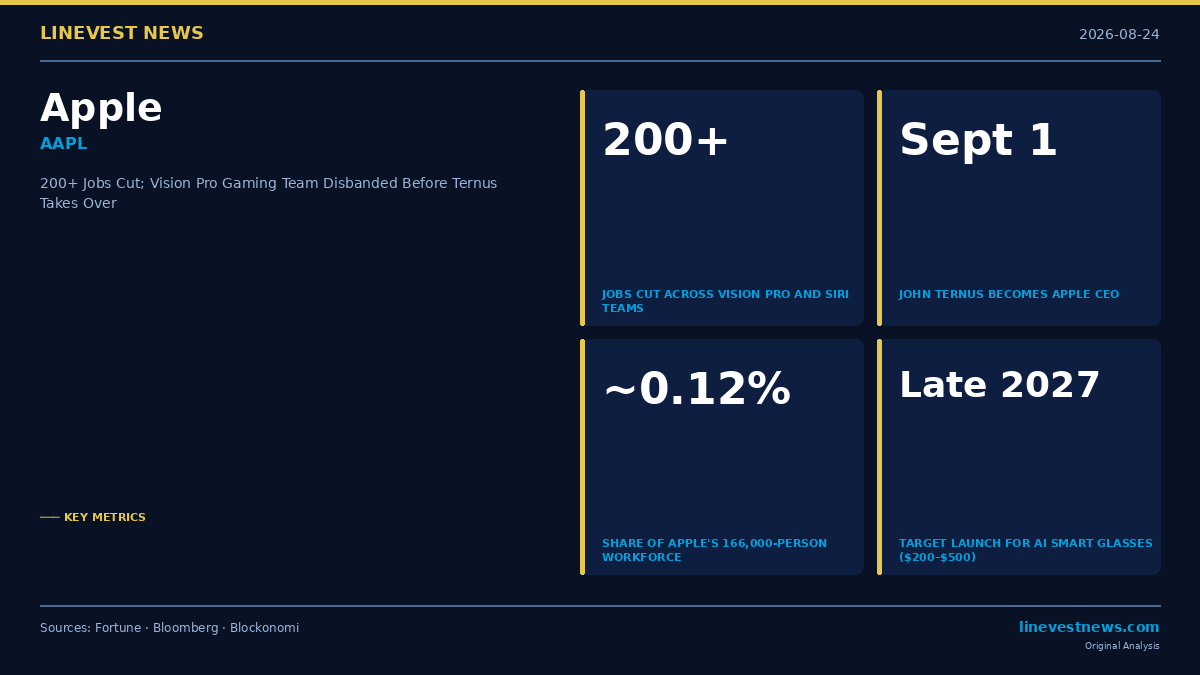
John Ternus, who takes over as CEO from Tim Cook on September 1, 2026, will ship both the Mac Mini and Mac Studio during his first month as chief executive. The Mac Mini is effectively Tim Cook's final product launch at Apple, with Ternus inheriting a pipeline that runs through the holiday season.
Analyst Consensus
As of August 25, 2026, 16 of 31 analysts covering AAPL rate the stock Buy, 11 rate it Hold, and 4 rate it Sell. The consensus price target stands at $336.63, implying 8.5% upside from Tuesday's close. The key swing variable for the next 90 days remains iPhone 18 demand and whether the iPhone Ultra can command premium pricing in a consumer environment where $1,200+ handsets face growing resistance.
The Mac Mini M6 and Mac Studio M5 Ultra are the right products at the right time for Apple's AI pivot. They may not move the needle on this quarter's revenue, but they reinforce the narrative that Apple's silicon execution — from entry-level desktop to high-memory AI workstation — remains best-in-class.
This article is for informational purposes only and does not constitute investment advice. Always consult a licensed financial advisor before making investment decisions.
Sources: - Apple Newsroom — Mac Mini M6 and M5 Pro announcement (Aug 25, 2026) - MacRumors — Everything Apple Announced Today (Aug 25, 2026) - MacRumors — New Mac Mini with M6 and M5 Pro (Aug 25, 2026) - Bloomberg — Apple to Launch New Mac Mini; AirPods 5 and OLED iPad Mini Timing Details (Aug 25, 2026) - AppleInsider — New Mac Mini days away, OLED iPad mini in October, AirPods 5 in 2026 (Aug 25, 2026)