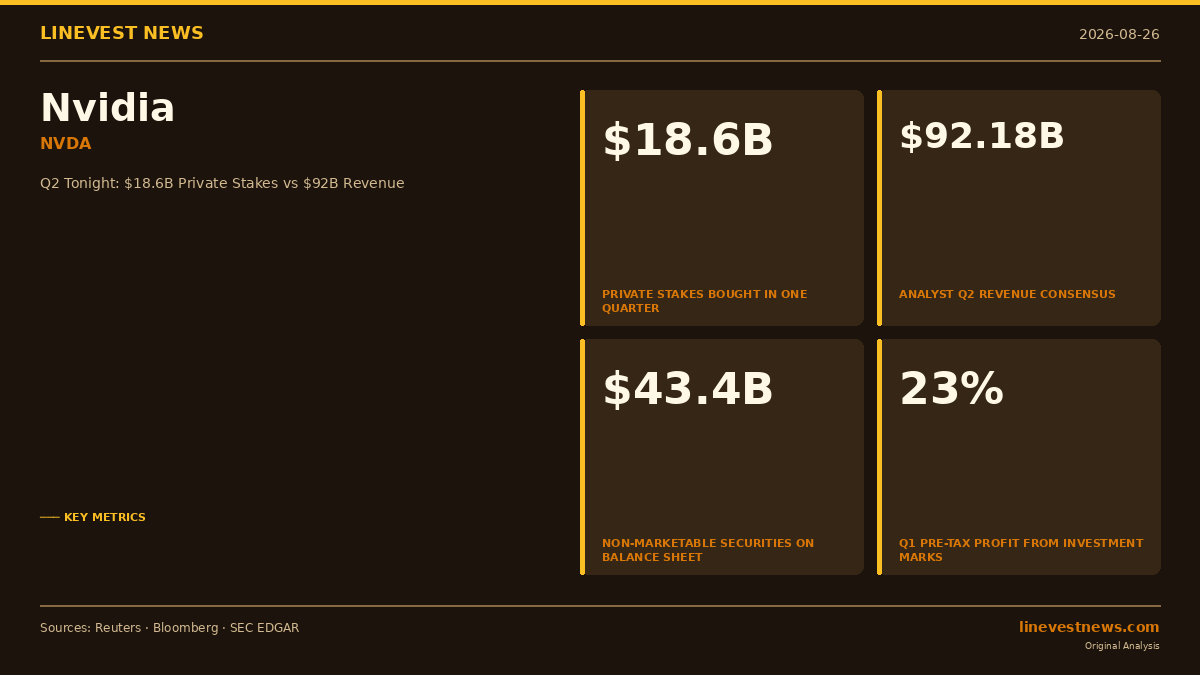
TL;DR - Nvidia reports Q2 FY2027 tonight (after close). Revenue guidance $91B; analyst consensus $92.18B. - The last 10-Q shows $18.6B in private-company stakes in one quarter — 37% of operating cash. - Non-marketable securities nearly doubled to $43.4B in 13 weeks; $27B more is committed. - $27B in additional commitments is stated as pending in the notes to the same filing.
Nvidia (NASDAQ: NVDA) reports fiscal second-quarter results after Wednesday's close. Its most recent filing shows the company spent $18.6 billion buying stakes in private companies in a single quarter. A year earlier that same line read $649 million. The figure sits in the cash-flow statement — not in the earnings release, and not in the wire previews.
That line is the part of the AI-financing argument that is already settled fact. Almost everything else being discussed tonight is a promise, a guarantee or a forecast. This one is cash that has left the building.
What is scheduled tonight
Nvidia will post results at about 1:20 p.m. Pacific time on Wednesday, per the company's scheduling notice as reported by Investing.com. The analyst call follows at 2:00 p.m. Pacific. The quarter under review ended in late July.
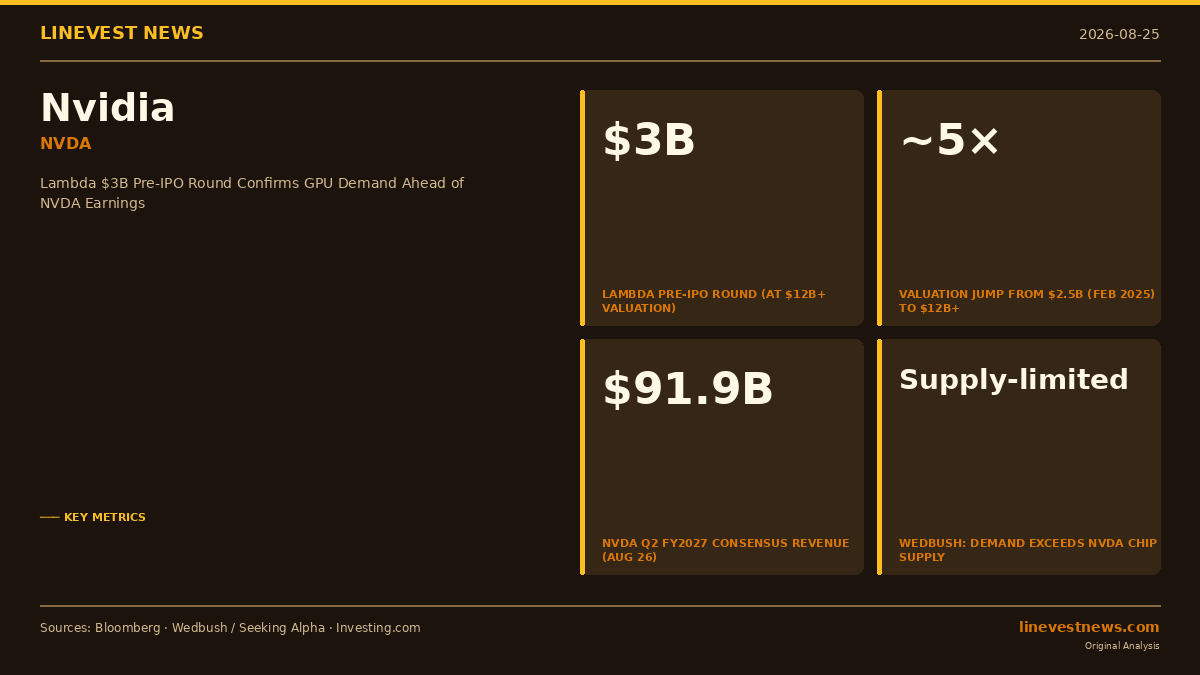
Management guided revenue to $91.0 billion. Analysts on average expect $92.18 billion, Reuters reported on Aug. 25. That would be roughly double the year-earlier figure, and the quickest growth in seven quarters.
The other half of the setup is Rubin, the processor family that follows Blackwell. Shipments are expected to begin in the autumn. Morgan Stanley estimates Rubin could contribute nearly $9 billion of sales in the October quarter, Reuters reported.
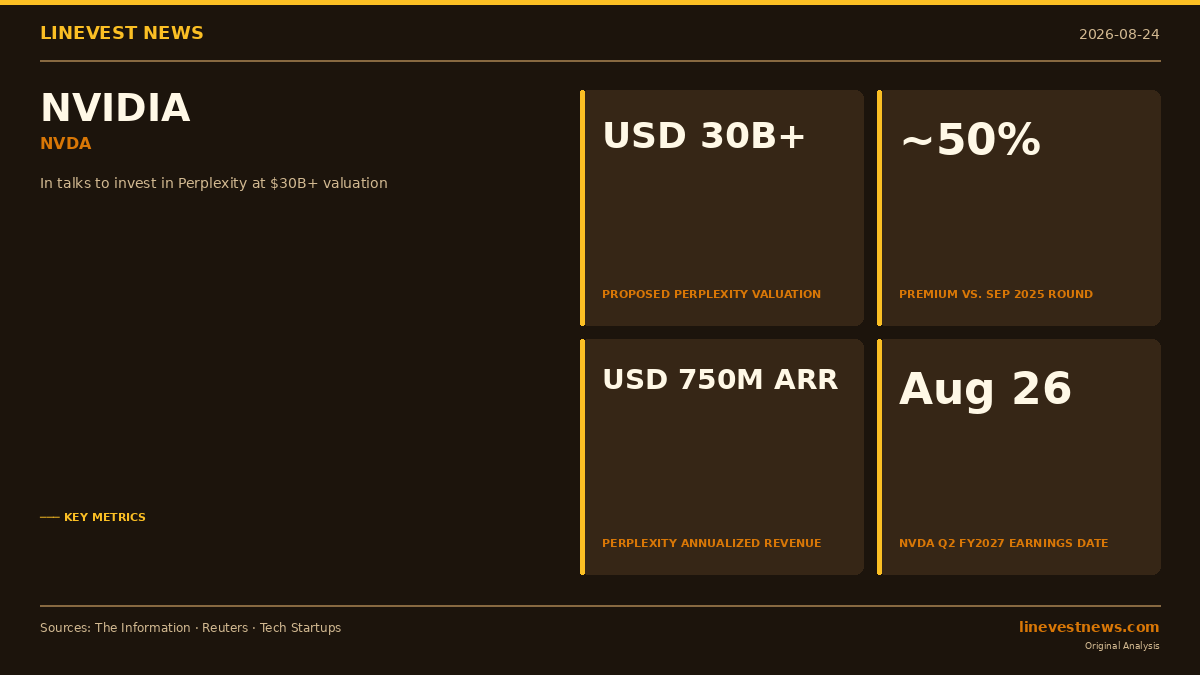
The stock closed at $213.05 on Aug. 25 for a market value of approximately $5.18 trillion, per stockanalysis.com. Reuters noted that Nvidia shares have lagged major rivals this year and that the company briefly ceded its position as the world's most valuable firm to Apple last month.
None of that is the hard question. Revenue and product cadence are what the wire services will lead with, and they will have both within minutes of the release. The question a portfolio manager cannot answer from a press release is a different one. It is who is paying, and with whose money.
Why It Matters
Chip cycles have always been read the same way. A supplier sells parts. Customers buy them with their own money. Demand either holds or it does not. The signal is clean because buyer and seller are separate parties.
That separation is what the past month has blurred. Nvidia now stands behind some of its customers' financing, and it has become an investor in their sector. Each role is defensible on its own. Together they change what a revenue number tells a reader.
The commitments everyone is arguing about are contingent
On Aug. 11, Nvidia said six financial firms plan to mobilize more than $500 billion of third-party capital for data centers, chip plants and power projects. They are Apollo, BlackRock, Blackstone, Brookfield, Goldman Sachs and KKR. Apollo, Brookfield and KKR are alternative-asset managers that finance infrastructure. Nvidia's role is to guarantee up to 25% of the residual value of its own chips installed in those projects.
Chief Executive Jensen Huang has described the headline figure as an aggregate target spread over several years. It is not a single commitment, and it is not Nvidia revenue. He said the guarantee share is well below what compute financing normally carries, and that the financial partners keep responsibility for judging customer credit and utilization.
Six days later came a second number. Nvidia agreed to guarantee up to $105 billion to help OpenAI lease a data center under development in Ohio, on a 20-year term. It is among the largest financing commitments the company has made.
Both structures share a feature that makes them hard to size from outside. They are guarantees. No cash moves unless something goes wrong, and the amount at risk depends on used-chip prices years from now. An outside analyst cannot mark them to anything. That is exactly why they generate argument rather than analysis.
Brian Mulberry is client portfolio manager at Zacks Investment Management, an asset-management firm. He framed the position this way to Reuters: "This makes them a kind of central banking figure in the AI space." The real risk, he added, is total exposure to AI with no diversification.
That phrase is worth pausing on. A central bank stands behind the system it regulates, and its balance sheet expands when private balance sheets will not. A supplier doing something similar for its own customers is not regulated, not diversified, and not indifferent to the outcome.
What has already left the building
The cash-flow statement in Nvidia's Form 10-Q — the quarterly report that U.S.-listed companies must file with securities regulators — does not have that problem. It covers the quarter ended April 26. Under investing activities, the line "Purchases of non-marketable securities" reads $18,582 million. The same line a year earlier read $649 million.
A cash-flow line has one virtue the guarantees do not. It is settled. The money is gone, the accounting is closed, and no assumption about future chip prices is required to read it. Anyone arguing about how deep Nvidia is into funding its own ecosystem can start here rather than with a press release.
Non-marketable securities are stakes in companies whose shares do not trade publicly. The filing does not name them. In practice this is the line that carries Nvidia's equity investments in privately held AI firms — model developers, GPU cloud operators, infrastructure startups.
Set that against what Nvidia spent on itself. Purchases of property, equipment and intangible assets came to $1,757 million in the same quarter. The company put 10.6 times as much into other companies' equity as into its own plant and tools. That ratio is not in the filing. It is arithmetic on two lines of one statement.
The scale against cash generation is similar. Operating activities produced $50,344 million of cash in the quarter. The private-stake purchases absorbed roughly 37% of it.
The balance sheet shows where the money landed. Non-marketable securities stood at $43,364 million on April 26, against $22,251 million at the January year-end. The holding nearly doubled in thirteen weeks.
And the filing says more is coming. "Total Investment commitments were $27 billion as of April 26, 2026, subject to certain contingencies, which we expect will be made through the remainder of fiscal year 2027," the notes state. That is a stated intention to deploy capital, not a contingent backstop.
The precedent, and where it stops working
There is a template for the fear. Winstar Communications, a U.S. fixed-wireless telecom carrier, agreed in the late 1990s to buy up to $2 billion of equipment from Lucent Technologies. Lucent, then one of the largest American telecom-equipment makers, provided some of the financing, Light Reading reported. Winstar filed for Chapter 11 bankruptcy protection in April 2001.
The unwind was slow. A federal bankruptcy court later ordered Lucent to pay $244 million in the case brought by Winstar's trustee, and Lucent estimated the ruling would produce a $300 million charge, per the same report. Vendor financing — a supplier lending customers the money to buy its own products — had flattered revenue on the way up and produced charges years after the sale.
The analogy has a limit, and it is worth naming plainly. Lucent lent money to a leveraged carrier that could not service the debt. Nvidia is mostly buying equity in companies that are themselves raising capital at rising valuations, and it is doing so out of operating cash rather than borrowings. Equity losses are absorbed in one line of the income statement, not through a bad-debt cycle. The exposure is real. The instrument is different.
What would make this reading wrong
One quarter is not a policy. If private-stake purchases in the July quarter fall back toward the prior year's level, then the April figure was one or two large rounds landing in the same three months rather than a strategic turn. In that case the financing debate is a headline effect, and the chip business stands on its own numbers.
The confirming data point arrives within days, and it is not the press release. It is the Form 10-Q for the quarter ended July 26. Three lines settle the argument: purchases of non-marketable securities in the investing section, the investment-commitments note, and whether other income, net stays above a fifth of pre-tax profit.
If all three move the same way again, a pattern is established rather than a quarter. If they do not, April was noise. Either way, the answer arrives in a document that lands after the stock has already moved.
In the full report: the data center segment split between hyperscale and enterprise customers, the four-quarter revenue and margin trend table, peer comparison against AMD and Broadcom, and the cash-flow bridge from operating cash to the investing lines discussed above.
Disclaimer: LineVest News is an independent publication. This article is journalism, not investment advice. LineVest is not a registered investment adviser and does not solicit the purchase or sale of any security. Figures are drawn from the cited primary sources as of the dates noted; readers should verify against original filings before acting.