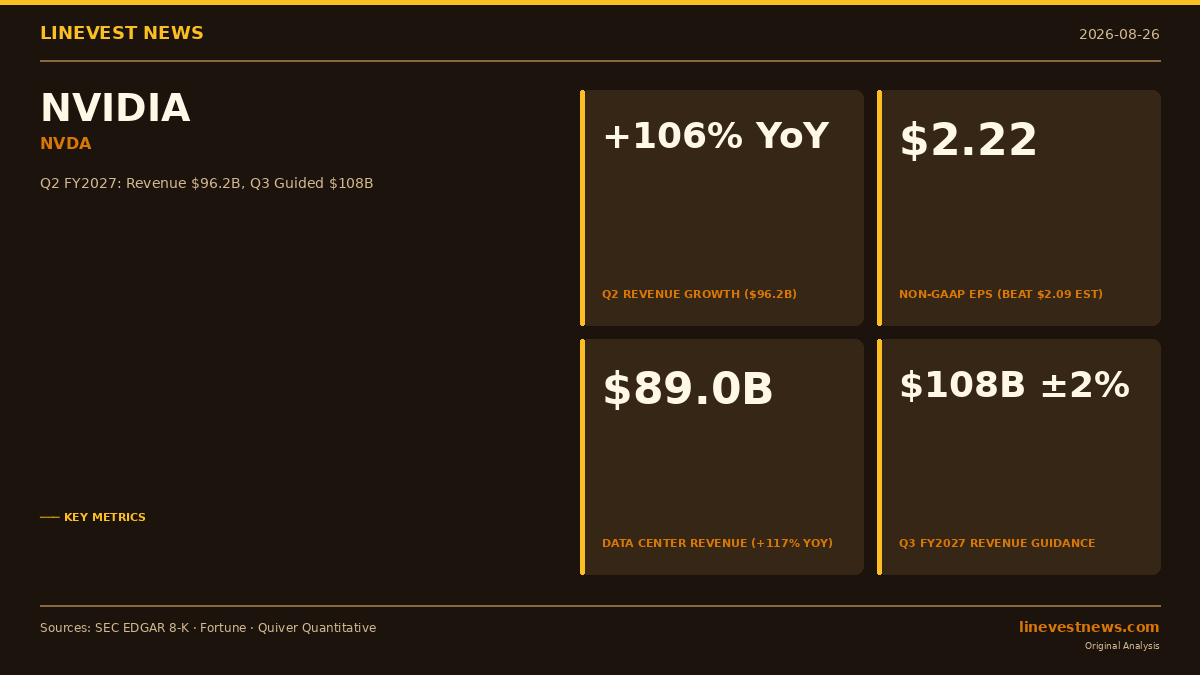
TL;DR - Q2 FY2027 revenue $96.2 billion, up 106% year over year — beating the $91.0 billion management guidance midpoint by roughly 5.7% - Non-GAAP EPS $2.22, more than double the prior-year quarter; GAAP EPS $2.46 - Data Center revenue $89.0 billion (+117% YoY); AI Clouds, Industrial & Enterprise sub-segment accelerated to +138% YoY - Q3 FY2027 guidance: $108.0 billion ±2%, above the $104.2 billion Street consensus - Stock declined ~1.7% after hours to ~$206, a classic post-earnings sell-the-news pattern; gross margin guidance slips 100 basis points sequentially to 74.0%
Part A — The Numbers
Q2 FY2027 Financial Summary (Quarter Ended July 26, 2026)
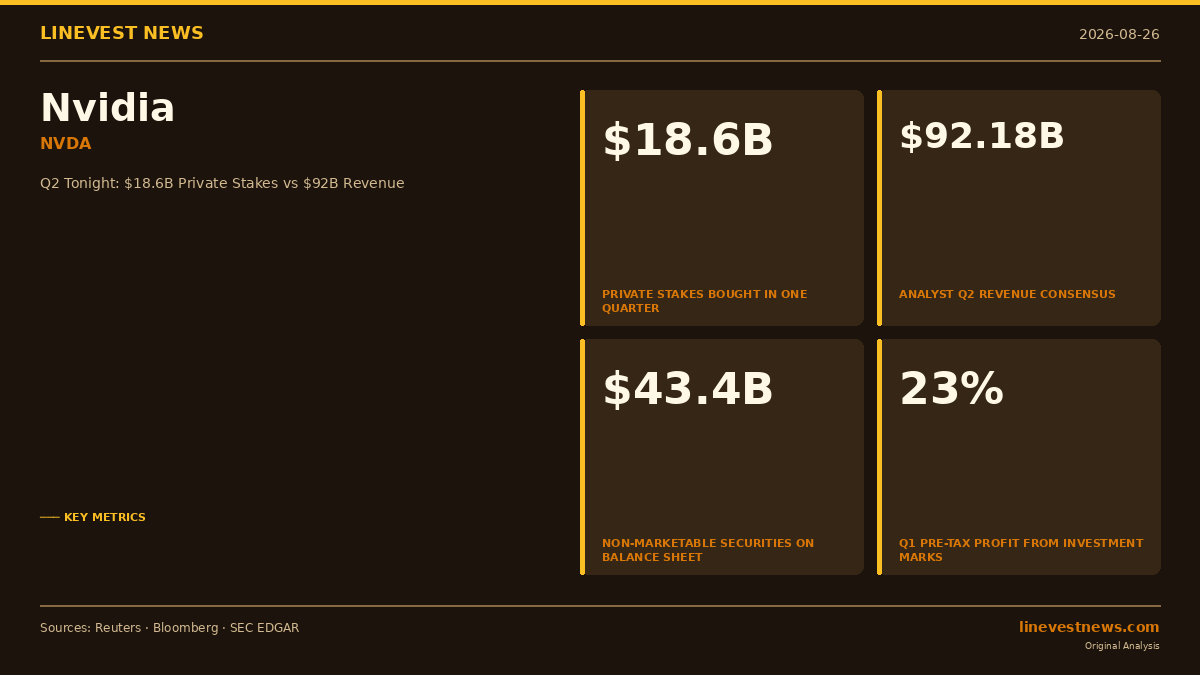
NVIDIA Corporation (NASDAQ: NVDA) reported record second-quarter results on August 26, 2026, filing an 8-K (Item 2.02) with the SEC. Revenue of $96.22 billion cleared both the company's own $91.0 billion guidance midpoint and Wall Street's approximately $92 billion consensus by a wide margin.
| Metric | Q2 FY2027 | YoY Change | QoQ Change |
|---|---|---|---|
| Total Revenue | $96.22B | +106% | +18% |
| Data Center | $89.0B | +117% | +18% |
| Edge Computing | $7.2B | +27% | +13% |
| Compute & Networking (product) | $88.3B | +114% | — |
| Graphics (product) | $7.9B | +46% | — |
Note: NVIDIA reports by two market platforms (Data Center, Edge Computing) and two product categories (Compute & Networking, Graphics). These are complementary views of the same revenue base.
Earnings Per Share and Profitability
| Metric | Q2 FY2027 |
|---|---|
| Non-GAAP EPS (diluted) | $2.22 |
| GAAP EPS (diluted) | $2.46 |
| GAAP Gross Margin | 75.0% (+2.6 pp YoY) |
| Non-GAAP Gross Margin | 75.0% (+2.5 pp YoY) |
| GAAP Operating Income | $63.7B |
| GAAP Net Income | $59.7B |
| Non-GAAP Net Income | $54.0B |
Non-GAAP EPS of $2.22 beat the approximately $2.09 consensus and more than doubled compared to the prior-year quarter. GAAP net income of $59.7 billion exceeded Non-GAAP net income of $54.0 billion, a pattern driven by large stock-based compensation tax deductions recognized under GAAP accounting but excluded from Non-GAAP figures.
Data Center Sub-Segment Breakdown
| Sub-Segment | Q2 FY2027 Revenue | YoY | QoQ |
|---|---|---|---|
| Hyperscale | $48.7B | +102% | +13% |
| AI Clouds, Industrial & Enterprise (ACIE) | $40.3B | +138% | +25% |
| Total Data Center | $89.0B | +117% | +18% |
Q3 FY2027 Guidance
| Item | Guidance |
|---|---|
| Revenue | $108.0B ±2% |
| GAAP Gross Margin | 74.0% ±50 bps |
| Non-GAAP Gross Margin | 74.0% ±50 bps |
| GAAP Operating Expenses | ~$9.2B |
| Non-GAAP Operating Expenses | ~$9.0B |
The $108.0 billion midpoint for Q3 exceeded the $104.2 billion average analyst estimate by roughly 3.7%. Year over year, the Q3 guidance implies growth of more than 89% compared to the prior-year quarter.
Capital Returns and Balance Sheet
NVIDIA returned nearly $26.0 billion to shareholders in Q2 through share repurchases and cash dividends. The board declared a quarterly dividend of $0.25 per share, payable October 1, 2026. Remaining share repurchase authorization stands at $99.0 billion.
Inventory rose to $31.6 billion from $25.8 billion sequentially, reflecting build-ahead activity for the Vera Rubin architecture ramp. Days Sales Outstanding increased to 60 days from 45 days, which management attributed to extended payment terms on large, multi-quarter agreements with certain investment-grade customers — a structural shift accompanying mega-deal contracting.
Operating cash flow was $24.1 billion in Q2, down from an exceptional $50.3 billion in Q1 FY2027, reflecting higher working capital needs tied to the inventory build and DSO extension.
China Revenue and Export Controls
NVIDIA confirmed that Hopper GPU shipments to China represented less than 1% of Data Center revenue in Q2. For Q3 guidance, management stated explicitly: "We are not assuming any Data Center compute revenue from China in our outlook." This effectively treats China as a zero-contribution market for planning purposes.
Part B — What This Means for Investors
"Compute Is Revenue" — Jensen Huang's Inflection Point Declaration
CEO Jensen Huang distilled the quarter into one sentence: "AI has reached its inflection point. It's doing useful work. Its tokens are productive and profitable. Now, compute is revenue."
The phrase "compute is revenue" marks a strategic turning point. For the past three years, AI investment was largely pre-revenue infrastructure spending — hyperscalers and enterprises buying GPU clusters hoping to monetize later. Huang's statement signals that the monetization cycle has begun in earnest: AI-generated tokens (from ChatGPT, Copilot, Claude, Gemini, and thousands of enterprise applications) are generating billable revenue for the companies running them. That revenue, in turn, justifies buying more NVIDIA compute. The demand loop is now self-reinforcing rather than speculative.
Enterprise AI Accelerates Past Hyperscale
The most important structural signal in the quarter is hidden inside the Data Center sub-segment numbers. Hyperscale revenue grew 102% year over year — impressive by any normal standard, but it was the ACIE (AI Clouds, Industrial & Enterprise) segment that delivered the standout result: +138% year over year and +25% quarter over quarter.
For the first time, ACIE's sequential growth rate (25%) meaningfully outpaced Hyperscale (13%). At $40.3 billion versus $48.7 billion, ACIE is closing fast on Hyperscale and is likely to represent the majority of Data Center revenue within the next two to three quarters if current growth differentials hold.
This matters because Hyperscale revenue is inherently lumpy and subject to large-order timing. Enterprise adoption tends to be stickier and more predictable. A center of gravity shift toward ACIE would improve revenue quality and reduce the quarter-to-quarter variance that has historically amplified NVDA's stock price swings.
Hyperscaler Capex Expanding to $1.3 Trillion
CFO Colette Kress disclosed on the earnings call that capital expenditures among the top five hyperscalers are expected to increase to approximately $1.3 trillion in calendar year 2027, up from roughly $800 billion in 2026. This 62.5% capex expansion is the single most important demand signal in the quarter. AWS separately announced it would purchase 2 million NVIDIA GPUs and deploy the company's Vera CPU, adding a concrete volume commitment to back up the aggregate capex forecast.
For NVIDIA shareholders, this trajectory provides unusual multi-year revenue visibility. The company's own total future commitments — supply and capacity agreements, cloud service contracts, data center leases, equity investments, and capital expenditures — stand at $366 billion through fiscal year 2032 and beyond. That figure includes $279 billion in supply and capacity commitments, $29 billion in cloud service agreements, and a $108.5 billion guarantee exposure (primarily a SoftBank Energy / OpenAI Ohio data center campus). These commitments represent a pipeline, not recognized revenue, but they structurally limit the downside of a sudden demand reversal.
Gross Margin: A 100-Basis-Point Sequential Step Down
The one genuine blemish in an otherwise exceptional quarter is the Q3 gross margin guidance of 74.0% (±50 bps), down 100 basis points from Q2's 75.0%. For a company at NVIDIA's scale, 100 bps on $108 billion is approximately $1.1 billion in gross profit — non-trivial.
Management has not explicitly explained the decline, but the most likely driver is the ongoing transition from Hopper/Blackwell to the Vera Rubin architecture. New product introductions typically carry higher initial costs — assembly complexity, lower initial yields, and ramp-related inefficiencies. The inventory step-up to $31.6 billion is consistent with Vera Rubin build-ahead, and some of that cost may be flowing through cost of goods sold before volumes fully ramp.
Investors should watch whether the 74.0% level represents a floor or the beginning of a multi-quarter margin normalization toward the 72-73% range that accompanied the Hopper ramp in 2023. For now, gross margins remain extraordinarily high relative to semiconductor industry norms.
China: Optionality Surrendered, Risk Contained
NVIDIA's decision to assume zero China Data Center revenue in Q3 guidance reflects the ongoing impact of U.S. export controls targeting advanced AI compute. With Hopper shipments already below 1% of segment revenue, the financial impact is largely absorbed. The more significant implication is that any easing of export restrictions — which remains a wildcard in the bilateral tech trade relationship — represents pure upside to guidance that the company has explicitly not included.
Conversely, further tightening of controls on potential China-compatible SKUs (a periodic regulatory risk) poses limited incremental downside from a revenue forecasting perspective. The China optionality is now asymmetrically structured: upside exists if controls loosen; downside is already priced in.
Why the Stock Declined After a Record Quarter
Shares fell roughly 1.7% after hours to approximately $206, from a $209.91 regular-session close that itself reflected a 1.6% intraday decline. Given that NVIDIA beat revenue guidance by 5.7%, beat consensus EPS by roughly 6%, and guided Q3 above Street estimates by $3.8 billion, the muted stock reaction deserves explanation.
Three factors are most likely at work. First, the stock had already rallied sharply in the months preceding the report, compressing the "beat and raise" surprise premium. Second, the Q3 gross margin guidance of 74.0% introduces a near-term margin trajectory question that the market is pricing cautiously. Third, the increase in DSO to 60 days and the operating cash flow decline to $24.1 billion (from a record $50.3 billion in Q1) introduce working capital questions that sophisticated investors will probe in the coming days.
None of these concerns fundamentally challenges the demand narrative. But at a stock trading near $210, representing a substantial premium to book value and a P/E multiple that assumes sustained hyper-growth, any deviation from perfection tends to trigger distribution. The after-hours decline is consistent with short-term profit-taking rather than a structural reassessment of NVIDIA's position.
Investor Outlook: Vera Rubin as the Next Inflection
The $31.6 billion inventory build positions NVIDIA for a Vera Rubin product cycle that is expected to follow Blackwell's record ramp. The NVL72 (72-GPU rack-scale configuration) and HGX Rubin NVL8 (workstation-class) address distinct use cases — frontier model training and inference, respectively. If Vera Rubin sees demand absorption comparable to Blackwell, the Q3 guidance of $108 billion could look conservative by Q4.
For investors, the core risk remains execution: NVIDIA must continue to convert hyperscaler and enterprise commitments into recognized revenue without supply disruptions, yield issues, or a policy environment that unexpectedly restricts key customer deployments. The $366 billion commitment backlog suggests demand is not the constraint. Supply, manufacturing yield, and geopolitical stability are the variables to monitor.
This article is based on NVIDIA's 8-K filing (SEC accession 0001045810-26-000073, filed August 26, 2026) and accompanying CFO Commentary. The information presented is for journalistic and informational purposes only and does not constitute investment advice or a recommendation to buy or sell any security. LineVest News is not a registered investment adviser.
Sources: - NVIDIA Q2 FY2027 Earnings Press Release (SEC EDGAR, EX-99.1) - NVIDIA Q2 FY2027 CFO Commentary (SEC EDGAR, EX-99.2) - NVIDIA NVDA Q2 Revenue Hits $96.2 Billion (Quiver Quantitative) - Nvidia doubles Q2 revenue to $96 billion (Fortune) - NVIDIA Q2 FY2027 Earnings: Revenue, EPS beat (Shacknews) - NVIDIA Q2 FY2027 Revenue $96.2B (StockTitan)