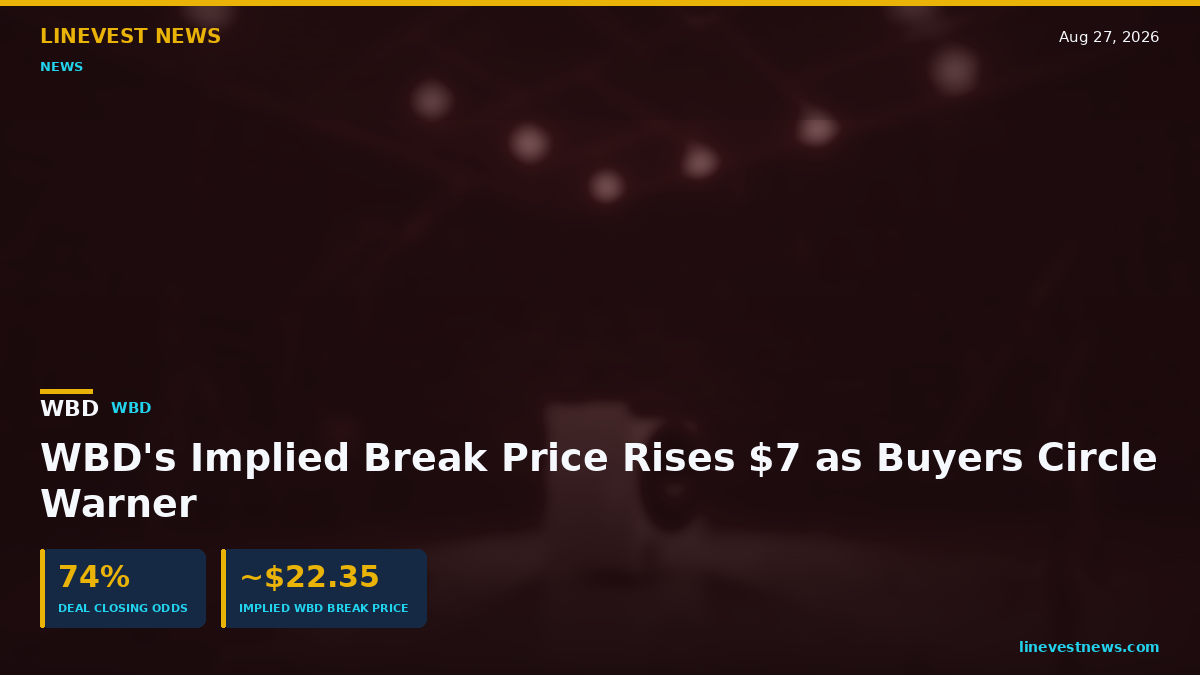
Advent International and Stripe have abandoned their pursuit of PayPal (NASDAQ: PYPL), Bloomberg reported late Thursday. The awkward part is where the stock already sits. PayPal closed above the $60.50 a share the two bidders declined to raise. The buyers walked away from a company the market had already marked higher than their last offer.
What was on the table
Advent International is a Boston-based private equity firm. Stripe is the privately held payments company that handles card processing for online merchants. In July the two offered $60.50 a share for PayPal, valuing it at roughly $51.8 billion, Reuters reported, citing Bloomberg. PayPal's board called that inadequate and flagged regulatory and financing hurdles, according to the same report.
The approach started earlier and with more people. Block, the payments company behind Square and Cash App, joined Stripe and Advent in a first approach to PayPal in April, Reuters said. Block left the group before the formal offer went in. PayPal, Stripe and Advent all declined to comment on Bloomberg's report this week.
A purchase at that size would have ranked among the largest leveraged buyouts ever attempted. A leveraged buyout is a takeover financed mostly with borrowed money, with the target's own cash flow paying down the loans afterwards. That structure is what makes the seller's share price so unforgiving. It is also, on the reporting available, what broke.
The regulatory objection was not hypothetical. Coverage of the July offer relayed by Investing.com said the bidders did not intend to break PayPal up, and expected significant antitrust scrutiny in both the United States and Europe. Two of the larger online payment processors merging is the kind of deal competition authorities examine slowly. Slow review is expensive when the purchase is financed with debt. The interest starts running long before the ownership changes.
Why It Matters
A listed company's share price usually carries two stories at once. One is what the business earns. The other is what someone might pay to own the whole thing. For six weeks those stories were tangled together at PayPal. One has now been removed, and the other has to stand on its own.
Nothing changed inside the payments business this week. No product was cancelled, no large merchant walked, no guidance was withdrawn. What disappeared was a hypothetical buyer, and with it the assumption that someone stood ready to catch the shares.
For investors watching from Seoul, the mechanism matters more than the headline. A takeover premium does not drain away gradually. It leaves on the day the news lands. A recovery in the underlying business behaves in the opposite way. It has to be argued with quarter by quarter, and it can survive a bad week.
The gap the stock now has to close by itself
PayPal closed at $61.47 on Aug. 27, per market data on stockanalysis.com. That values the company at roughly $52.6 billion. It also leaves the stock 97 cents above the bid the consortium has just walked away from.
LineVest reported on July 29 that the board's advisers had pointed the bidders toward roughly $70 a share as the level that would buy serious engagement. Measured against Thursday's close, that target sits 13.9% higher.
Put that distance in dollars. Across the 855.5 million shares outstanding, it comes to about $7.3 billion of market value. There is now no buyer in the room to supply it. Management has to produce it out of the business, or the market has to decide on its own that the business deserves it.
The twelve-month range shows how far the stock has already travelled. PayPal has traded as low as $38.46 and as high as $79.22 over the past year, according to stockanalysis.com. Thursday's close sits roughly 60% above that low.
There is a mechanical reason a rally can kill a buyout rather than reward it. The buyer borrows most of the price and repays the debt out of the target's earnings. Every dollar the shares rise falls entirely on the equity cheque, while the cash flow servicing the loan stays exactly where it was. Past a certain point the arithmetic stops working, however good the underlying business is. Engadget, pointing to the run in PayPal's shares, wrote that the rally had made a leveraged buyout less feasible.
The buyer's own position is worth a line. Stripe is not listed, so its price is set by private rounds and secondary trades rather than by a market open. It was valued at $159 billion in February 2026, and secondary-market pricing put it near $198.8 billion by mid-August, per reporting relayed by Investing.com. A private company with a rising internal mark has other uses for capital than a contested public takeover.
None of that makes the walk-away a verdict on PayPal. It is a verdict on a financing structure meeting a share price that moved while the paperwork was being drawn up. Buyers of this kind are price-takers in a way strategic acquirers are not, because the lenders behind them impose a ceiling. When the ceiling and the seller's asking price cross, the process ends quietly and without a press release.
Two catalysts, one exit
Set the sequence side by side. PayPal rose 32.5% in July, its best month on record and the third-best performance in the S&P 500 that month, per reporting relayed by Investing.com. Two things caused that. The bid became public in the middle of the month, and the company beat second-quarter estimates on July 28. One of those two has now left the building.
Which share of July belonged to each cause — that is the question the walk-away hands to shareholders, and the tape cannot answer it. A month of re-rating arrived with two causes stacked on top of each other. Nobody can separate them cleanly after the fact. What is knowable is that one cause has been formally withdrawn, and the other one has to report again.
For now, nothing at all changes inside the company. There is no merger agreement to terminate, no break fee to pay, no shareholder vote to cancel. A bid that was never agreed cannot be formally called off. What ends is an expectation, and the expectation was carrying part of the price.
There is a practical reason this matters more than usual here. A takeover premium and an earnings recovery look identical on a price chart. They behave very differently afterwards. One evaporates on a single wire story, which is roughly what happened this week. The other has to be disproved by the company itself, quarter after quarter, and takes far longer to unwind.
What PayPal itself has said: nothing
The most striking fact in this story is not on the wires. It is in the filings, or rather in their absence. PayPal has disclosed none of this to the Securities and Exchange Commission. Its EDGAR filing index shows exactly one 8-K since June, filed July 28 and carrying Items 2.02 and 9.01 — the quarterly earnings release and the exhibits attached to it.
An 8-K is the form a public company uses to disclose a material event between quarterly reports. Six weeks of offer, rejection, revived talks and now abandonment produced no such filing. That is not improper. A board is under no obligation to announce a proposal it never accepted. But it does mean every figure in this story traces back to reporters and unnamed sources rather than to the company. There is no management statement here that anyone can be held to later.
For readers used to companies confirming everything, the silence is a useful reminder about how deal reporting works. Boards talk to bankers, bankers talk to reporters, and none of it becomes a disclosure obligation until something is signed. Nothing was signed here. The entire episode existed in the press and in the share price, and it has now left both.
The Xerox template
The nearest recent parallel is Xerox and HP Inc. Xerox abandoned a $35 billion hostile bid for HP on March 31, 2020, roughly five months after launching it, Reuters reported. HP had rejected the offer as too low, and said it would load the combined business with too much debt. Xerox cited the pandemic on the way out. The bid never came back, and HP stayed independent.
The resemblance runs deeper than the shape of the story. Reuters described that withdrawal as a victory for HP's chief executive, Enrique Lores. PayPal's chief executive now finds himself in a structurally identical position. A board that declined to negotiate on price has watched a debt-heavy acquirer walk away without a press conference. The first time that script ran, at HP, the company that remained standing was left to argue its own case to the market. That is precisely where PayPal stands this morning.
What we said before, and what changed
LineVest has covered this bid twice. On July 29 we reported that the board had left the door open to a revised offer, and that the distance from $60.50 to about $70 was a 15.7% raise for the bidders to fund.
On July 31, in our analysis of the second-quarter 10-Q — the quarterly financial report US-listed companies file with regulators — we described the rejected bid as an implicit floor beneath discussions of what the company was worth.
That second framing no longer holds. A floor supplied by a bidder disappears when the bidder does. The consortium had two choices, to raise or to leave, and it left. Whatever support the share price has from here has to come out of the operating numbers instead of an offer document.
The date that settles it
This reading has a clear way of being wrong. If the next quarter shows the same improvement the second one did, then July was mostly an earnings move and the bid was mostly noise. On that version, losing the bidder costs shareholders a headline rather than anything durable.
The test has a date. PayPal's third-quarter earnings call is scheduled for Oct. 27 at 8:00 a.m. Eastern, according to the company's investor relations calendar.
What to measure it against is already on record. LineVest's analysis of the second-quarter filing found revenue up 4.9% while operating income fell 5.1%.
Watch whether those two lines still point in opposite directions. If they do — revenue climbing while operating income stays compressed — the business still has not made the case the bid used to supply. If they converge, and operating income growth turns positive while revenue holds, July's move will look less like a premium paid for a hypothetical deal and more like a genuine re-rating. Either way, October 27 is when the answer stops being hypothetical.