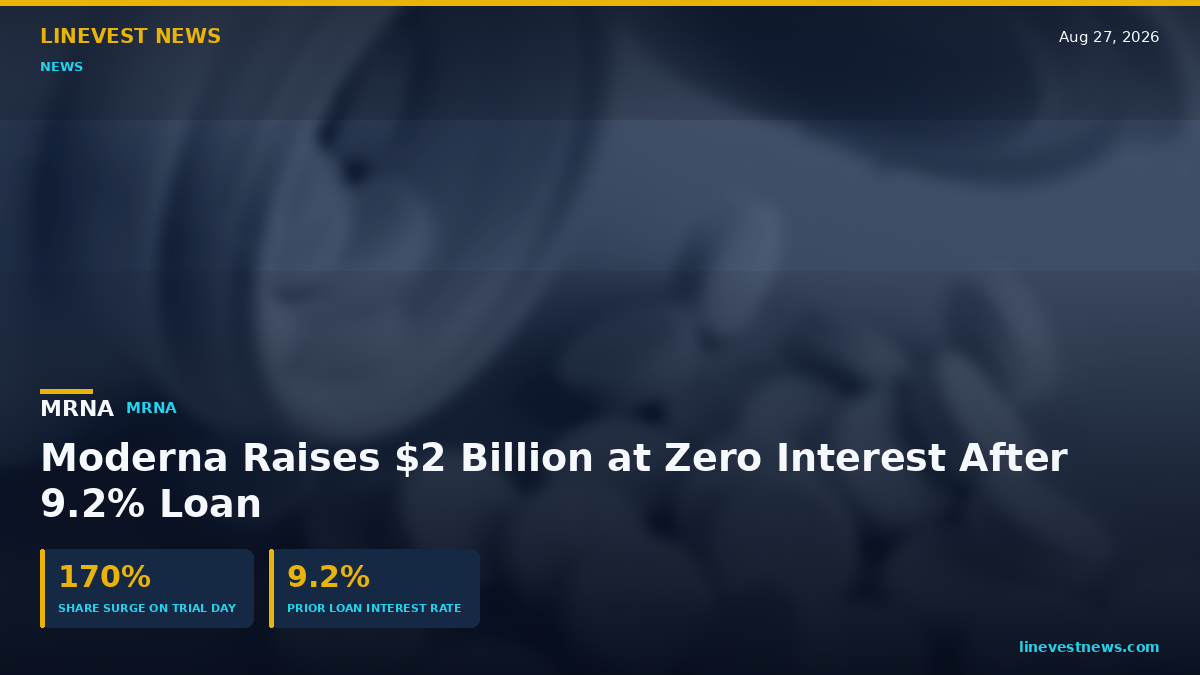
Moderna (NASDAQ: MRNA) intends to pay no interest at all on the $2 billion it is raising this week. About ten months ago the same company signed a credit facility that as of June 30 carried a floating rate of roughly 9.2%, pledging nearly everything it owns as security. No product Moderna sells changed in between. A trial result did, and so did the share price.
The company said on Aug. 27 that it intends to sell $2.0 billion of convertible senior notes due 2032, with an option for the initial purchasers to take another $300 million. Convertible notes are bonds a holder can swap for stock. These notes carry no coupon: they "will not bear regular interest and the principal amount of the notes will not accrete," the announcement says.
Why it matters
A borrowing cost is a price the market puts on a company's future. Moderna's has just been rewritten, and the rewrite came from a trial result rather than from anything the business sold. That is the story underneath the paperwork.
A buyer of a zero-coupon convertible is not lending money for income. They are buying an option on the shares and paying for it by giving up the interest. That trade only works when a stock moves violently: the wilder the stock, the more that option is worth, and the less coupon the issuer has to offer.
Volatility is the raw material these instruments are built from. For three years Moderna had the wrong kind — a long grind downward. This month it delivered exactly the kind of move that makes such an option valuable.
On Aug. 19, Moderna and Merck (NYSE: MRK) said their late-stage melanoma trial met its main goal. The therapy is intismeran autogene, a personalized cancer vaccine given alongside Merck's checkpoint-inhibitor drug Keytruda. Shares rose more than 175% that day, adding about $45 billion in market value, BioPharma Dive reported. The stock touched an intraday high of $176.66.
What money used to cost here
Contrast that with last November. Moderna signed a credit and guaranty agreement with lenders led by Ares Capital Corporation, a publicly traded private-credit lender. The facility provided for $1.5 billion of term loan commitments, of which $600 million was funded at closing.
The rate floats. Moderna's second-quarter 10-Q, the quarterly financial report public companies file with the SEC, put it at approximately 9.20% as of June 30. That filing came on July 31. The loan is secured by a first-priority lien on substantially all of the company's assets. Its covenants also limit how much additional debt Moderna can take on.
Consider what that security means. A first-priority lien on substantially all assets is the collateral package a lender asks for when it is genuinely worried about getting paid back. The manufacturing plants and the intellectual property sit behind it. That is the posture of a borrower with limited alternatives, not one with a choice of lenders.
Now run the new raise through that old structure. At 9.20%, $2 billion would carry a hypothetical annual interest bill of roughly $184 million — the Ares facility funded only $600 million, at an actual annual cost of about $55 million. Moderna's total revenue in the second quarter of this year was $145 million, per the same 10-Q. On that hypothetical full-$2-billion basis, a single year of interest at the private-credit rate would have exceeded a full quarter of sales. At a zero coupon, it is nothing.
That gap is the clearest available measure of what the melanoma data bought. It did not put a product on the market. Regulatory filing and approval are still ahead, and the detailed trial results have not yet been presented at a medical meeting. What changed immediately was the price Moderna pays for money.
What the release actually commits to
Early news summaries of the deal said the proceeds go to the cancer vaccine business and to repaying debt. The press release is considerably looser. Proceeds first pay for the capped call transactions. The rest goes "for general corporate purposes, which may include the flexibility to invest in the growth of our oncology business and repayment of debt."
Read that phrase again. Not "will" — "may include the flexibility to." No dollar figure is attached to either use, and no specific borrowing is named for repayment. This is about as broad as use-of-proceeds language gets.
The wording is standard and nothing about it is improper. But it does less work than the headlines suggest. The company has reserved the right to spend this money on anything, and the oncology framing is an example rather than a commitment. Anyone building expectations around a dedicated cancer-vaccine war chest is building on the summary, not the source.
The capped call is a hedge Moderna buys alongside the notes. It softens dilution — the shrinking of each existing shareholder's slice when new shares are issued. Moderna said the cap price will start at a premium of at least 150% above the closing share price on the pricing date — equivalent to at least 2.5 times that close. Measured against the Aug. 27 close of $140.35, that points to a cap near $351.
Sizing the raise
Set the $2 billion against the company's own cash forecast. Moderna held $6.91 billion of cash and investments at the end of the second quarter, and guided to $4.7 billion to $5.2 billion at year-end, according to its second-quarter results.
Subtract the two, and management is telling investors it expects to consume $1.7 billion to $2.2 billion over six months. The new raise lands in the middle of that range. In cash terms this is not expansion capital so much as a replacement for roughly one half-year of spending.
That distinction matters more than it sounds. Money raised to build something new and money raised to keep the lights on look identical on a balance sheet. Only the spending that follows tells them apart. The company's own guidance points at continuity rather than acceleration.
There is a simpler way to grasp the scale. Moderna's full-year 2025 revenue was $1.94 billion, per the company's 2025 annual report. The raise is $2.0 billion. The company is borrowing slightly more than everything it sold last year — and borrowing it for free.
The market did not treat it as free. Shares fell 6.2% on announcement day to $140.35. Against 399.24 million shares outstanding, as reported in the second-quarter 10-Q, that erases roughly $3.7 billion of market value.
The announcement cost shareholders nearly twice what the company raised, in a single session. Nobody is objecting to interest expense, because there isn't any. What is being priced is the possibility that these notes eventually turn into shares.
Part of that drop is also mechanical rather than a verdict. Many buyers of convertible notes are hedge funds running an arbitrage: they hold the bond and sell the underlying stock short to isolate the option. That short selling arrives with the deal itself. It typically presses on the share price around pricing, and it says nothing about what those funds think of the company.
The precedent, and how it ended
The structure has recent history, and it did not always end well. In February 2021, Peloton Interactive, the connected-fitness equipment maker, sold $1 billion of zero-coupon convertible notes. The conversion price was $239.23, about 65% above the share price at the time of pricing.
Peloton's stock never came close to that level. The notes stayed debt instead of becoming equity. In 2024 the company repurchased roughly $800 million of them, funding part of that buyback with new convertible notes carrying a 5.50% coupon. Interest-free money became interest-bearing money.
The lesson is narrow but real. A zero-coupon convertible is free only if the shares stay high enough that holders choose to convert. If they do not, the issuer repays cash at maturity. The savings on the coupon are certain. The conversion is optional, and the option belongs to the holder rather than to the company.
Seen that way, the deal is a bet by both sides on the same thing. Moderna is betting the shares will be strong enough that repayment never becomes a cash problem. The buyers are betting the shares move enough to make a yield-free bond worth owning. Only one of those bets needs to be wrong for the arrangement to look different in a few years.
What we said two weeks ago
LineVest covered Moderna earlier this month on mFlusiva, the mRNA flu vaccine the FDA approved on Aug. 5. Our Aug. 11 article reported that the stock closed down 1.3% at $56.26 on approval day.
We also wrote then that meaningful flu-vaccine revenue was not expected before the second half of 2027. A federal immunization advisory panel had been halted by a court injunction, and the company had missed that year's contracting cycle.
Put the two events beside each other. A real regulatory approval of a real product left the stock lower on the day. A trial readout for a therapy still years from market lifted it by more than 175%, and handed Moderna interest-free access to $2 billion. The repricing is happening in the pipeline, not the product line.
One procedural note matters for anyone hunting documents. Moderna did not file an 8-K for this offering. An 8-K is the current report companies file to announce major events. Its most recent one, filed July 31, covered second-quarter results. That is ordinary rather than evasive. The notes are being sold under Rule 144A, a private-placement exemption that restricts buyers to large institutions.
Ordinary investors cannot buy these notes, or read the indenture yet. Definitive terms will surface in a later periodic filing. Until then the announcement is all there is — which is why its wording repays attention.
What would make this reading wrong
There is a specific way this argument fails. Suppose the notes price with a conversion premium high enough that they never convert. Suppose Moderna then uses part of the proceeds to retire the 9.2% Ares loan. In that case this was a cheap refinancing, not a company selling into strength. Moderna has not said it will retire that loan. The release only permits the possibility.
Two data points will settle it. The first is the pricing itself, due within days: the conversion price and premium will show how much of the stock's current level the market expects to hold. A conversion price set close to today's share price signals skepticism; one set well above it signals confidence. The second is the Ares term loan. If Moderna repays it in the months ahead, this raise was refinancing dressed as strategy. If it remains on the books, the cost-of-capital story stands on its own. Both answers are coming. Neither is here yet.