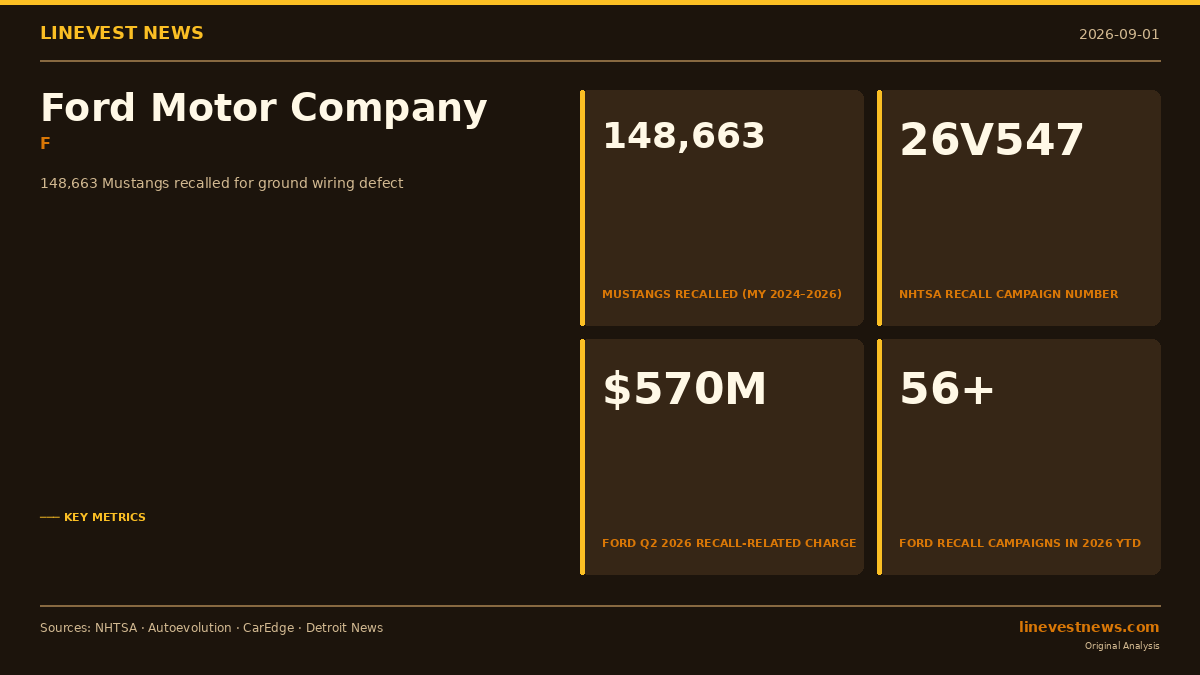
TL;DR - Ford (NYSE: F) recalled 148,663 model-year 2024–2026 Mustangs under NHTSA campaign 26V547 (internal code: 26C40), built at Flat Rock, Michigan between September 2022 and June 2026 - A manufacturing defect allows heat-shrink adhesive to deform a wiring harness ground eyelet, which then fractures under engine vibration — simultaneously cutting drive power, headlights, windshield washers, A/C, and the engine cooling fan - Roughly 1% of recalled vehicles (~1,487 cars) are estimated to carry the live defect; Ford has tracked 8 U.S. warranty claims, 4 within the first 3 months of service - Interim owner letters ship by September 4, 2026; free dealer repairs begin no later than March 31, 2027 - The action adds to Ford's already-heavy 2026 recall burden: more than 56 campaigns covering 12.1 million vehicles, the highest pace in the U.S. auto industry, with a $570 million recall-related charge already booked in Q2 2026
Part A: The Defect — One Small Eyelet, Multiple Failure Modes
On September 1, 2026, the National Highway Traffic Safety Administration posted recall campaign 26V547, covering 148,663 Ford Mustang S650-generation vehicles produced at the Flat Rock Assembly Plant in Michigan.
Root cause: During assembly, adhesive from the heat-shrink sleeve on the engine wiring harness can seep into the bolt-clearance area of the ground eyelet. The adhesive intrusion bends the eyelet slightly, reducing its fatigue life. Under repeated engine vibration, the bent terminal fractures — severing the ground connection that multiple vehicle systems share simultaneously.
What fails when the ground breaks: - Motive drive power — the vehicle can stop moving without warning - Headlights and taillights - Windshield washers - Air conditioning and climate control - Engine cooling fan — a secondary risk that can itself cause overheating
| Recall detail | Specification |
|---|---|
| NHTSA campaign | 26V547 |
| Ford internal number | 26C40 |
| Affected vehicles | 148,663 Mustangs, MY 2024–2026 |
| Production window | Sept. 7, 2022 – June 9, 2026 |
| Assembly plant | Flat Rock, Michigan |
| Estimated defect rate | ~1% of recalled population (~1,487 units) |
| Known U.S. warranty claims | 8 total; 4 within first 3 months in service |
| Remedy | Ground terminal replacement, free of charge |
| Interim owner notification | By September 4, 2026 |
| Remedy parts / appointments | By March 31, 2027 |
Because the estimated defect rate is roughly 1 percent, NHTSA projects that approximately 1,487 of the 148,663 recalled vehicles contain the fracture-prone eyelet. All registered owners will receive two notices: an interim letter this week alerting them to the campaign, and a second when dealer appointment slots and replacement parts are available.
Ford's internal engineers identified the root cause through warranty claim analysis. Of the 8 U.S. claims associated with the condition, four appeared within three months of vehicle delivery — suggesting the weakened eyelets can fail relatively early in service life under sufficient vibration loading.
Part B: Quality Crisis Context — What This Means for F Investors
Ford's 2026 Recall Volume in Industry Context
The Mustang ground-eyelet recall is not an isolated event. Through mid-2026, Ford Motor Company had launched more than 56 separate recall campaigns covering approximately 12.1 million vehicles — a pace that outstrips every other automaker in the U.S. market, according to industry tracking firm CarEdge. The 2026 cadence follows a record-setting 2025, when Ford filed 153 campaigns affecting roughly 13 million vehicles.
| Year | Recall campaigns | Vehicles affected |
|---|---|---|
| FY 2025 | 153 | ~13 million |
| 2026 YTD (through Aug.) | 56+ | ~12.1 million |
CEO Jim Farley has been direct about the gap. "We are not satisfied with our quality," he said at the company's most recent earnings call, framing quality improvement as the single largest variable in Ford's long-term margin trajectory.
The Billion-Dollar Warranty Ledger
Ford's recall frequency has carried a measurable financial cost.
| Period | Warranty / recall item |
|---|---|
| FY 2023 | $4.8 billion warranty costs (company record) |
| FY 2025 | ~$1.5 billion in warranty and material savings (YoY reduction) |
| Q2 2026 | $570 million recall-related charge |
The FY 2025 savings represented genuine progress, driven by process-engineering changes across several high-volume platforms. But Q2 2026's $570 million charge interrupted the narrative, widening the gap to Wall Street's margin estimates for Ford Blue — the segment that houses the Mustang.
The Mustang recall's immediate remediation cost is unlikely to be material: replacing a small metal terminal on roughly 1,487 vehicles is far below the threshold of a dedicated warranty reserve. What investors will watch is whether the claim rate on this batch rises as the full owner population is notified, or whether Flat Rock's build-process correction prevents a tail of late-emerging faults.
Mustang's Strategic Importance to Ford
The Mustang, now in its seventh-generation S650 platform introduced for model year 2024, is one of Ford's most prominent consumer nameplates. After discontinuing most passenger-car models to focus on trucks, vans, and the Ford Pro commercial segment, Ford retained the Mustang as its primary brand-defining consumer vehicle.
The nameplate commands a pricing premium compared to the rest of Ford's lineup. Costly quality actions on a halo product carry reputational costs that go beyond direct warranty spend — particularly for a company in the middle of a public quality turnaround campaign.
Three Questions Investors Are Watching
1. Is the Q2 $570M charge the last recall-related reserve build of 2026? Ford's full-year quality guidance has historically been revised upward by year-end as additional campaigns emerge. Analysts will monitor whether Q3 results include another warranty reserve increase.
2. Does the Flat Rock process flaw extend beyond the announced production window? The recall covers vehicles built between September 7, 2022 and June 9, 2026. If the root-cause adhesive-intrusion issue was present across a broader set of assembly line configurations, the claim rate could vary by build date, potentially surfacing additional warranty costs after the formal remedy window opens in March 2027.
3. Does the recall affect Mustang's commercial momentum at a critical transition point? The S650 is the first Mustang generation to offer a Dark Horse performance variant alongside the GT. Consumer perception of build quality is a key competitive differentiator against international sport-coupe alternatives. A three-model-year recall spanning virtually the entire S650 production run to date is a broad-coverage event by any measure.
F Stock Snapshot
Ford shares (NYSE: F) closed at approximately $13.89 on August 31, 2026, with a 52-week trading range of $11.11 to $17.78 and a market capitalization of approximately $55.4 billion. The stock carries a negative trailing P/E ratio, reflecting the cumulative drag of recall and restructuring charges in recent fiscal periods. Analysts covering F will receive the recall filing as part of their ongoing quality-cost tracking models.
Figures are sourced from NHTSA recall campaign 26V547, Ford Motor Company public earnings disclosures, and industry recall data reported by CarEdge and Motor1. This article is journalistic reporting and does not constitute investment advice. Ford Motor Company (NYSE: F) is listed on the New York Stock Exchange.
Sources: - NHTSA Recall 26V547 – Autoevolution - Mustang7G Forum – 26C40/26V547 Recall Discussion - CarEdge – Ford Already Leads in 2026 Recalls - Detroit News – Ford Recalls Outpaced Auto Industry Combined - Motor1 – Ford CEO Not Satisfied With Quality - Barchart – Ford's Recall Headache