
Ford MotorF
About Ford Motor
Ford Motor Company designs, manufactures, markets and services a full line of Ford trucks, sport utility vehicles, cars and Lincoln luxury vehicles, alongside a growing portfolio of connected services and battery electric vehicles. The business is organized around three reportable segments: Ford Blue, which builds internal combustion and hybrid vehicles; Ford Model e, which develops and sells electric vehicles and the underlying software and digital services; and Ford Pro, which serves commercial, government and rental customers with vehicles, telematics, financing and physical service. Ford Motor Credit Company, the captive finance arm, supports dealer floorplan lending and retail consumer financing. Trucks and vans, led by the F-Series and Transit franchises, and the commercial-focused Ford Pro unit typically drive the bulk of operating profit.
Investors track the durability of the F-Series pickup franchise, which anchors both volume and margin, and the pace at which electric vehicle losses narrow relative to Ford Blue and Ford Pro contribution. Warranty and recall costs, quality metrics, and pricing power against a unionized North American cost base are recurring structural questions, as is exposure to the United Auto Workers master agreement and to Chinese battery and rare earth supply chains. Regulatory watch items include fuel economy and emissions rules, tariff regimes on imported vehicles and components, and autonomous driving oversight. Governance features include a dual-class share structure that concentrates voting power with the Ford family through Class B stock, and a long-standing dividend policy that management treats as a signal of cycle confidence.
Ford was founded in Dearborn, Michigan in 1903 by Henry Ford and a group of investors, and the introduction of the Model T in 1908 and the moving assembly line shortly thereafter made mass-market motoring possible and reshaped industrial production globally. The company went public in 1956, ending decades of private family ownership while preserving family voting control through the Class B share class. Over the following decades Ford built out and later divested a premium car portfolio, selling Aston Martin, Jaguar, Land Rover and Volvo Cars in the late 2000s and winding down the Mercury brand in 2010. In 2022 Ford reorganized its automotive operations into the Ford Blue, Ford Model e and Ford Pro segments that define its current structure.
Ford sells vehicles primarily through a franchised dealer network that takes title to inventory financed in large part by Ford Motor Credit, with fleet and commercial customers served directly by Ford Pro under multi-year purchase, upfit and service arrangements that increasingly bundle telematics subscriptions and physical service. Revenue is concentrated in North America, where the F-Series and Super Duty trucks compete against General Motors' Silverado and Sierra and Stellantis' Ram, while Transit anchors the commercial van category against Mercedes-Benz Sprinter and Ram ProMaster. Europe skews toward commercial vehicles, and China is served largely through joint ventures. Competitive position rests on truck and van scale, dealer and service density, and the captive finance relationship with dealers and buyers.
Company profile by LineVest editorial. Journalism, not investment advice.
Order a report on Ford Motor — $15Ford Motor coverage
3 articlesFord Motor Company (F) Q2 FY2026: Cash Trails Profit
Ford’s consolidated operating cash flow fell to $5.7B in the first half of 2026 from $10.0B a year earlier, despite stronger operating profit. The largest adverse cash-flow swing was reduced support from accounts payable and accrued and other liabilities.
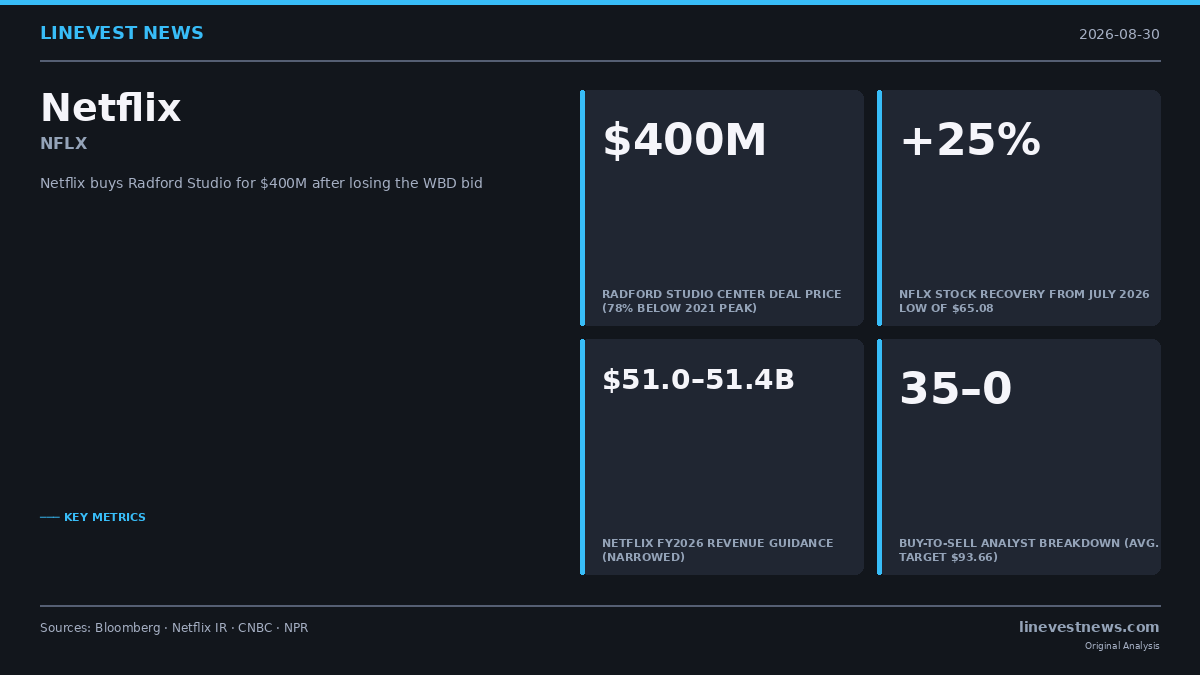
Netflix (NFLX) Up 25% From 2026 Lows: $400M Radford Studio Deal and Aggregation Pivot Drive Recovery
Netflix stock rebounds 25% from July lows as the $400M Radford Studio deal nears Q3 close. NFLX's post-WBD pivot explained — and what it means for investors.
Ford (F) Q2 2026: $3.6B BlueOval SK Exit Drives $1.33B Net Loss
> This analysis is based on Ford Motor Company's Form 10-Q for the quarterly period ended June 30, 2026, filed with the U.S. Securities and Exchange Commission
Go deeper than the headline
You just read what happened. Here's how to read what it means.
The day's reports, every morning — free
LineVest Daily lands in your inbox before the opening bell with the reports we published that day — what each company's latest 10-K or 10-Q actually says about the numbers, in plain English. Free, no card required.
This report, on any company you name
What you just read on Ford Motor is the format. Name any U.S.-listed company and we do the same for it — its latest SEC filing read in full, financials under US GAAP, governance, and what it means for the stock. PDF in your inbox within 3 hours.
Which company should we read?
$15 · one-time · PDF within 3 hours
Pick a company to continueIndependent journalism based on primary SEC filings — not investment advice. No brokerage affiliation.