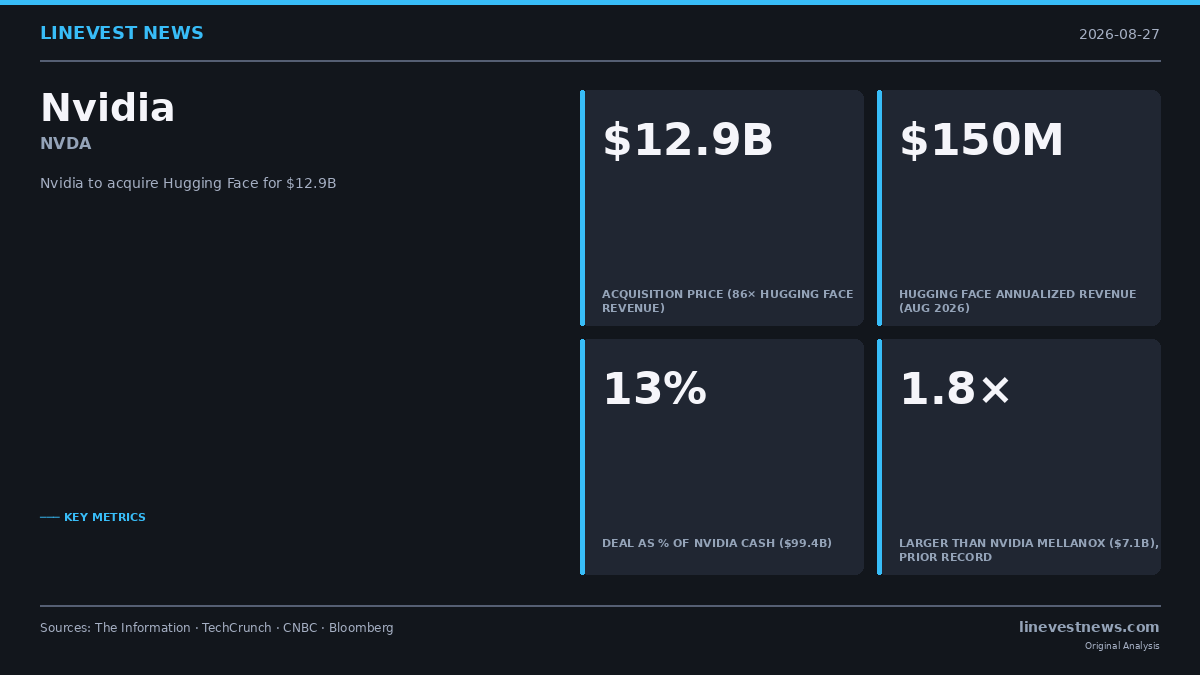
Nvidia (NASDAQ: NVDA) has agreed to acquire Hugging Face for about $12.9 billion, The Information reported Wednesday. That would be the largest acquisition Nvidia has ever completed — and still less than it spent buying minority stakes in private firms in a single quarter this summer.
The Information is a subscription technology-news outlet. It cited a person familiar with the agreement. Hugging Face is a New York-based hub where developers publish and download open-source AI models and datasets. Neither company has confirmed the deal. Gizmodo, a technology news site, reported that the agreement is still being finalized and "may still crumble."
Why It Matters
Nvidia sells the hardware that AI runs on. What it has never owned is the place developers go to decide which model to run in the first place. Hugging Face is that place for the open-source side of the field. Open-source is where developers outside the big labs do most of their building.
So this is a move up the stack rather than sideways. Chips are sold to a few dozen enormous buyers, several of whom are now designing their own. A distribution hub is used by a far broader community of individual developers, and habits spread that thin are harder for any one rival to redirect. The price tag, large as it looks, is the smaller half of the story.
What the money buys
Hugging Face's annualized revenue reached about $150 million by late August, The Information reported. Annualized revenue is the run-rate figure — what a company would collect over twelve months if its current monthly pace held. At $12.9 billion, the price works out to about 86 times that revenue line.
That multiple is the number the wire copy did not compute, and it is the whole argument in one figure. Nvidia is not paying for a revenue stream. It is paying for a position in the layer above its own chips.
The revenue trajectory is steep even so. Sacra, a private-market research firm, puts Hugging Face at roughly $81 million at the end of 2025. The line reached about $100 million in June, then $150 million by late August.
The valuation ladder is short and steep. Hugging Face was worth $4.5 billion in its 2023 funding round, which Salesforce Ventures led with Alphabet and IBM Ventures taking part. Three years later, the agreed price is $12.9 billion.
Chief Executive Clément Delangue told TechCrunch the company is "close to profitability" and had only recently begun spending the money it raised three years ago. That matters to how the price should be read. A company burning capital to buy growth is a different asset from one whose growth arrives with the margin attached. Delangue is describing the second kind.
Hugging Face employed roughly 250 people as of 2025, a figure that has circulated in trade press coverage but has not been confirmed in a regulatory filing. Against that headcount, the purchase price sits near $51.6 million per employee.
Headcount arithmetic is a crude tool for a software business, and it is worth saying why it is useful here anyway. It shows that almost none of what Nvidia is buying sits on a balance sheet. There are no factories, no networks, no long-term contracts of consequence. What transfers is a habit — the reflex of a very large developer community to look in one place first.
The threat this is meant to answer
Nvidia's biggest customers are becoming its competitors. OpenAI, Google and Amazon are all working on their own processors to reduce what they buy from Nvidia. That is the strategic problem sitting behind this deal.
Open models are the counterweight. They are published freely, run on whatever hardware a developer already owns, and in practice that hardware has been Nvidia's. Every open model that gets downloaded and fine-tuned somewhere outside the big labs is demand that never routes through a rival's custom silicon. Owning the place where those models are distributed puts Nvidia a layer above the chip itself.
TechCrunch reported a second motive that has drawn less attention. Hugging Face already rents out computing capacity to its users. That gives Nvidia a direct cloud-hosting revenue channel, and somewhere to place capacity it has committed to but not yet sold.
Enormous for the target, small for the buyer
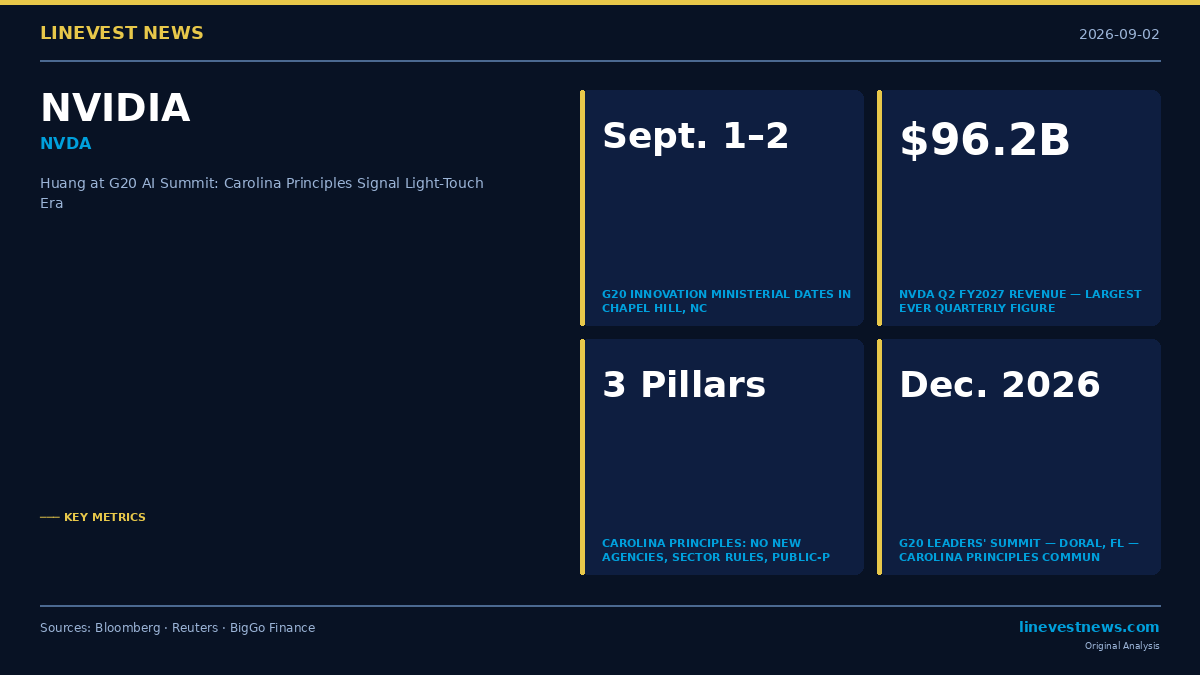
Nvidia reported revenue of $96.2 billion for the quarter that ended July 26, up 106% from a year earlier. It has guided the current quarter to $108.0 billion.
The gap between those two figures is $11.8 billion. The purchase price is $12.9 billion. Put plainly: Nvidia is paying slightly more than one quarter's projected sequential revenue increase to buy the entire company — $12.9 billion against a $11.8 billion guidance step-up. That comparison is not in any of the deal coverage. It is the cleanest way to see why a price like this does not strain Nvidia.
The funding question barely arises. Nvidia closed the quarter with $99.4 billion in cash and marketable securities, per its results announcement. The purchase price is about 13% of that balance.
This is where our own archive is useful. LineVest reported on Aug. 26 that Nvidia's most recent quarterly filing showed $18.6 billion spent on stakes in private companies in three months. The year-earlier figure on that same line was $649 million. Two days before that, we covered talks for Nvidia to take an equity position in Perplexity, an AI search startup, at a valuation above $30 billion.
Those were all minority positions. This is control. Through the summer, the pattern was Nvidia buying pieces of the AI stack and letting the founders keep the wheel. Hugging Face is the first time it has reached for the whole thing. And the whole thing costs less than Nvidia spent buying private stakes in a single quarter.
Nvidia has tried a large acquisition before
It did not end well. In September 2020, Nvidia agreed to buy Arm for $40 billion. Arm is the UK chip-design firm whose blueprints sit inside most of the world's smartphones.
The FTC — the U.S. antitrust and consumer-protection agency — sued to block that transaction in December 2021. Nvidia and SoftBank announced the termination of the agreement on Feb. 8, 2022, citing "significant regulatory challenges," according to Nvidia's own newsroom statement. The deal was dead about seventeen months after it was announced, and Nvidia never got to argue the merits in court.
The deal that survived was much smaller. Nvidia completed its purchase of Mellanox, an Israeli maker of high-speed data-center networking equipment, in April 2020. Total purchase consideration was $7.13 billion, per Nvidia's fiscal 2021 annual report (filed for the year ended Jan. 31, 2021). That stood as the largest acquisition Nvidia had ever completed. Hugging Face would cost roughly 1.8 times as much.
The regulatory shape of the two deals rhymes without matching. Arm licensed designs that Nvidia's direct rivals depended on to build competing chips, which is what the FTC's complaint fastened onto. Hugging Face distributes models that run on rival hardware as readily as on Nvidia's. A regulator could reach for the same theory. What differs is the size of the revenue at stake and the fact that Hugging Face sells no silicon of its own.
What would make this reading wrong
The value here rests on something Nvidia cannot purchase along with the equity. Model publishers use the hub because they believe it is neutral ground. Ecosystems built by Google, Amazon and Microsoft all publish there today, TechStartups noted. Neutrality is a perception, and perceptions of neutrality do not usually survive a change of owner unnoticed.
So the counter-case is straightforward. If publishing volumes on the platform hold steady a year after any close, the neutrality worry will have been overstated, and Nvidia will have bought a working distribution layer. If rival-aligned publishers start routing releases elsewhere, the download traffic that makes the hub worth owning follows them out, and $12.9 billion will have bought an asset in decline.
There is also a plainer way for this reading to fail. The reporting describes an agreement, not a signed contract, and Gizmodo was explicit that the talks could still collapse.
Hugging Face has walked away from Nvidia once already. It turned down a $500 million investment at a $7 billion valuation late last year, because it did not want an investor large enough to make decisions on its behalf. The current price is roughly 84% above that rejected mark.
The founders' stated reason for that refusal is worth holding onto, because nothing about it has changed. They did not object to the amount. They objected to the influence that came with it. An outright sale hands over more influence than any investment could, which suggests either the price finally cleared the founders' number or the strategic logic of staying independent weakened. Both readings are available, and the reporting does not settle which is right.
The dates that settle it
Three things convert this from reporting into fact. The first is a confirmation from either company. The SEC requires an 8-K — a current report on material corporate events — within four business days of the trigger. A signed merger agreement of this size would normally surface there. The second is an antitrust filing and whether the agencies issue a second request for information — that step, not the announcement, is what would signal a fight.
The third is Nvidia's next quarterly report. The fiscal third quarter ends in late October, and the accompanying 10-Q would show whether the purchase closed, what it cost in cash versus stock, and how much goodwill it added. Until then, the confirmed figures in this story are the ones Nvidia filed: its $96.2 billion quarterly revenue, its $108.0 billion guidance, and its $99.4 billion in cash and marketable securities. The $150 million revenue run-rate for Hugging Face is The Information's estimate, not a filed figure. Everything between them is a bet on where AI development happens next.
What this article did not cover: the segment-level breakdown of Nvidia's Data Center revenue. The four-quarter trend in its non-marketable securities balance. A peer comparison of AI-platform acquisition multiples. And the cash-flow bridge showing how the investment spending has been funded. Those four are in the full report.
Disclaimer: This article is journalism, not investment advice. LineVest is not a registered investment adviser. Figures are drawn from the sources cited inline and were accurate as of publication. Reported deal terms are unconfirmed by either company.
Sources: The Information · TechCrunch · CNBC · Bloomberg · Fortune · Forbes