
NetflixNFLX
About Netflix
Netflix operates a subscription streaming service that delivers films, series, documentaries, live events, unscripted programming and games over the internet to television-connected devices, computers and mobile screens. Revenue is generated almost entirely from monthly membership fees, with subscribers choosing among tiers that differ by video quality, number of simultaneous streams and, more recently, the presence of advertising. The ad-supported plan has introduced a second, smaller revenue stream from brand advertisers, while paid sharing surcharges monetise viewing across households. The company also licenses selected owned titles and sells consumer products tied to major franchises. The core subscription business is what drives the vast majority of revenue and effectively all of the operating profit.
Serious holders track the balance between subscriber growth, average revenue per member and the enormous content cash spend that underwrites the catalogue, since free cash flow is the metric that ultimately governs buybacks and net debt reduction. Governance features include a classified board and a founder-led culture memorialised in a widely circulated culture document. Regulatory exposure spans content quotas and investment obligations in the European Union, streaming-service regulation in South Korea, telecommunications and digital services taxes in various jurisdictions, and antitrust attention to bundling. Password-sharing enforcement, password rules, live rights auctions and the trajectory of the advertising tier are structural questions rather than one-quarter events. Index weight in large-cap U.S. benchmarks makes the shareholder register heavily indexed.
Netflix was founded in 1997 by Reed Hastings and Marc Randolph in Scotts Valley, California, as a mail-order DVD rental service, and went public in 2002. Streaming launched in 2007 alongside the DVD business, and in 2011 the company attempted to separate the two under the Qwikster brand before reversing course after customer backlash. International expansion accelerated from 2010, culminating in a near-global rollout announced in 2016. Original programming began in earnest in 2013 with House of Cards and has since become the centre of the content strategy. The legacy DVD-by-mail operation was wound down in 2023. Netflix remains a single-segment company headquartered in Los Gatos, California.
The customers are individual households paying a recurring monthly fee, generally billed directly by Netflix or through partners such as mobile carriers, pay-television operators and device makers that bundle the service. The competitive position rests on the scale of the content library, the reach of the recommendation system across a very large global installed base, and the ability to spread production spend across many territories through local-language originals. Netflix competes with Disney, Warner Bros. Discovery, Comcast's Peacock, Paramount, Amazon Prime Video, Apple TV+ and, for time spent, with YouTube, TikTok and video games. Revenue is split across four reported regions, with the United States and Canada the largest and the rest of the world collectively contributing the majority.
Company profile by LineVest editorial. Journalism, not investment advice.
Order a report on Netflix — $15Netflix coverage
2 articles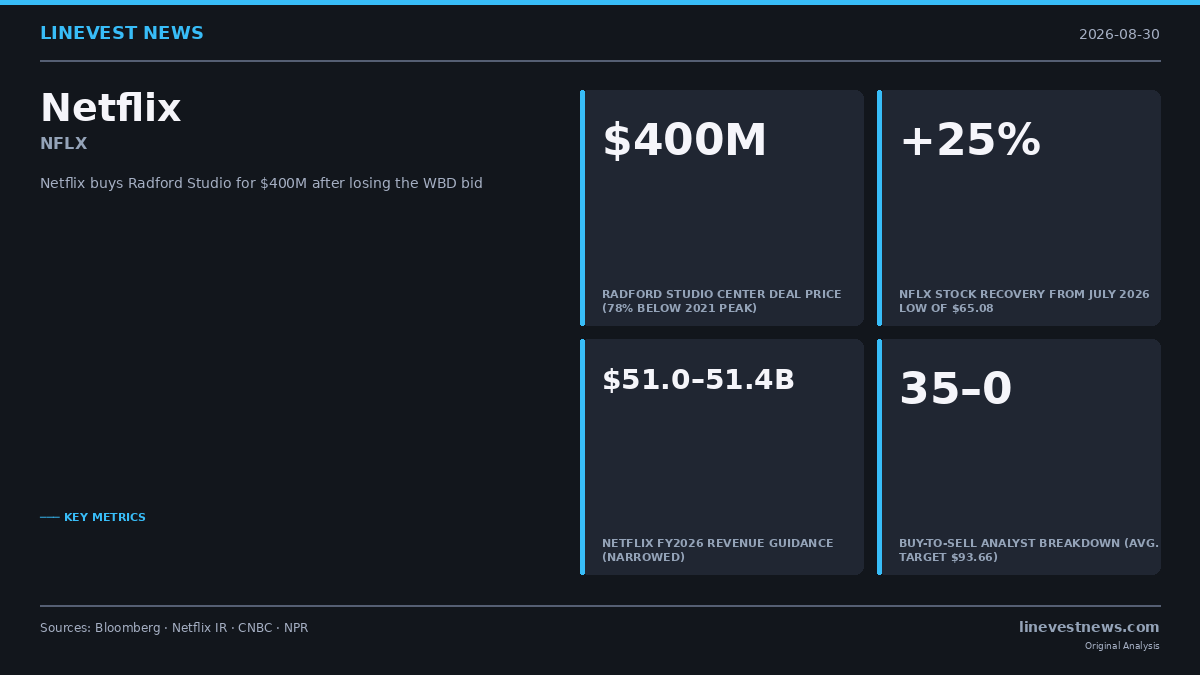
Netflix (NFLX) Up 25% From 2026 Lows: $400M Radford Studio Deal and Aggregation Pivot Drive Recovery
Netflix stock rebounds 25% from July lows as the $400M Radford Studio deal nears Q3 close. NFLX's post-WBD pivot explained — and what it means for investors.
Netflix (NFLX) Q2 2026: $2.8B Q1 WBD Fee Inflates H1 Net Income, Q2 Margin Stalls
Netflix lost the fight for Warner Bros. Discovery and walked away with a $2.8 billion consolation check recorded in Q1 2026 — inflating the six-month net income headline while the underlying Q2 operating margin fell to 33.4% from 34.1% a year earlier.
Go deeper than the headline
You just read what happened. Here's how to read what it means.
The day's reports, every morning — free
LineVest Daily lands in your inbox before the opening bell with the reports we published that day — what each company's latest 10-K or 10-Q actually says about the numbers, in plain English. Free, no card required.
This report, on any company you name
What you just read on Netflix is the format. Name any U.S.-listed company and we do the same for it — its latest SEC filing read in full, financials under US GAAP, governance, and what it means for the stock. PDF in your inbox within 3 hours.
Which company should we read?
$15 · one-time · PDF within 3 hours
Pick a company to continueIndependent journalism based on primary SEC filings — not investment advice. No brokerage affiliation.