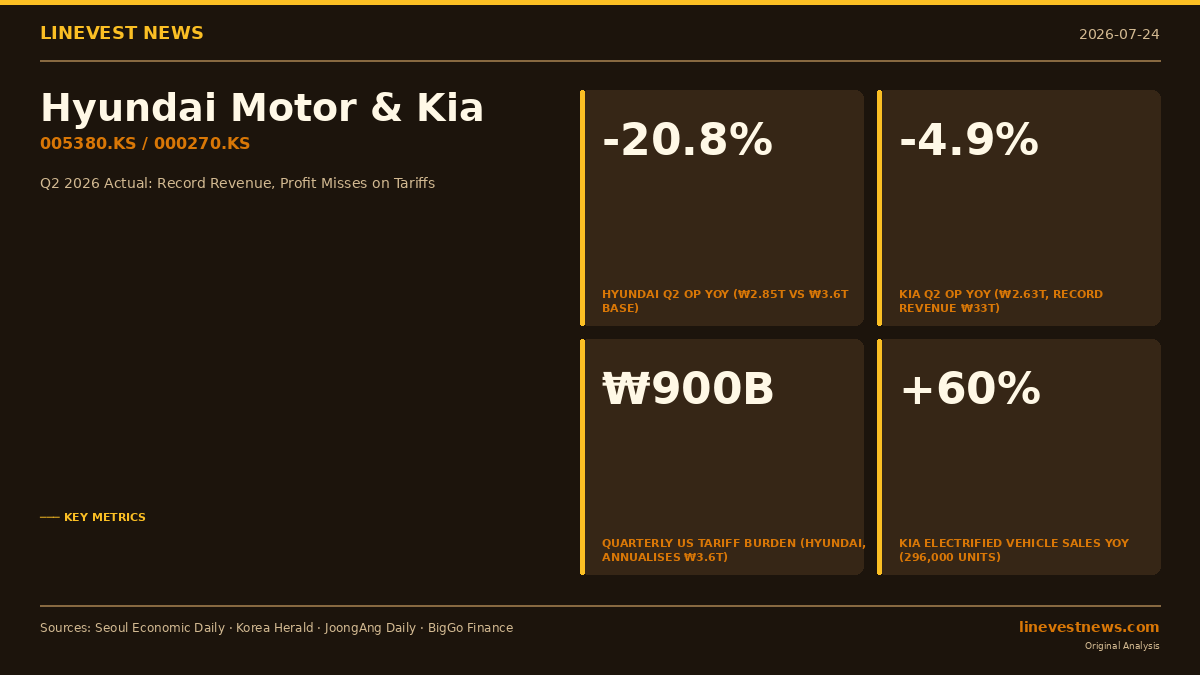
TL;DR - Hyundai Motor (005380.KS) Q2 2026 OP fell 20.8% to ₩2.85T ($1.93B), missing ₩3.1T consensus; revenue hit a record ₩49.2T (+1.9%) - Kia (000270.KS) Q2 2026 OP fell 4.9% to ₩2.63T despite record revenue of ₩33.04T (+12.6%); net profit rose 2.6% to ₩2.33T - Combined headwinds: ~₩900B US tariffs (each quarter), Anjeon fire disruption ~₩200B, and sharply higher warranty provisions from a weaker won - Both companies maintained full-year guidance; shares sold off — Hyundai -7.2%, Kia -12.9% — on margin compression and muted robotics/AI updates
Part A — What the Numbers Show
Hyundai Motor (005380.KS) — Profit Miss on Record Revenue
Hyundai Motor reported Q2 2026 operating profit of ₩2.8509 trillion ($1.93B at ₩1,480/USD), a 20.8% year-on-year decline from ₩3.6 trillion in Q2 2025. Revenue reached a record ₩49.2153 trillion ($33.2B), up 1.9% year-on-year, but the operating margin compressed sharply to 5.8% from approximately 7.5% a year earlier. Net profit fell approximately 11% to around ₩2.9 trillion, with non-operating income from Hyundai's financial affiliates (Hyundai Capital, Hyundai Card) partially cushioning the operating shortfall.
| Metric | Q2 2026 | Q2 2025 | YoY Change |
|---|---|---|---|
| Revenue | ₩49.22T ($33.2B) | ₩48.28T | +1.9% |
| Operating Profit | ₩2.8509T ($1.93B) | ₩3.60T | -20.8% |
| Operating Margin | 5.8% | ~7.5% | -1.7pp |
| Net Profit | ~₩2.9T | ₩3.25T | ~-11% |
| Global Wholesale Units | 991,885 | ~1.065M | -6.9% |
The result fell approximately 8–11% below the LSEG SmartEstimate consensus range of approximately ₩3.1–3.2 trillion.
Why profits fell despite record revenue: Four cost buckets combined for roughly ₩1.9 trillion in additional drag:
- US tariffs (~₩900B): The 25% US auto tariff, similar in scale to Q1 2026, remained the single largest headwind. Hyundai produces a large share of US-bound vehicles at its Ulsan and Asan plants in Korea.
- Anjeon Industrial fire (~₩200B): A fire at the Anjeon Industrial parts supplier in March 2026 disrupted production of the Genesis and Palisade models through the quarter.
- Increased sales incentives (~₩400B): To maintain market share in a competitive US market, Hyundai raised per-unit incentive spending.
- Higher raw material costs (~₩400B): Plastics and other inputs saw sustained price increases.
Partially offsetting these was strong hybrid vehicle momentum: Hyundai sold 187,661 hybrid vehicles in Q2 2026, a quarterly record representing 18.9% of global wholesale — contributing approximately ₩400B in incremental profit versus weaker EV mix. Total electrified vehicle sales reached 266,627 units (+1.7% YoY), comprising 187,661 hybrids, 69,366 battery-electric vehicles, and approximately 9,600 plug-in hybrids and fuel-cell vehicles.
Hyundai declared a quarterly dividend of ₩2,500 per share and maintained its full-year 2026 operating margin guidance at 6.3%–7.3%, implying a stronger second half driven by new model launches — Ioniq 3 and Grandeur Hybrid — and production normalisation.
Kia (000270.KS) — Record Revenue, But Margins Squeezed
Kia's Q2 2026 results showed a different profile from its parent: revenue hit a quarterly record of ₩33.037 trillion ($22.3B), up 12.6% year-on-year, driven by record global wholesale volume of 851,639 vehicles (+4.5% YoY). Yet operating profit fell 4.9% to ₩2.6285 trillion ($1.78B), against a consensus of roughly ₩2.79 trillion — a miss of approximately 5.8%.
| Metric | Q2 2026 | Q2 2025 | YoY Change |
|---|---|---|---|
| Revenue | ₩33.037T ($22.3B) | ₩29.34T | +12.6% (record) |
| Operating Profit | ₩2.6285T ($1.78B) | ₩2.764T | -4.9% |
| Operating Margin | 8.0% | ~9.4% | -1.4pp |
| Net Profit | ₩2.33T ($1.57B) | ₩2.27T | +2.6% |
| Global Wholesale Units | 851,639 | ~815,000 | +4.5% (record) |
Net profit rose 2.6% to ₩2.33T, a partial buffer from financial income even as operating earnings fell.
Kia's electrified vehicle mix surged: 296,000 hybrid/EV units (+60% YoY), with the electrified share of total vehicle sales rising by approximately 11.9 percentage points year-on-year to roughly one-third of the fleet — the highest in Kia's history. Battery-electric vehicles alone reached 110,000 units (+88.4%), with South Korea EV sales more than doubling and Western Europe BEV up 101.5%.
Despite the volume growth, three cost pressures squeezed margins: - US incentives rose by roughly $400 per vehicle - European incentives rose by more than €1,000 per vehicle to compete with Chinese EV entrants - Warranty provisions rose sharply, partly amplified by the weaker Korean won increasing foreign-currency warranty reserves - Cost of sales climbed to 81.7% of revenue
Kia maintained its full-year targets, pointing to expanded Telluride production, new Sportage hybrid deliveries, Mexico-sourced EV3 availability for the US market, and EV2/EV4 European production as H2 catalysts.
Part B — Investment Implications for Korea Stock Investors
Why the Share Reactions Diverged
Hyundai shares fell approximately 7.2% to ₩401,000, while Kia plunged 12.9% to ₩130,500 — a seemingly counterintuitive outcome given that Kia's OP decline (-4.9%) was far shallower than Hyundai's (-20.8%).
The explanation lies in relative expectations. Sell-side consensus had already baked in a severe miss for Hyundai after months of tariff warnings, whereas Kia — with its record revenue and rising EV mix — was expected to hold margins more firmly at around ₩2.79T. When Kia's OP came in at ₩2.63T, the wider-than-expected warranty and incentive charges surprised investors who had anticipated the EV mix shift to show through more clearly in margins.
Both stocks were also weighed down by a broader market disappointment: analyst hopes for momentum in physical AI businesses — robotics and autonomous driving — were not meaningfully addressed in either earnings call, according to BigGo Finance.
The Tariff Arithmetic
Hyundai's ₩900B quarterly tariff drag ($608M) deserves particular attention. With two quarters now confirmed at approximately this run-rate, the annualised tariff burden approaches ₩3.6T — representing roughly 30% of Hyundai's estimated full-year 2026 operating profit based on analyst consensus. The company has partially offset this through pricing, cost cuts, and currency benefits from the weaker won, but structural relief requires either US-Korea trade negotiation progress or a meaningful shift of production to US soil (Hyundai's Metaplant America in Ellabell, Georgia is ramping production).
For Kia, the tariff drag is smaller in absolute terms but the combination with surging European incentives signals that the EV volume ramp — while impressive at +60% — is coming at the cost of per-unit economics. Battery-electric vehicles remain margin-dilutive until the EV2/EV3/EV4 lower-cost platforms reach scale.
Hyundai's Hybrid Bright Spot — and What It Means
Hyundai's hybrid quarterly record (187,661 units, 18.9% of total) is a structural positive. Global hybrid demand continues to outpace battery-electric uptake in key markets, and the Grandeur Hybrid launch in H2 2026 targets the premium domestic segment where margins are higher. The ₩400B hybrid contribution partially offset the tariff pain and suggests the company's "multi-powertrain" strategy is delivering incremental value.
Kia's parallel BEV acceleration (+88.4% YoY) is more aggressive and reflects a different mix bet. If EV price competition stabilises in Western Europe, Kia's margin profile should improve materially in H2. But European EV incentive spending above €1,000/unit indicates competition from BYD, SAIC, and other Chinese brands is intensifying in a market that represents ~18% of Kia's global volume.
Guidance Reality Check: Can 6.3–7.3% Materialise?
Hyundai's H2 2026 recovery thesis rests on: 1. New model launches (Ioniq 3, Grandeur Hybrid) adding volume and mix 2. Production normalisation after the Anjeon disruption 3. Tariff relief or mitigation — the company cited ongoing cost offset efforts covering roughly 50% of raw material increases
For the full-year 6.3–7.3% OP margin target to hold, H2 OP would need to average approximately ₩3.2–3.8T per quarter — a 12–33% sequential rebound from the ₩2.85T Q2 level. This is achievable if tariff headwinds moderate, but the ₩900B/quarter tariff run-rate provides limited margin for error.
Consensus FY2026 OP for Hyundai Motor sits at approximately ₩11.5–12.5T, with the sell-side average target price at approximately ₩733,000 (31 analysts), implying ~83% upside from the ₩401,000 post-earnings close. The target-price-to-current gap suggests investors are pricing in a structurally lower earnings base than the buy-side consensus — which may create re-rating potential if H2 results deliver.
For Kia, the multi-analyst consensus target implies substantial upside from ₩130,500, with a positive long-term view anchored to the EV platform ramp. Kia's net profit growth of +2.6% — even with OP falling — demonstrates the underlying earnings resilience via financial income.
Key Risks to Monitor
- US tariff permanence: The 25% US auto tariff remains the dominant earnings swing factor. Any escalation or extension materially pressures both companies. Conversely, any negotiated relief could restore significant margin.
- Korean won direction: A weaker won amplifies foreign-currency warranty reserves (as seen this quarter) but provides a translation benefit on revenue — a double-edged dynamic.
- Chinese EV competition in Europe: Kia's European incentive escalation reflects pricing pressure from Chinese entrants. If EU tariffs on Chinese EVs tighten further, this pressure could ease; if trade tensions moderate, it could worsen.
- Anjeon supply disruption tail: Hyundai flagged Genesis and Palisade production as partially recovered, but any re-emergence of supply constraint would hit high-margin vehicles disproportionately.
- Physical AI timeline: Both companies' long-term valuation cases increasingly include robotics and autonomous driving. Earnings calls disappointed on concrete near-term catalysts here.
All figures sourced from official company earnings releases and Korean financial media. This article is for informational purposes only and does not constitute investment advice. LineVest is an independent publication; the author holds no positions in securities mentioned.
Sources: - Seoul Economic Daily — Hyundai Q2 2026 OP Falls 20.8% - Seoul Economic Daily — Kia Q2 2026 OP Falls 4.9%, Shares Plunge - Seoul Economic Daily — Kia Record Q2 Revenue - Korea Herald — Kia Q2 Profit Falls Despite Record Sales - Yahoo Finance — Hyundai Q2 21% Drop - BigGo Finance — Hyundai, Kia Plunge in Tandem - JoongAng Daily — Kia Q2 Net Profit Rises Despite Tariffs