
Hyundai Motor005380.KS
About Hyundai Motor
Hyundai Motor is South Korea's largest automaker and the anchor of the Hyundai Motor Group, selling vehicles under the Hyundai brand and the premium Genesis marque. Its lineup spans internal-combustion cars, hybrids, battery-electric vehicles, and hydrogen fuel-cell models, produced at plants in Korea, the United States, India, Europe, and other regions. The company also consolidates a captive finance arm that supports vehicle sales and holds a controlling interest in Kia, its sister automaker. Profitability rests on global vehicle volumes and mix, with sport-utility vehicles and premium models carrying higher margins than entry segments.
Structural questions start with the group's circular shareholding, in which Hyundai Motor, Kia, and Hyundai Mobis hold stakes in one another, a legacy arrangement regulators and minority investors have long scrutinized. The United States is the company's most important export market, so tariff policy and the localization of production there carry outsized weight. Electric-vehicle incentives and emissions rules across major markets shape capital-allocation choices. The shares include separately listed preferred stock that trades at a discount, and the company has formalized a shareholder-return framework combining dividends and buybacks, which income-oriented foreign funds track closely.
Chung Ju-yung founded Hyundai Motor in 1967 as an offshoot of his construction-centered Hyundai empire, initially assembling Ford models under license. The 1975 Pony, Korea's first mass-produced domestic car, set the company on an export path that reached the U.S. market in the 1980s. Amid a family division of the conglomerate in 2000, shortly before the founder's death the following year, the automotive businesses split away under son Chung Mong-koo to form the Hyundai Motor Group; Hyundai had acquired Kia out of post-crisis receivership in 1998. Leadership has since passed to third-generation chairman Chung Euisun, who has steered the push into electrification and premium vehicles.
The company earns money the way volume automakers do, but with distinctive mechanics: vehicles are sold wholesale to dealers and distributors across roughly two hundred markets, a captive finance arm earns interest and leasing income that smooths the cycle, and after-sales parts and service add recurring revenue. Korea remains the manufacturing hub, yet overseas plants increasingly build where they sell, reducing tariff and currency exposure. Genesis-brand and sport-utility models carry the richest margins, so mix management matters as much as volume. Competitively, the company pairs fast product cycles with in-house engines, transmissions, and dedicated EV platforms shared with sister company Kia, an integration few rivals match.
Company profile by LineVest editorial. Journalism, not investment advice.
Hyundai Motor coverage
2 articles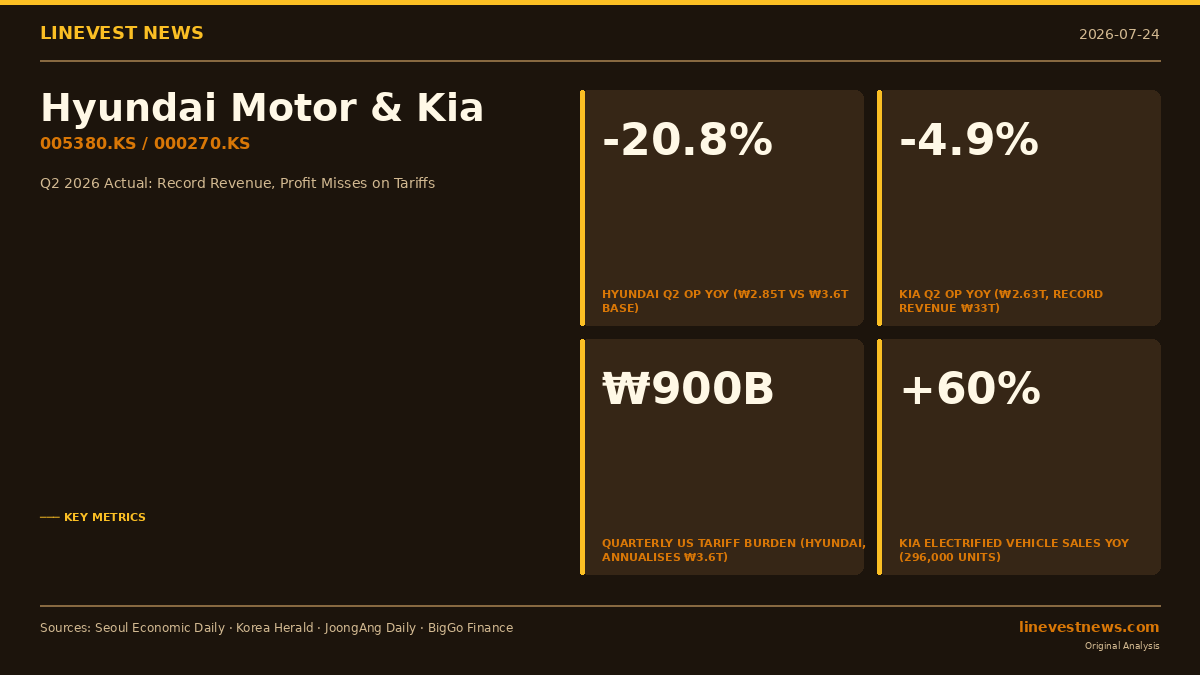
Hyundai Motor & Kia Q2 2026 Actual Results: Tariffs and Warranty Costs Drag Profits Despite Record Revenue
Hyundai Motor Q2 2026 OP fell 20.8% to ₩2.85T, missing consensus. Kia OP down 4.9% on record ₩33T revenue. Tariffs, warranty costs bit hard. Both held FY2026 guidance.
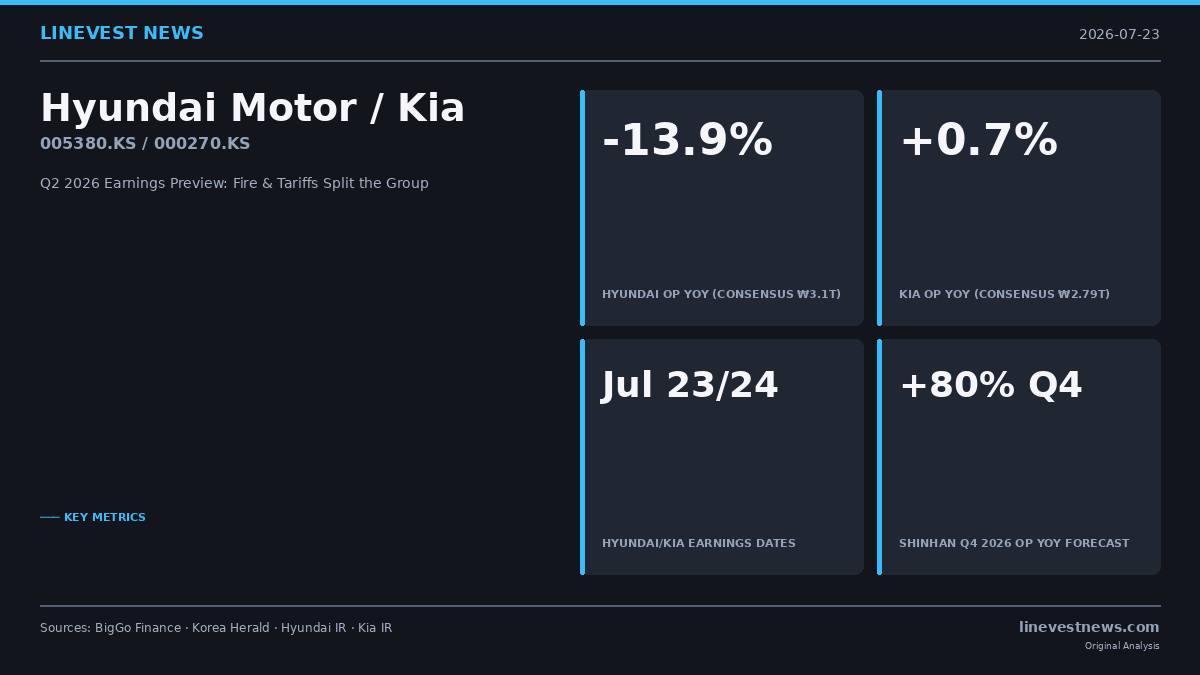
Hyundai Motor and Kia Q2 2026 Earnings Preview: Fire, Tariffs, and a Surprising Divergence
Hyundai Motor reports Q2 on July 23, Kia on July 24. Consensus sees Hyundai OP down ~14% from a factory fire and tariffs; Kia up ~1% on hybrid strength. Three things to watch.
Frequently asked questions
What does Hyundai Motor do?
Hyundai Motor is South Korea's largest automaker, producing cars, SUVs, and commercial vehicles under the Hyundai and premium Genesis brands. Its lineup spans gasoline, hybrid, battery-electric, and hydrogen fuel-cell models built at plants across Korea, the United States, India, and Europe, supported by a captive vehicle-finance business.
Who controls Hyundai Motor?
Hyundai Motor anchors the Hyundai Motor Group, controlled by the founding Chung family under chairman Chung Euisun. Hyundai Mobis is the largest single shareholder, part of a circular ownership loop among Hyundai Motor, Kia, and Mobis that keeps family control intact while the family holds direct stakes as well.
How can foreign investors get exposure to Hyundai Motor?
Common and preferred shares trade on the Korea Exchange under ticker 005380, and the company has global depositary receipts listed in London. Many foreign investors access the stock through brokers offering Korean market trading or through Korea-focused ETFs, where it is consistently among the largest index constituents.
Answers are editorial summaries for general information, not investment advice.
Go deeper than the headline
You just read what happened. Here's how to read what it means.
The day's reports, every morning — free
LineVest Daily lands in your inbox before the opening bell with the reports we published that day — what each company's latest 10-K or 10-Q actually says about the numbers, in plain English. Free, no card required.
This report, on any company you name
Apply this depth of research to a company you choose. We connect the selected filing’s financial detail with management choices, relevant industry evidence and the conditions that could change the business. English PDF by email within 3 hours.
Which company should we read?
$15 · one-time · PDF within 3 hours
Pick a company to continueIndependent journalism based on primary SEC filings — not investment advice. No brokerage affiliation.