Hyundai Motor Group unveiled its most detailed robotics roadmap yet at the JP Morgan conference in Boston last week, pledging to deploy more than 25,000 Boston Dynamics Atlas humanoid robots across its own U.S. manufacturing plants from 2028 — making itself the largest customer of a subsidiary it is simultaneously scaling toward mass production.
The announcement, made jointly by Hyundai Motor (005380.KS) and Kia (000270.KS) on May 21, sent shockwaves through Korean equity markets: Hyundai Mobis (012330.KS) surged 26.17%, while Hyundai Motor, Kia, and Hyundai AutoEver rose 12.25%, 12.99%, and 15.05% respectively on the day.
A captive market within the group
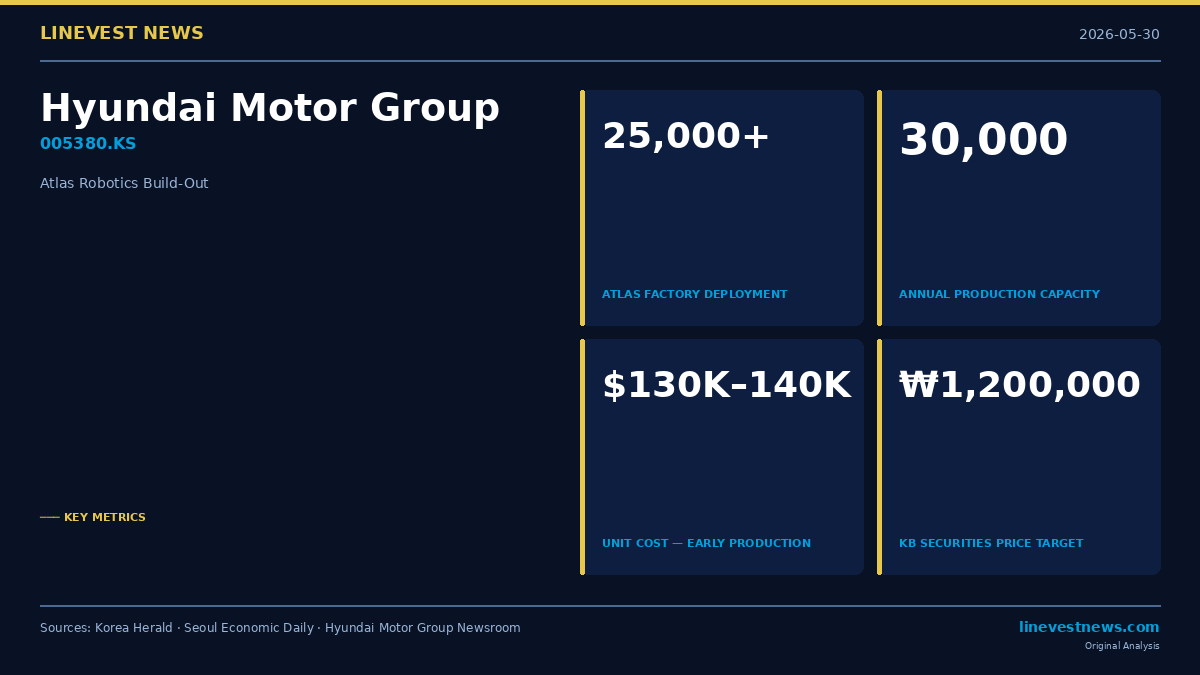
Of the 30,000 Atlas units Hyundai aims to produce each year by 2028, roughly 83% — or 25,000 robots — will be deployed within the group's own factories. Hyundai Motor Group Metaplant America (HMGMA) in Georgia is slated to receive the first batch in 2028, with Kia's Georgia facility following in 2029.
The strategy addresses a critical chicken-and-egg dilemma in humanoid robotics: commercial production at scale requires high-volume orders, yet external customers are unwilling to commit without a proven track record. By absorbing most of its own early output, Hyundai sidesteps the market-development risk that has hobbled rival programs.
Cost curve: from $140,000 to $30,000
Unit economics will be steep at first. Boston Dynamics expects to sell early Atlas units to group companies at $130,000–$140,000 apiece during the initial mass-production phase. Once cumulative output crosses 50,000 units, the group projects a roughly 78% cost reduction to approximately $30,000 per robot — a level competitive analysts say would unlock broad commercial deployment beyond the group's own plants.
Actuators, which account for more than 60% of robot material costs and number more than 10 per Atlas unit, sit at the heart of the cost-reduction roadmap. Hyundai Mobis is building an actuator manufacturing base in the United States with capacity for 350,000 units per year, set to come online in 2028 alongside the first Atlas deployment.
Ecosystem wiring: Mobis makes, AutoEver runs
Hyundai Motor Group's plan distributes roles among affiliates rather than concentrating them in one subsidiary. Hyundai Mobis handles hardware — actuators and core components — while Hyundai AutoEver takes on system integration, data operation platforms, and smart-factory control. Boston Dynamics retains design and software ownership.
Analysts see this structure as a durable competitive moat. "The group's ability to compress the supply chain — from raw actuators to deployed robot — within a single corporate umbrella gives it a cost and quality edge that pure-play robotics startups cannot easily replicate," KB Securities analyst Kang Sung-jin wrote in a May 28 note.
Kang raised KB's long-term operating margin forecast for Hyundai Motor to 4.5% from 3.0% and set a twelve-month price target of ₩1,200,000 per share — against a current trading price near ₩700,000, implying approximately 71% upside.
Boston Dynamics IPO: timing undecided
The robotics push has reignited speculation about a Boston Dynamics initial public offering. Kia Chief Executive Song Ho-sung, when asked by investors, said "the company has not yet decided on the timing of an IPO or whether to pursue external fundraising" — a non-denial that traders took as confirmation that options remain open.
Boston Dynamics' implied valuation has surged roughly 20-fold to an estimated $28 billion, driven by comparisons to Tesla's Optimus program and rising demand for humanoid robots in logistics and manufacturing. Hyundai Motor Group acquired the company from SoftBank in 2021 for $1.1 billion.
Autonomous driving overlay
The robotics push runs alongside a separate partnership with Nvidia (NVDA) announced in March, in which Hyundai Motor and Kia will integrate Nvidia's DRIVE Hyperion platform across Level 2 through Level 4 autonomous-driving applications in select production vehicles. The Nvidia tie-up adds a software revenue layer to a company that traditional auto analysts had long valued on commodity-cycle multiples.
Hyundai Motor's price-to-earnings ratio has risen from roughly 4–5x in early 2026 to the 10–11x range, with analysts at Daol Investment & Securities arguing for further expansion toward 12x as robotics and Software-Defined Vehicle revenue streams become more visible.
The caveat: Q1 earnings disappointment
Not all of the physical AI optimism is tethered to near-term financials. Most sell-side forecasters expect Hyundai Motor's first-quarter 2026 operating profit to fall short of the consensus estimate of approximately ₩2.8 trillion, citing weak global sales and foreign-exchange valuation losses on overseas assets. Hyundai Motor's market capitalization of ₩201 trillion remains less than half of Toyota's ₩441 trillion, though the gap has narrowed sharply since the start of 2026.
The bull case, nonetheless, rests on a structural transformation bet: that a company long defined by combustion-engine cycles is quietly becoming one of the world's most vertically integrated physical-AI platforms — its own factories serving as the first proving ground.
Sources
- Korea Herald — Hyundai Motor Group to deploy 25,000 Atlas robots across factories (May 20, 2026)
- Seoul Economic Daily — Hyundai Motor Group Shares Surge on Humanoid Robot Roadmap (May 21, 2026)
- Seoul Economic Daily — Top Investors Buy Hyundai Motor on ₩1.2M Target (May 28, 2026)
- Hyundai Motor Group Newsroom — Hyundai, Kia and NVIDIA Expand Strategic Partnership (Mar 16, 2026)
- Korea Herald — Boston Dynamics valuation jumps 20-fold on humanoid hype