TL;DR
- Hana Financial Group (086790.KS) filed provisional Q2 2026 results (잠정실적) with Korea Exchange on July 24, 2026
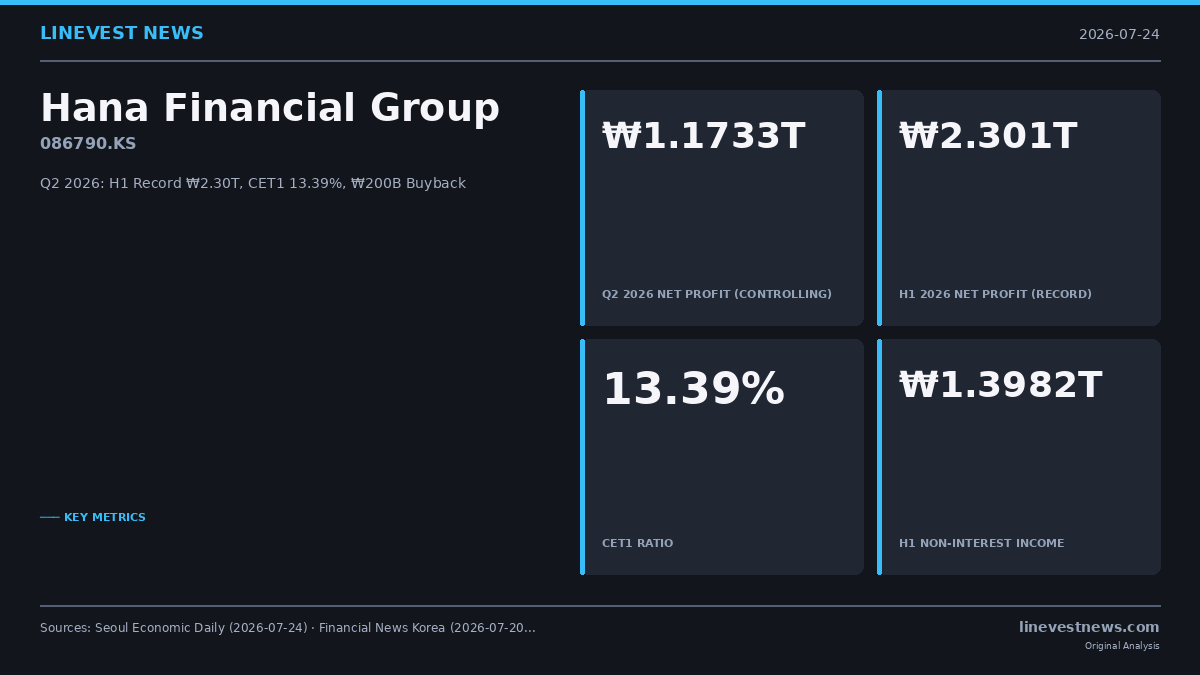
- Net profit attributable to controlling shareholders: ₩1.1733 trillion (+13.4% YoY); total consolidated net income ₩1.21 trillion (+16.6% YoY)
- H1 2026 cumulative net profit: ₩2.301 trillion (+11.2% YoY) — record first half in company history
- CET1 capital ratio: 13.39% (+59bp YoY), comfortably above the 13% Value-Up Program floor
- Board approved an additional ₩200 billion share buyback, bringing 2026 total buyback plan to a minimum ₩600 billion
- Full earnings call and investor presentation scheduled for 3 PM KST today
Part A — The Provisional Disclosure
Hana Financial Group filed a consolidated provisional earnings disclosure (연결재무제표기준영업(잠정)실적(공정공시)) with the Korea Exchange (KRX) securities market on July 24, 2026, under filing reference 20260724800407. The filing was triggered as a "material event of subsidiary" disclosure — standard procedure when a major operating subsidiary releases preliminary results that are material to the group's consolidated financials.
Q2 2026 Headline Numbers
| Metric | Q2 2026 | Q2 2025 | YoY Change |
|---|---|---|---|
| Net profit (controlling shareholders) | ₩1.1733T | ₩1.0347T | +13.4% |
| Total consolidated net income | ₩1.21T | ₩1.037T | +16.6% |
| H1 2026 net profit (controlling) | ₩2.301T | ₩2.069T | +11.2% |
| H1 non-interest income | ₩1.3982T | ₩1.2714T | +10.0% |
| CET1 ratio | 13.39% | 12.80% | +59bp |
| BIS ratio | 15.58% | n/a | — |
| ROE | 10.76% | 10.36% | +40bp |
| ROA | 0.73% | 0.69% | +4bp |
The H1 result of ₩2.301 trillion marks the best first-half performance in Hana Financial Group's history, surpassing the previous record of ₩2.069 trillion set in H1 2025. Against the sell-side consensus estimate of ₩1.2455 trillion for Q2 total net income, the group delivered ₩1.21 trillion — a modest underperformance of roughly ₩35 billion (approximately -2.8%), within the normal variance range.
Core Earnings Drivers
Net Interest Income & NIM: Hana Bank, the group's flagship subsidiary, expanded its net interest margin to approximately 1.82% in Q1 2026, and sell-side analysts had projected further NIM improvement of 3–5 basis points to 1.85–1.87% in Q2, driven by won-denominated loan growth of 1.3–1.5% quarter-on-quarter. At the group consolidated level, the blended NIM (which is diluted by insurance and securities subsidiaries) was tracking at approximately 1.61–1.63%. Confirmed figures will be disclosed at the 3 PM KST investor call.
Non-Interest Income: H1 2026 non-interest income reached ₩1.3982 trillion, up 10.0% year-on-year (a gain of roughly ₩126.6 billion). Hana Bank alone generated H1 non-interest income of ₩740.6 billion, up 74.4% year-on-year, reflecting a surge in brokerage commissions and fee income from Hana Securities amid the July 2026 KOSPI bull run.
Subsidiary Performance: Hana Bank's H1 2026 net income rose 19.1% to ₩2.09 trillion, outpacing the group's consolidated growth rate — a sign that the core banking franchise is delivering above-average profitability even after holding-company adjustments.
Asset Quality
Credit metrics remained stable. The non-performing loan (NPL) coverage ratio held at 138.68%, providing a buffer exceeding the regulatory recommendation. The delinquency rate stood at 0.35%, indicating no material deterioration despite rising household debt levels industrywide.
Capital & Shareholder Returns
| Item | Amount / Level |
|---|---|
| CET1 ratio (end-Q2) | 13.39% (+59bp YoY) |
| BIS ratio | 15.58% |
| Quarterly cash dividend (Q2) | ₩913 per share |
| H1 buyback completed | ₩400 billion |
| Additional buyback (newly authorized) | ₩200 billion |
| FY 2026 total buyback (minimum) | ₩600 billion |
CET1 at 13.39% sits 39 basis points above the group's stated 13.0% floor for the Value-Up program, leaving headroom for expanded distributions in H2 if the ratio is maintained above 13.5%.
Part B — Korean Market Impact Analysis
1. H1 Record Sets Up a Strong Full-Year Narrative
The ₩2.301 trillion first-half result is not just a record — it extrapolates, if H2 delivers at a similar pace, to a full-year net income exceeding ₩4.5 trillion. Analyst consensus for FY2026 was already at approximately ₩4.57 trillion (revised upward post-Q1). If the KOSPI bull run seen in July 2026 — when the index surged from a July 20 intraday low of 6,515 to 7,150 on July 22 — sustains brokerage activity into Q3 and Q4, Hana Securities' fee income could add further upside to the non-interest income line.
The 10% H1 non-interest income growth (+₩126.6 billion YoY) is particularly notable because it reduces the group's dependency on Korea's interest rate cycle. Hana Financial has historically been seen as more rate-sensitive than Shinhan or KB; an improvement in fee income diversification meaningfully upgrades the quality of its earnings.
2. Capital Return Trajectory Under Korea's Value-Up Program
Korea's Financial Services Commission (FSC) Value-Up program has pushed the major financial holding companies to increase shareholder returns, with a target of delivering CET1 above 13.0–13.5% while allocating surplus capital to buybacks and dividends. Hana's 13.39% CET1 — up 59bp year-on-year — suggests the group has been generating internal capital at a rate exceeding risk-weighted asset growth.
The newly authorized ₩200 billion buyback brings the 2026 committed total to at least ₩600 billion, on top of a quarterly cash dividend of ₩913 per share. For context, Shinhan Financial Group (055550.KS), which reported Q2 2026 net income of ₩1.8201 trillion (+17.5% YoY), also announced its YTD buyback at ₩1.4 trillion as of July 23, 2026.
Implication for investors: Among the Big 4 financial groups (KB, Shinhan, Hana, Woori), Hana's Q2 absolute net income (₩1.1733T) trails KB Financial's estimated ₩1.914T and Shinhan's ₩1.820T, but its H1 YoY growth rate of +11.2% is competitive. The group's shareholder return commitment at a minimum ₩600B buyback for 2026 — combined with a quarterly DPS of ₩913 — provides a floor for the stock's total return.
3. BlackRock Passive Ownership Signals International Credibility
As of July 2026, BlackRock held 7.22% of Hana Financial Group, ranking it among the 19 Korean companies where the U.S. asset manager maintains above-5% passive stakes. For a Korean financial holding company, having the world's largest asset manager as a top shareholder serves as an implicit signal on governance and capital allocation discipline — factors that have weighed on the "Korea Discount" historically. Hana's sustained CET1 expansion and quarterly dividend progression reinforce this alignment.
4. Risks to Monitor at Today's 3 PM Earnings Call
NIM sustainability: The Bank of Korea (BOK) cut its base rate from 3.0% in late 2024 to 2.5%, with markets debating further easing. If the BOK signals additional cuts in H2 2026, Hana Bank's NIM could compress from current levels. Management guidance on the NIM trajectory for H2 will be the key item to watch at today's earnings call.
Household debt regulatory risk: Korea's Financial Supervisory Service (FSS) has repeatedly signaled concern over household debt levels. Any tightening of debt service ratio (DSR) rules could slow loan volume growth, impacting net interest income even if per-unit margins hold.
Dunamu mark-to-market risk: In May 2026, Hana Bank acquired a 6.55% stake in Dunamu (the operator of Upbit, Korea's largest crypto exchange) for approximately ₩1 trillion. Dunamu is not publicly listed; its valuation is subject to mark-to-market adjustments on Hana's balance sheet. Any significant revaluation — upward or downward — could swing the group's non-interest income and CET1 ratio in coming quarters.
Foreign exchange translation: Korea's won strengthened materially during the July 2026 equity rally (to approximately ₩1,480/USD). Foreign currency translation effects on the group's overseas subsidiaries (Hana Bank Vietnam, Hana Bank Indonesia, etc.) are a secondary but recurring headwind/tailwind depending on the direction of the KRW.
5. Stock Valuation Context
Following target price revisions post-Q1 2026, sell-side analysts had raised their Hana Financial consensus target to approximately ₩115,000 per share (from ₩100,000). At a recent trading level of ₩94,100 (pre-July rally), the stock offered roughly a 22% upside to the consensus target, at a price-to-book ratio below the group's ROE, which analysts described as presenting "no valuation burden." With ROE now at 10.76% — approaching the 11% level that many Korean banking stocks use as a re-rating threshold — and capital return policies in place, the valuation case for Hana Financial has strengthened compared to a year ago.
This article is based on the DART provisional earnings filing (rcept_no 20260724800407) and Korean financial media reports published prior to the full Q2 2026 investor call scheduled for 3 PM KST on July 24, 2026. Provisional figures are subject to revision at the full earnings disclosure. This is journalism, not investment advice.
Sources: - DART Filing 20260724800407 — Hana Financial Group provisional Q2 2026 results (July 24, 2026) - Seoul Economic Daily: "하나금융, 2분기 순익 1.2조…상반기 비이자이익 10% 늘어" (July 24, 2026) - Seoul Economic Daily: "'하나금융지주 2분기 최대 실적'…목표가 11만 5000원" (July 24, 2026) - Financial News Korea: "4대 금융지주 상반기 순익 11조 돌파 전망" (July 20, 2026) - Bloter: "하나금융, 상반기 순익 2.5조 기대…NIM 상승에 대출 확대" (July 21, 2026)