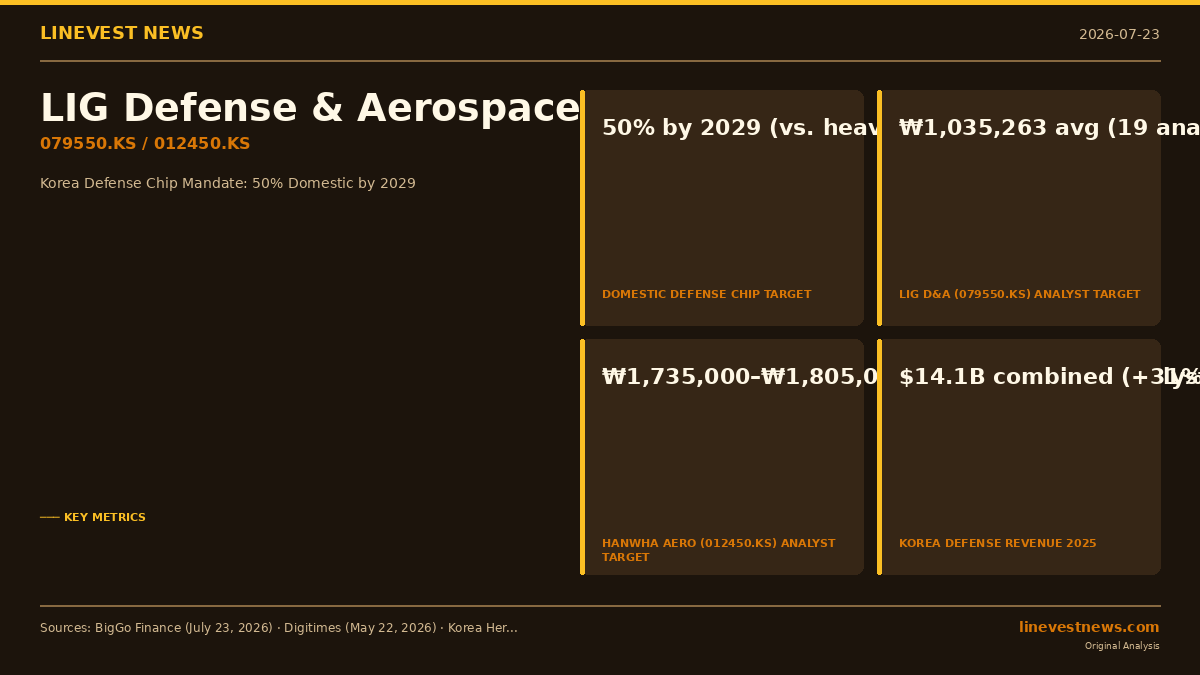
TL;DR - South Korea's 11th Science & Technology Ministers' Meeting (July 23) mandated defense chips in all weapons systems, with a 50% domestic supply target by 2029 - A public-private joint fabrication plant will be established; government reliability verification made compulsory for all defense chips - LIG Defense & Aerospace (079550.KS) is already developing X-band MMIC chips for AESA radar and UAV SAR; 19 analysts rate Buy, avg target ₩1,035,263 - Hanwha Aerospace (012450.KS) — Korea's #21 global defense firm — gives broader policy exposure; 23 analysts rate Strong Buy, avg target ₩1,735,000–₩1,805,000
The Policy Mandate
At the 11th Science and Technology Ministers' Meeting on July 23, 2026, Deputy Prime Minister and Minister of Science and ICT Bae Kyung-hoon finalized a set of defense-technology-sovereignty directives with direct ramifications for Korea's USD 14.1 billion defense-industry complex.
The centerpiece is defense semiconductor localization. Under the new framework, chips used in weapons systems must pass government-led reliability verification, and procurement will mandatorily favor domestically produced components. A public-private joint special-purpose fabrication company will be set up to build and operate dedicated production capacity. The strategic goal — first detailed at the May 2026 Advanced Strategic Technology conference — is to raise the domestic share of defense chips to 50% by 2029, sharply reducing reliance on US and Taiwanese supply chains that Korean military planners now view as a national-security vulnerability.
The ministerial directive builds on a bill the cabinet approved in June 2026, which mandated a formal development roadmap, preferential purchase arrangements for R&D-originated domestic chips, reduced delay penalties when integrating new chips into weapons platforms, and the designation of certified "defense semiconductor operators."
Key Applications
The defense-chip push centers on three hardware categories whose performance is directly tied to chip specifications:
| Application | Technology | Strategic Importance |
|---|---|---|
| AESA radar | X-band MMIC, front-end modules | Multifunction radar for KF-21, next-gen fighters, stealth UAVs |
| UAV SAR | Broadband MMIC, front-end modules | Drone ISR payloads, battlefield reconnaissance |
| Small satellites | Custom SoCs | Space-based communications and reconnaissance |
Beyond defense chips, the meeting also approved a domestic SMR supply-chain roadmap (with the SMR Special Act taking effect September 11, 2026) and the Jinhae New Port AI-port model (nine-berth completion by 2032), alongside 520 additional Nvidia B200 GPUs allocated to national AI projects.
Investment Significance
LIG Defense & Aerospace (079550.KS) — The Chip Execution Play
LIG Nex1 — which rebranded to LIG Defense & Aerospace Co., Ltd. in April 2026 — is the most direct public-market proxy for the defense-chip mandate.
In November 2025, the company signed a co-development agreement with the Defense Technology Promotion Research Institute to build X-band common MMIC and front-end module platforms for AESA radar, alongside broadband MMIC platforms for UAV SAR systems. LIG D&A is also developing an air-cooled AESA radar for overseas customers, creating a commercial-export channel that complements the mandatory-domestic-use rules now in place.
| Metric | Value |
|---|---|
| Share price (approx.) | ₩840,000–₩913,000 |
| Analyst consensus | 19 analysts, Buy |
| 12-month avg target | ₩1,035,263 (~+23–53% upside) |
| Recent major contract | USD 3.2B — 10 missile batteries to Saudi Arabia |
The mandatory reliability-verification requirement raises the qualification bar in the near term, but locks in long-term procurement certainty for certified domestic suppliers. LIG D&A's early-mover AESA/SAR chip program positions it as a frontrunner for that certification.
Hanwha Aerospace (012450.KS) — Broader Defense Exposure
Hanwha Aerospace — and its defense-electronics subsidiary Hanwha Systems — provides wider exposure to Korea's defense-export boom, with AESA radar and electronic warfare product lines that stand to benefit from chip localization.
| Metric | Value |
|---|---|
| 2025 weapons revenue | ~USD 8B (+42% YoY) |
| Global defense ranking | #21 worldwide (up from #24 in one year) |
| FY2025 total revenue | ₩26.7T (+137.6% YoY) |
| Q1 2026 operating profit | +21% YoY |
| Share price (approx.) | ~₩966,000 |
| Analyst consensus | 23 analysts, Strong Buy |
| 12-month avg target | ₩1,735,000–₩1,805,000 (~+79–87% upside) |
Hanwha Systems is a significant producer of shipborne and ground-based AESA radar, making it a natural candidate for the joint fabrication SPV.
Sector Context: Korea's Defense Export Machine
Korea's four largest defense companies — Hanwha Group, LIG Defense & Aerospace, Hyundai Rotem, and Korea Aerospace Industries (047810.KS) — posted combined arms revenues up 31% to USD 14.1 billion in 2025, outpacing global industry average growth. Total Korean defense exports reached USD 15.4 billion in 2025, against a government aspiration of USD 37 billion for 2026.
The chip-localization mandate adds a structural government-procurement layer on top of cyclical export momentum — and creates a protected domestic market for certified chip makers.
Key Risks
- No budget specifics disclosed: Today's ministers' meeting did not announce a funding envelope for the joint fabrication plant. Without capital commitments, the 2029 deadline may slip.
- Qualification timelines: Defense-grade chip qualification typically takes three to five years from prototype to integration in live weapons systems — compressing that window to three years is ambitious.
- US-Korea alliance dynamics: Korea's move to reduce reliance on US defense chips could create friction at a time when alliance management remains politically sensitive.
- Joint-fab execution risk: The public-private SPV structure has not been specified; IP arrangements, technology licensing, and foundry selection (Samsung DS? SK Hynix?) will matter for unit economics.
Sources: BigGo Finance (July 23, 2026) · Digitimes (May 22, 2026) · The Korea Herald (June 2026) · The Korea Times (June 2, 2026) · AJU Press (Dec 5, 2025) · Seoul Economic Daily (Dec 5, 2025) · The Korea Herald "K-defense climbs global rankings" · StockAnalysis.com (079550, 012450)
This article is journalistic reporting and does not constitute investment advice. LineVest is an independent publication and is not a registered investment adviser.