TL;DR - Sell-side consensus (FnGuide): revenue ₩84.6T (+281% YoY), operating profit ₩64.8T (+604% YoY), ~77% operating margin - Bear case: KIS Semicon analyst Minsook Chae forecasts ₩60.4T, citing long-term supply agreement (LTA) price caps on general DRAM - Bull case: Kiwoom Securities at ₩70T; HBM3E inventory completely sold out through 2027 - DRAM prices +50% quarter-on-quarter; NAND +60–70% QoQ - Three things to watch on July 29: HBM4 ramp timeline, H2 2026 capacity guidance, general DRAM ASP trajectory
Part A: What the Consensus Numbers Show
SK Hynix (000660.KS), South Korea's largest pure-play memory chipmaker, is scheduled to release second-quarter 2026 preliminary results on July 29, 2026, at 09:00 KST, with a simultaneous bilingual investor conference call.
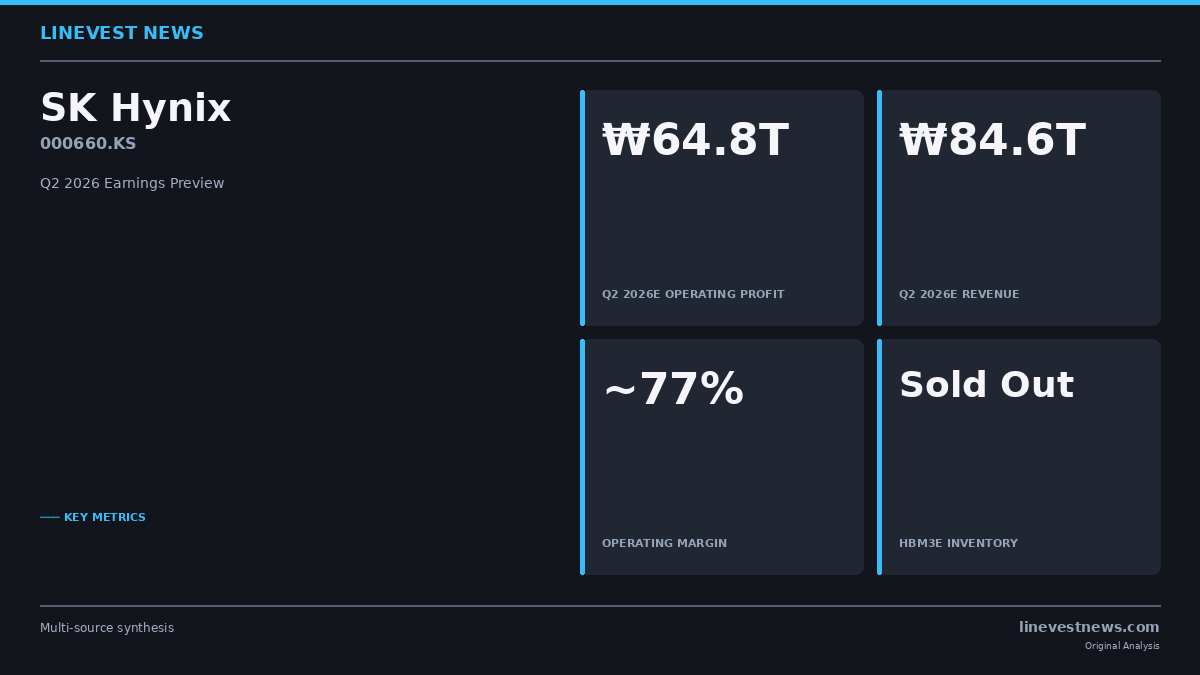
FnGuide's sell-side aggregate puts consensus at revenue of ₩84.6 trillion (approximately USD 56 billion) and operating profit of ₩64.8 trillion (approximately USD 43 billion), implying an operating margin of roughly 77% — a 36-percentage-point expansion from the 41% margin the company posted in Q2 2025 and five points above Q1 2026's record 72%.
| Metric | Q2 2025 (Actual) | Q1 2026 (Actual) | Q2 2026E (Consensus) | YoY Change |
|---|---|---|---|---|
| Revenue | ₩22.2T | ₩52.6T | ₩84.6T | +281% |
| Operating Profit | ₩9.2T | ₩37.6T | ₩64.8T | +604% |
| OP Margin | 41% | 72% | ~77% | +36pp |
The analyst range spans ₩60.4 trillion at the low end to ₩70 trillion at the high end. KIS Semicon's Minsook Chae recently cut her estimate to ₩60.4 trillion after revising DRAM ASP assumptions sharply downward, while Kiwoom Securities maintains a ₩70 trillion outlook tied to stronger-than-expected HBM volume. The spread — roughly 16% — is unusually wide for a company of SK Hynix's scale, reflecting genuine uncertainty about the pricing structure of multi-year supply contracts.
What drove the surge: Memory prices accelerated across both product lines in Q2 2026. Spot DRAM prices rose over 50% quarter-on-quarter; NAND flash jumped 60–70%. The primary catalyst was sustained hyperscaler AI infrastructure investment from NVIDIA, Microsoft, Google, and Amazon — all of whom are expanding data center buildouts to support large language model inference at scale.
Part B: What It Means for Korean Market Investors
The Margin Story: An Operating Margin That Rivals Global Peers
If the 77% operating margin holds, SK Hynix would post a higher operating margin than many global semiconductor peers. This outcome — a South Korean memory maker delivering record margins — reflects HBM's distinct economics. Because SK Hynix's HBM3E commands pricing unavailable to commodity DRAM, and because demand is not contested (Samsung has publicly acknowledged quality challenges in its own HBM program), SK Hynix occupies a near-sole-source position for many AI accelerator manufacturers.
KB Securities analyst Kim Dong-won stated: "Memory supply will remain extremely limited through next year, while demand driven by AI proliferation is rapidly increasing, meaning it will take at least two years to resolve the supply shortage." The statement echoes a broader market characterization of HBM as a "shared destiny" supplier relationship — hyperscalers and SK Hynix are locked into each other.
The Bear Case: When LTAs Become a Ceiling
KIS Semicon's Minsook Chae represents a more cautious read. Her revised assumptions cut combined DRAM average selling price growth from a previous forecast of 50.0% to 28.9%, and commodity DRAM ASP growth from 60.6% to 34.2%. The mechanism is the LTA structure: multi-year fixed-price frameworks protect customers from sharp price spikes but simultaneously cap the seller's upside.
Even at her ₩60.4 trillion forecast, Chae's long-term projections remain extraordinary: full-year 2026 operating profit growth of +419%, followed by +53% in 2027 and +19% in 2028. This is a debate about the pace of normalization, not about whether a fundamental reversal is coming.
HBM4: The Next Catalyst Under Discussion
SK Hynix's fifth-generation HBM3E is completely sold out through next year. The company has begun distributing sixth-generation HBM4 samples to lead customers, and the July 29 earnings call is expected to include the first concrete timeline for HBM4 mass production. HBM4 carries a further step-up in average selling price and margin versus HBM3E, making the date and pace of the ramp a primary driver of 2027 earnings visibility.
CXMT as a Long-Lead Risk
Chinese rival CXMT has grown its DRAM market share from 4.7% in Q4 2025 to 7.6% in Q1 2026, after raising approximately USD 8.55 billion in a STAR Market IPO. CXMT's current product line sits two to three technology generations behind SK Hynix in HBM, limiting near-term displacement of premium HBM revenue.
However, CXMT's expansion in general-purpose DRAM introduces a plausible ASP headwind for the commodity DRAM segments — precisely the vulnerability Chae's LTA-adjusted bear case already captures. Korean investors following the stock should track CXMT's customer win announcements as an early-warning indicator for general DRAM pricing.
Rate Hike Adds a Capex Financing Variable
The Bank of Korea raised its benchmark rate to 2.75% on July 16, the first hike in three and a half years. For SK Hynix, which carries a multi-trillion-won capital expenditure program to expand HBM capacity and DDR5 production lines, the rising domestic cost of capital incrementally increases the hurdle rate for new investments. Governor Hyun Song Shin signaled further rate increases until inflation converges toward 2%, making the rate trajectory an additional variable in SK Hynix's capex planning.
Three Things to Watch on July 29
- HBM4 mass production timeline: A firm start-of-production date would reinforce the bull case that margins can sustain above 77% into 2027.
- H2 2026 capacity guidance: Whether SK Hynix raises, holds, or trims capital expenditure in the context of rising rates and CXMT expansion signals management's confidence in the demand pipeline.
- General DRAM pricing guidance: The gap between HBM premiums and LTA-capped commodity DRAM pricing is the single variable most likely to determine whether Q3 2026 consensus estimates are revised upward or downward following the call.
This article is for informational purposes only and does not constitute investment advice. LineVest News is an independent publication with no affiliation to any brokerage or investment firm.
Sources - BigGo Finance — SK Hynix Q2 Operating Margin Forecast at 77% - KuCoin — Analyst Lowers SK Hynix Q2 2026 Profit Forecast - SK Hynix — Q1 2026 Financial Results Press Release - Data Center Dynamics — SK Hynix Q2 2025 Record Results - K-Stock Briefing — SK Hynix IR Conference July 29 Disclosure