Microsoft Azure Bets on AMD's Helios AI Racks — Samsung Gains as AMD's Primary HBM4 Supplier in the GPU Memory Race
TL;DR - Microsoft Azure will deploy AMD's Helios rack-scale AI platform (72 MI455X GPUs, 31 TB HBM4 per rack) in H2 2026, announced July 20 - Samsung Electronics (005930.KS) is AMD's designated primary HBM4 supplier under a March 2026 MoU — making each Helios rack a direct revenue event for Samsung's DS Division - Samsung HBM4 sales reportedly crossed $1 billion by June 2026, with AMD's widening customer base adding incremental demand - Korea's two memory giants now mirror the GPU duopoly: SK Hynix (000660.KS) → Nvidia's Vera Rubin / Samsung → AMD's Instinct MI455X - With SK Hynix Q2 results due July 29 and Samsung's full Q2 report July 30, the HBM4 split is about to become highly visible in earnings
Part A: AMD Helios Lands a Flagship Cloud Customer
On July 20, 2026, AMD confirmed that Microsoft will integrate its Helios rack-scale AI platform into Azure infrastructure, with deployment slated for the second half of 2026.
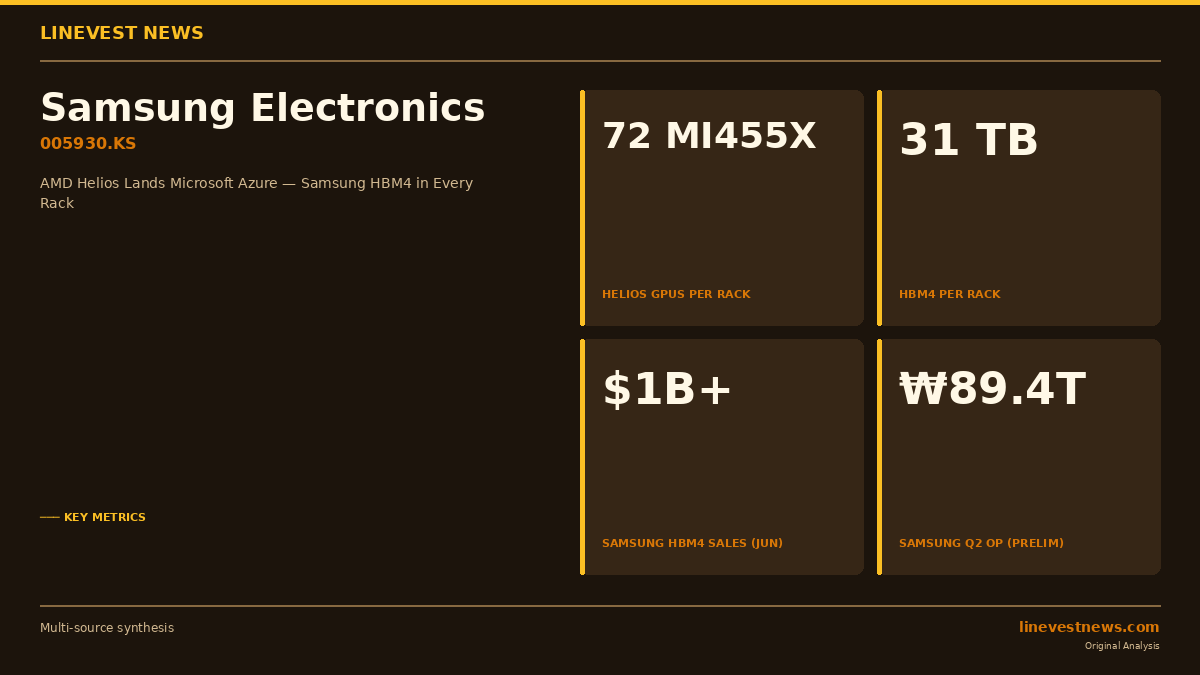
The Helios architecture is a pre-integrated system: 72 Instinct MI455X GPUs per rack, built on AMD's CDNA 5 microarchitecture, paired with Pensando DPUs for networking, EPYC "Vulcan" CPUs for host processing, and a liquid-cooled chassis. Each MI455X carries 432 GB of HBM4 memory and 19.6 TB/s of aggregate bandwidth. At the rack level, that amounts to 31 terabytes of HBM4 per Helios unit.
Microsoft will launch three new Azure virtual machine families off the Helios platform:
| VM Family | Target Workload | Key Spec |
|---|---|---|
| ND MI455X v7 | AI inference | Helios-native, MI455X GPUs |
| HDv2 | HPC simulation | Up to 500 EPYC Vulcan cores, 4 TB RAM |
| HXv2 | High-frequency HPC | 176 EPYC Vulcan cores, >5 GHz boost |
The ND MI455X v7 instances are purpose-built for the inference tier — the serving of AI models at production scale behind chatbots, copilots, and agentic workflows. This segment is growing faster than training, making Microsoft's choice of AMD over an Nvidia-exclusive configuration a notable endorsement.
AMD CEO Lisa Su called Microsoft's deployment "an important milestone," citing "integration across the full computing stack — from silicon to system to rack" as the differentiator.
Part B: Samsung's Structural Position in the AMD Memory Chain
The Supply Chain: Why This Is a Samsung Story
The Helios rack's 31 TB of HBM4 is not generic memory. Under an MoU signed March 18, 2026, at Samsung's Pyeongtaek advanced fab, Samsung Electronics became AMD's primary HBM4 supplier for the Instinct MI455X line. The ceremony was attended by AMD CEO Lisa Su and Samsung Electronics Vice Chairman & CEO Young Hyun Jun.
Samsung's HBM4 carries the following specifications: - Processing speed: up to 13 Gbps per pin - Aggregate bandwidth: 3.3 TB/s per HBM4 stack - Process: 6th-generation 10nm-class DRAM stacked on a 4nm logic base die - Configuration: 432 GB per MI455X GPU (consistent with 16-Hi stack architecture)
Samsung described this product as the industry's first HBM4 to enter mass production. AMD's selection was strategic: Samsung had already served as the primary HBM3E supplier for AMD's Instinct MI350X and MI355X accelerators, building a qualification relationship that predates the MI455X generation.
AMD's Customer Base Is Broadening — and So Is Samsung's HBM4 Revenue Opportunity
The Microsoft Azure deployment adds to a growing list of confirmed AMD Helios/MI455X customers. OpenAI, Meta, and Microsoft have signed agreements involving the Instinct MI400 series, with the largest planned deployments targeting inference workloads at scale.
By June 2026, Samsung's HBM4 sales were reported to have exceeded $1 billion in aggregate, according to TrendForce — a figure that will increase with each additional Helios rack deployed at hyperscalers.
The Korea Memory Duopoly Map: Samsung vs. SK Hynix
The competitive dynamics in the global AI memory market now follow a clean structure that benefits both KOSPI-listed memory giants:
| GPU Leader | Memory Partner | Korea Stock |
|---|---|---|
| Nvidia (Vera Rubin, Blackwell) | SK Hynix (~70% HBM4 share) | 000660.KS |
| AMD (Instinct MI455X, Helios) | Samsung (primary HBM4) | 005930.KS |
SK Hynix holds approximately 62% of the overall HBM market through Q1 2026, powered by its dominant position with Nvidia. Samsung, meanwhile, has carved out AMD's side of the ledger.
This division is strategically notable. If the AI data center market remains a two-GPU market — Nvidia for training, AMD pushing into inference — both Korean companies are structurally insulated from single-customer concentration risk at the GPU layer.
Near-Term Catalysts for Both Stocks
The memory split will come into sharp focus over the next two weeks:
SK Hynix Q2 2026 earnings (July 29, 09:00 KST): Sell-side consensus projects operating profit of ₩64.8 trillion (+604% year-over-year), driven by HBM3E/HBM4 margins and DRAM mix upgrades. HBM pricing premiums remain intact despite early-cycle supply concerns.
Samsung Q2 2026 full results (July 30): Preliminary figures released July 7 showed revenue of ₩171 trillion (+129% YoY) and operating profit of ₩89.4 trillion (+1,810% YoY), with the DS Division (semiconductors) contributing an estimated ₩53.7 trillion of that OP. HBM4 AMD revenue — though not separately disclosed — is embedded in this figure. Samsung CFO commentary on July 30 may offer the first substantive disclosure on AMD-specific HBM4 volumes.
Investment Context
For investors tracking Korea's semiconductor supply chain, the Microsoft-AMD Helios deal is an incremental demand signal, not a new strategic pivot. Samsung's role as AMD's primary HBM4 partner was established in March; what Microsoft's Azure adoption confirms is that the AMD alternative is commercially viable at hyperscaler scale.
Importantly, AMD's inference focus matters for duration. Training workloads tend to concentrate in discrete upgrade cycles; inference demand is continuous and scales with deployed AI applications. If the ND MI455X v7 instances gain adoption among Azure's enterprise inference customers, the HBM4 pull from AMD's side of Samsung's ledger is recurring, not episodic.
One risk to monitor: AMD's MI455X is scheduled to ship to Microsoft and other customers in H2 2026. Any delay in rack qualification or software stack readiness could shift Samsung's HBM4 revenue recognition. Samsung's foundry division may also participate in producing AMD's next-generation chip; the March MoU included scope for a foundry partnership, though no volumes have been disclosed.
This article is journalism, not investment advice. LineVest News is an independent publication with no brokerage affiliation. Figures are sourced from company press releases, TrendForce, and SiliconANGLE.
Sources: - Microsoft Will Use AMD's AI-Optimized Helios Racks in Azure — SiliconANGLE, July 20, 2026 - Samsung and AMD Expand Strategic Collaboration on Next-Generation AI Memory Solutions — Samsung Global Newsroom, March 18, 2026 - Samsung and AMD Expand Strategic Collaboration on Next-Generation AI Memory Solutions — AMD Newsroom, March 18, 2026 - Memory Giants Split on HBM4 Strategy: Samsung HBM4 Sales Reportedly Tops $1B, SK Hynix Slows Ramp — TrendForce, June 23, 2026 - AMD Taps Samsung As Primary HBM4 Partner For Instinct MI455X AI GPUs — HotHardware - AMD and Samsung Ink Memory Supply MoU for EPYC and Instinct Products — Tom's Hardware