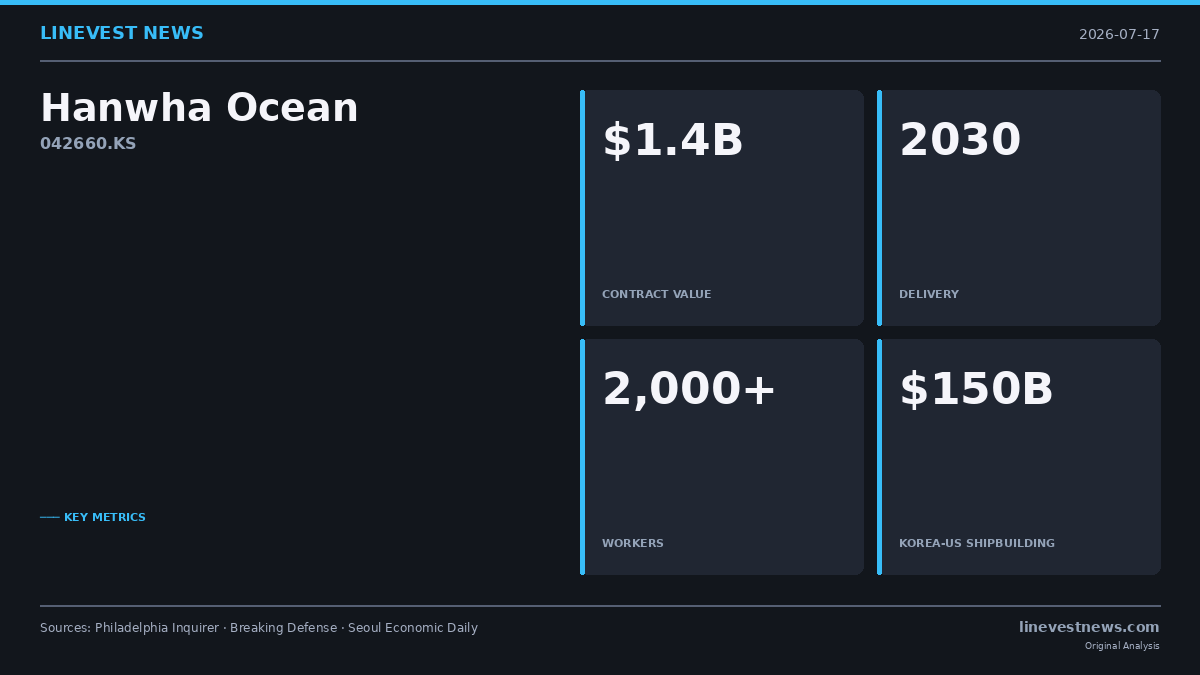
TL;DR - Hanwha Philly Shipyard International (HPSI) and TOTE Services selected to build two Missile Range Instrumentation Vessels (MRIVs) for the U.S. Missile Defense Agency - Combined contract value: approximately USD 1.4 billion for the two "Golden Defender" vessels - Ships form a core sensor layer of Trump's Golden Dome national missile-defense network - Hanwha Ocean (042660.KS) and Hanwha Systems co-own the Philadelphia shipyard, acquired in 2024 - First delivery expected in 2030, keeping 2,000 workers continuously employed through the early 2030s - Award signals Korea-U.S. shipbuilding cooperation has moved from commercial partnership to strategic defense procurement
Part A — The Contract
The U.S. Missile Defense Agency (MDA) on July 17, 2026 selected TOTE Services and Hanwha Philly Shipyard International to build two Missile Range Instrumentation Vessels. The ships, designated the "Golden Defender" class, are designed to track missile launches and monitor foreign weapons tests in real time — replacing the aging Pacific Tracker (commissioned 1965) and Pacific Collector (commissioned 1970).
White House Office of Management and Budget Director Russ Vought announced the award, stating the vessels "will support the President's Golden Dome missile defense system over the entirety of our nation." Trump's Golden Dome initiative aims to layer ground-based interceptors, advanced air defenses, and space-based sensors into a unified national missile-defense architecture.
The Golden Defenders are built on the same hull form as the National Security Multi-Mission Vessel (NSMV) already in production at HPSI for the U.S. Maritime Administration's training ship program. The government estimates this design reuse cuts acquisition costs by at least 50% compared with traditional government shipbuilding contracts. TOTE Services serves as vessel construction manager (VCM), while HPSI constructs the hulls at its Philadelphia yard. The first vessel is scheduled for delivery in 2030, following completion of the current NSMV order.
| Item | Detail |
|---|---|
| Contract value | ~USD 1.4 billion (2 vessels) |
| Vessel type | Missile Range Instrumentation Vessel (MRIV) |
| Class name | Golden Defender |
| Builder | Hanwha Philly Shipyard International (HPSI) |
| Construction manager | TOTE Services |
| Client | U.S. Missile Defense Agency (MDA) |
| First delivery | 2030 |
| Replaced vessels | Pacific Tracker (1965), Pacific Collector (1970) |
| Workforce | ~2,000 (Philadelphia shipyard) |
Part B — What It Means for Korean Investors
Hanwha Ocean's U.S. Pivot
Hanwha Ocean (042660.KS) and Hanwha Systems (012450.KS) jointly acquired Philadelphia Shipyard — rebranded Hanwha Philly Shipyard International — in 2024. The deal drew extended scrutiny from the Committee on Foreign Investment in the United States (CFIUS), with some U.S. lawmakers questioning whether a South Korean defense conglomerate should control American shipyard infrastructure that already handled military-support work.
The Golden Dome contract settles that debate with the most credible possible signal: a direct USD 1.4 billion award from the Pentagon's Missile Defense Agency for one of the White House's highest-profile defense programs. For Hanwha Ocean, the contract transforms HPSI from a commercial asset into a strategic beachhead in U.S. naval defense shipbuilding — a position that would have been unimaginable for a foreign-owned yard five years ago.
Revenue and Earnings Visibility
HPSI is currently finishing TS Golden Bear, the NSMV-class maritime academy training ship due for delivery in 2027. Construction of the two Golden Defenders begins immediately after, providing near-continuous production revenue through the early 2030s. Hanwha Ocean's U.S. operations currently contribute a small fraction of consolidated revenue, but the defense pipeline is building rapidly. Investors should expect U.S. segment disclosures to become increasingly material over the next two to three fiscal years.
Defense contracts also carry structural advantages over commercial LNG carrier orders: while near-term margins on fixed-price government work are often tighter, book-to-bill visibility extends much further and termination risk is negligible for a program tied directly to the White House's flagship defense initiative.
The Korea-U.S. Shipbuilding Alliance
The MRIV award sits within a rapidly expanding bilateral framework. In May 2026, South Korea and the United States announced a USD 350 billion economic cooperation package, with USD 150 billion earmarked for shipbuilding cooperation. A Korea-U.S. Shipbuilding Cooperation Center is scheduled to open in Washington, D.C. on July 23 — just days after this contract announcement — indicating the alliance is moving from letters of intent to funded program delivery.
The U.S. Department of Defense has separately issued Requests for Information to both Hanwha Ocean and HD Hyundai Heavy Industries (329180.KS) regarding combat vessel construction capabilities. The MRIV contract, while technically a non-combat platform, demonstrates HPSI's ability to execute on a complex military-spec vessel — a key prerequisite for any future combat ship work.
Defense Export Momentum
Korea's defense exports reached a record USD 15.4 billion in 2025, with the government targeting USD 37 billion by 2026. The traditional export product mix — K9 self-propelled howitzers, T-50 trainer jets, K2 tanks — is now being complemented by naval shipbuilding capacity embedded directly inside the U.S. defense-industrial base. That distinction matters strategically: hardware exports produce one-time revenue, while owning a shipyard inside the U.S. system locks Korean firms into multi-decade procurement cycles that are far stickier.
Risks to Watch
A Golden Dome budget debate in Congress could restructure or delay the MRIV program. The project's full architecture is still being defined, and any shift in scope could affect construction timelines. HPSI's current workforce of 2,000 is already stretched by the active NSMV program; the technical complexity of a military sensor vessel — with "bulbous radar, antenna, and other surveillance gear" (Philadelphia Inquirer) — could pressure both margin and delivery schedule. Investors should also monitor whether additional CFIUS conditions are attached as HPSI's role in sensitive defense programs expands.
Sources: Philadelphia Inquirer (Jul 17, 2026); Breaking Defense (Jul 17, 2026); Seoul Economic Daily (Jul 19, 2026); PR Newswire / TOTE Services announcement (Jul 17, 2026); Naval News (Jul 17, 2026); Washington Times (Jul 20, 2026).
This article is for informational purposes only and does not constitute investment advice. LineVest News is an independent publication not affiliated with any brokerage.