TL;DR - Ford (66%) and China's Geely Auto (34%) announced a manufacturing joint venture at Ford's Valencia, Spain plant — giving Geely its first EU production base and a path around Chinese EV tariffs - Production starts 2028: three Ford-branded multi-energy models and two Geely-branded EVs at a 500,000-unit-per-year facility - Korean batteries are absent: Ford has already exited both major Korean cell partnerships — cancelling a ₩9.6 trillion LG Energy Solution contract and dissolving BlueOval SK with SK On - Hyundai and Kia in the crosshairs: Chinese-brand EVs now hold 6.8% of Europe's car market (16% of the electrified segment); Geely's EU-made status amplifies the competitive threat starting 2028
Part A — The Deal
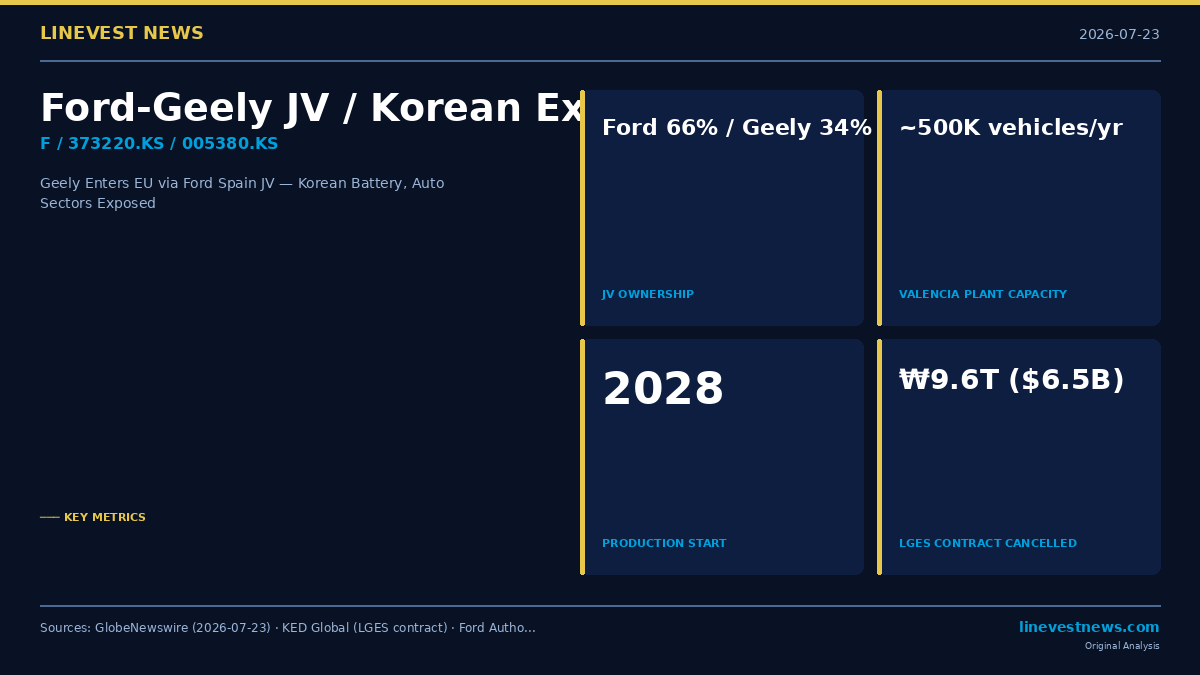
On July 23, 2026, Ford Motor Company and China's Geely Auto Group announced the formation of a manufacturing joint venture at Ford's Almussafes plant near Valencia, Spain — one of Europe's largest automotive facilities, with annual capacity of approximately 500,000 vehicles.
Under the agreement, Ford retains a 66% controlling stake while Geely Auto holds 34%. Pending European regulatory approvals, the venture will formally begin operations in the first half of 2027. The first jointly developed vehicles are expected to roll off the production line in 2028.
The production lineup includes three Ford-branded multi-energy vehicles — spanning hybrid and plug-in hybrid powertrains — and two Geely-branded fully electric vehicles. By sharing development costs and factory utilisation across both product families, the partners aim to revive a facility that has been running well below capacity since Ford wound down European mass-market combustion production.
For Geely, the deal carries strategic significance beyond surface economics: Valencia will serve as the company's first vehicle production site inside the European Union. EU tariffs on Chinese-made electric vehicles — up to 35.3% for Geely — have increasingly constrained price competitiveness. Vehicles assembled in Spain qualify as EU-manufactured, circumventing those levies.
Geely reported overseas sales of 474,228 units in the first half of 2026, a 158% year-on-year increase, positioning it among the fastest-growing Chinese automotive brands globally.
| Item | Details |
|---|---|
| Ford stake | 66% |
| Geely Auto stake | 34% |
| Location | Almussafes, Valencia, Spain |
| Plant capacity | ~500,000 vehicles/year |
| JV operations begin | H1 2027 (pending regulatory approval) |
| First production | 2028 |
| Models | 3 Ford multi-energy + 2 Geely EV |
| Geely H1 2026 overseas sales | 474,228 units (+158% YoY) |
Part B — Korea Market Impact
Korean Battery Decoupling — Already Under Way
Long before this JV was announced, Ford had systematically withdrawn from its two major Korean battery partnerships — a shift that has materially impacted both LG Energy Solution (KOSPI: 373220.KS) and SK On.
LG Energy Solution (373220.KS): In December 2025, Ford terminated a ₩9.6 trillion ($6.5 billion) cell supply contract originally scheduled to run from 2027 to 2032. That contract represented 75 GWh of annual capacity and accounted for approximately 28.5% of LG Energy's most recent annual revenue. A smaller 34 GWh agreement covering 2026 to 2030 remains in force. LG Energy stated it would "continue to maintain a mid- to long-term cooperative relationship with Ford" — signalling the relationship is reduced, not severed.
LG Energy shares stood at approximately ₩317,000 as of May 2026, against an analyst consensus target of ₩529,333 — representing a 67% implied upside — with 25 Buy, 3 Hold, and 2 Sell ratings among 30 analysts tracked by major brokerages.
SK On / SK Innovation (096770.KS): In December 2025, Ford and SK On agreed to dissolve the BlueOval SK battery joint venture — originally an $11.4 billion partnership with facilities in Kentucky and Tennessee. Ford absorbed an approximately ₩8.8 trillion ($6 billion) EBIT charge to unwind the arrangement. Kentucky's BlueOval SK Battery Park transferred to Ford; Tennessee's facility reverted to SK On, which has since announced a strategic pivot toward stationary energy storage.
The Spain JV is unlikely to reverse these departures. Geely's primary battery partner is CATL, the Chinese market leader, which has maintained a deep strategic supply relationship with the Zhejiang automaker since 2020. Any battery volume that Geely brings to its Valencia-assembled models is likely to follow CATL supply chains, not Korean ones.
Hyundai and Kia — The Competitive Escalation
The second layer of Korea exposure operates through Geely's newly secured EU manufacturing status.
Chinese-brand vehicles now account for 6.8% of Europe's total car registrations in 2026, with a more pronounced 16% share of the combined EV and PHEV segment. That market share gain has come disproportionately at the expense of Stellantis, Ford, and Asian incumbents — a category that explicitly includes Hyundai Motor (005380.KS) and Kia (000270.KS).
Prior to the Valencia JV, Geely and other Chinese brands faced meaningful tariff headwinds in Europe. EU-manufactured status removes that constraint for Geely's two EV models, which will compete on fully even tariff terms with Hyundai and Kia's European-assembled lineup from 2028.
The pricing pressure is already visible in Kia's European strategy. CEO Song Ho-sung told investors in April 2026 that the company had narrowed its price premium over Chinese rivals from 20–25% to 15–20% — an ongoing compression that will accelerate once Geely's localization advantage takes effect. Kia targets further convergence toward a €40,000 price point for both gasoline and EV C-segment SUVs by 2030, from a current EV6 entry price of around €55,000–€60,000.
One partial offset may emerge from EU battery origin rules. The EU's Industrial Accelerator Act requires EVs to use locally produced batteries to qualify for consumer subsidies, starting 2027 — the same year the Valencia JV begins operations. If Geely continues sourcing CATL cells from China for its Spain-assembled models, those vehicles may not qualify for EU incentive programs.
That advantage is conditional, however. CATL's ₩7 trillion ($4.7 billion) Hungary gigafactory — currently under construction — is expected to begin production in late 2027, precisely when the Geely Valencia vehicles are scheduled to ramp. A locally produced CATL supply chain would neutralise the battery-origin advantage for Korean suppliers.
Summary: Korea KOSPI Exposure
| Company | Ticker | Direct Exposure | Vector |
|---|---|---|---|
| LG Energy Solution | 373220.KS | Ford contract cancelled (₩9.6T) | Revenue contraction |
| SK Innovation/SK On | 096770.KS | BlueOval SK dissolved (\$6B EBIT hit) | Capacity impairment |
| Hyundai Motor | 005380.KS | EU EV market share pressure | Pricing/margin |
| Kia | 000270.KS | Already cutting EU prices; Geely worsens | Margin compression |
| Samsung SDI | 006400.KS | Limited Ford exposure; BMW/Stellantis anchored | Indirect / lower risk |
Sources: GlobeNewswire official announcement · CNBC · KED Global — LGES contract · Ford Authority — BlueOval SK · Korea Herald — Kia Europe strategy · Car News China
This article is journalism, not investment advice. LineVest News is not a registered investment adviser.