Alphabet Hikes 2026 CapEx to $205B as Cloud Jumps 82% — SK Hynix Surges 4.9%, KOSPI Rallies 4.4% on AI Memory Signal
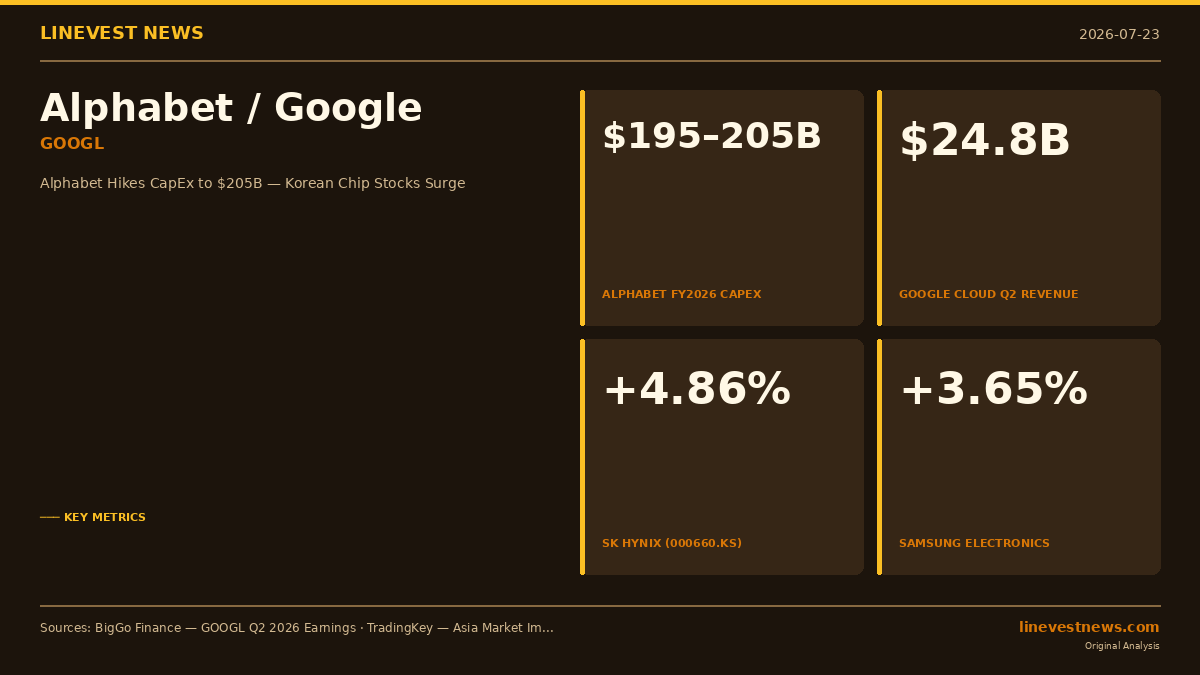
TL;DR - Google parent Alphabet raised full-year 2026 capital expenditure guidance to $195–$205B (midpoint +$15B vs. prior $180–190B) and signaled "significantly" higher spending in 2027 - Google Cloud grew 82% YoY to $24.8B in Q2 2026, with cloud backlog reaching $514B — a sequential gain of $50B - In Seoul, SK Hynix (000660.KS) closed +4.86% at ₩1,919,000 (intraday peak +6.5%), Samsung Electronics (005930.KS) rose +3.65% to ₩270,000, and KOSPI gained +4.40% to 7,096.82 - A Kiwoom Securities analyst flagged the results as "easing concerns about the memory cycle peaking out" for Korean chip makers
Part A: Alphabet Q2 2026 — Numbers Behind the CapEx Surge
Alphabet reported second-quarter 2026 consolidated revenue of $119.8 billion, up 24% year-over-year, after the close of U.S. trading on Wednesday, July 22. Operating income climbed 30% to $40.8 billion, pushing operating margin to 34.0% from 32.5% a year earlier.
The headline result that matters most for Korea's chip industry is the updated capital expenditure outlook. Alphabet lifted its full-year 2026 CapEx guidance to $195–$205 billion — up from the prior range of $180–$190 billion — representing a $15 billion increase at the midpoint. Management also stated that 2027 infrastructure spending would "increase significantly" versus 2026 levels.
| Metric | Q2 2026 | YoY Change |
|---|---|---|
| Consolidated Revenue | $119.8B | +24% |
| Operating Income | $40.8B | +30% |
| Operating Margin | 34.0% | +1.5pp |
| Google Cloud Revenue | $24.8B | +82% |
| Cloud Operating Margin | 35.6% | +14.9pp |
| Cloud Backlog | $514B | +$50B QoQ |
| Q2 Capital Expenditure | $44.9B | +107% |
| Free Cash Flow | −$5.9B | vs. +$10.4B prior year |
| FY2026 CapEx Guidance | $195–$205B | Raised from $180–$190B |
Google Cloud's 82% revenue jump to $24.8B beat analyst expectations of approximately $22.5B, with CEO Sundar Pichai attributing the performance to "strong demand for AI infrastructure and AI solutions." The cloud backlog of $514 billion underscores multi-year commitments from enterprise customers investing in AI workloads.
The single most striking figure is the Q2 capital expenditure of $44.9 billion in one quarter alone — more than double the same period a year earlier. That spending pace drove free cash flow into negative territory for the first time in recent memory, swinging from a positive $10.4 billion to a negative $5.9 billion. Alphabet's stock initially fell roughly 4% in after-hours trading on capex anxiety, but Asian markets on Thursday read the numbers differently.
Part B: Why Korean Chip Investors Are Cheering Alphabet's Splurge
Direct Supply-Chain Link: HBM4 From SK Hynix
For Korea's semiconductor sector, Alphabet's capital expenditure is not an abstraction — it is a forward order book. Data-center infrastructure spending by hyperscalers converts directly into purchases of servers, high-bandwidth memory (HBM), and DRAM. SK Hynix (000660.KS) is one of Alphabet's most important HBM suppliers, providing HBM3E and HBM4 modules that fill the memory stacks on Google's Tensor Processing Units (TPUs) and third-party GPUs deployed in Google Cloud.
TradingKey noted that "as an important supplier to Google, SK Hynix rose up to 6.5% intraday, with the market expecting its High Bandwidth Memory demand to continue to benefit." That intraday peak brought SK Hynix shares to approximately ₩1,949,000 — within striking distance of the psychological ₩2,000,000 level touched briefly on July 22 during the SK Hynix Q2 earnings rally.
SK Hynix settled at ₩1,919,000 at Thursday's close, a gain of +4.86%. The move builds on Monday's board approval of a ₩7.09 trillion investment in the Cheongju P&T7 advanced packaging hub, which is designed to meet precisely this kind of hyperscaler HBM4 demand acceleration.
Samsung's Dual Role: Supplying Both Memory and Servers
Samsung Electronics (005930.KS) closed +3.65% at ₩270,000. Samsung's stake in the Alphabet capex cycle is two-pronged. First, its Device Solutions (DS) division — which posted a preliminary Q2 2026 operating profit of ₩89.4 trillion — sells DRAM and NAND to hyperscaler supply chains globally, and Google is a significant customer. Second, Samsung's newly announced LPDDR5X PIM (Processing-In-Memory) solution, unveiled at Galaxy Unpacked this week, targets low-power AI inference in edge devices, a market that Alphabet's proliferating Gemini AI products are expected to accelerate.
Samsung's full Q2 results — due July 30 — will provide the segment-level breakdown that confirms how much of that record DS profit derives from hyperscaler orders.
The Hyperscaler Trifecta: Microsoft, Amazon, Now Google
Alphabet's updated capex reinforces what is shaping up as a synchronized three-year AI infrastructure cycle:
| Hyperscaler | 2026 CapEx Commitment | Key Korean Chip Beneficiary |
|---|---|---|
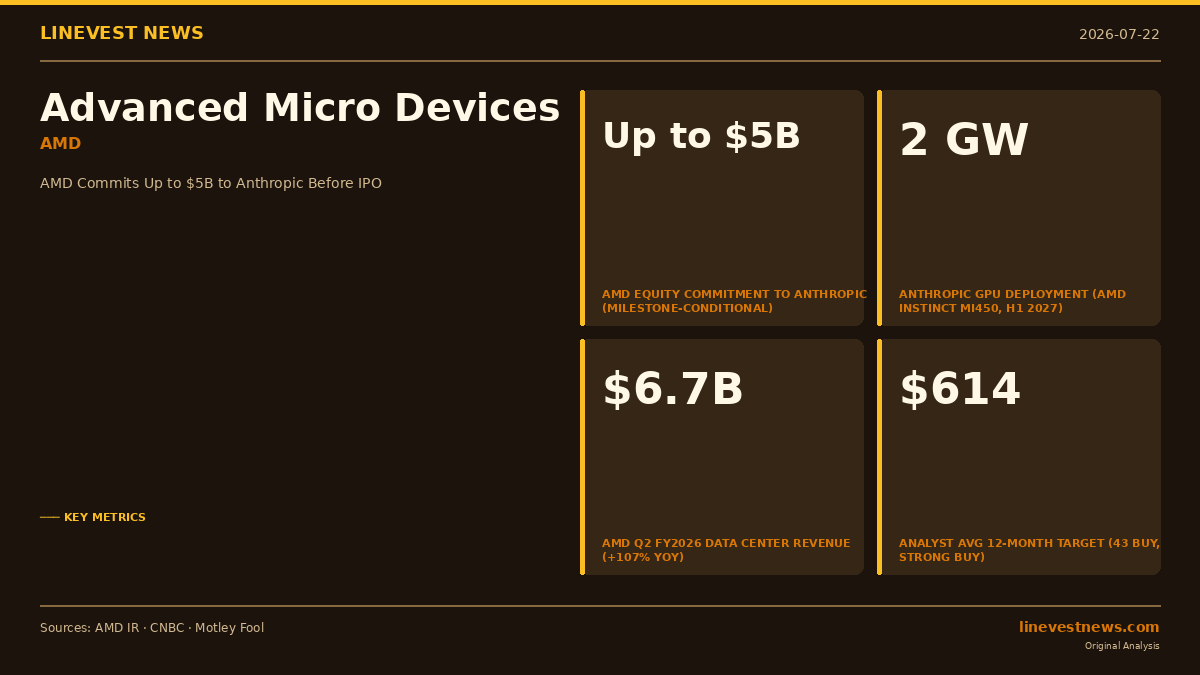
| Microsoft Azure | AMD Helios rack build-out (H2 2026) | Samsung HBM4 (1st supplier) |
| Amazon / AWS | Multi-year HBM3E/HBM4 contracts | SK Hynix, Samsung (allocated supply) |
| Alphabet / Google | $195–$205B (new guidance) | SK Hynix (HBM4), Samsung (DRAM/NAND) |
No single quarter of hyperscaler capex translates instantaneously into chip orders, but the direction is unambiguous. When hyperscalers raise full-year guidance and signal continued growth into 2027, it de-risks the forward demand assumptions that Korean chipmakers use to justify their own multi-trillion-won capacity expansions.
Analyst Read: Memory Cycle Concerns Fading
Han Ji-young of Kiwoom Securities, one of Korea's largest retail brokerages, offered the most direct assessment of the Alphabet news for chip investors: "We view Alphabet's strong results and raised CapEx guidance as easing concerns surrounding Korean semiconductors, including the possibility of clients reducing CapEx and the memory cycle peaking out."
The concern Han references — hyperscaler capex fatigue triggering a memory demand cliff — has been a persistent bear thesis for SK Hynix and Samsung since the KOSPI rally began in mid-June. Alphabet's results, taken alongside Microsoft's commitment to AMD's Helios HBM4 racks and Amazon's continued buildout, make that thesis harder to sustain in the near term.
KOSPI and Broader Market Context
KOSPI closed Thursday at 7,096.82, gaining 4.40% — one session after the index touched 7,150 intraday during the SK Hynix Q2 earnings excitement on July 22. The Alphabet catalyst reset the baseline and provided a fresh demand-side argument for the rally.
The Nikkei 225 also rose, though more modestly (+0.46%), as Japan's chip-equipment and materials exporters such as Tokyo Electron and Shin-Etsu Chemical benefit from the same capex wave but are one supply-chain step further removed from the HBM order book than Samsung and SK Hynix.
Risks to Watch
Alphabet's own stock fell after hours on the capex announcement, reflecting legitimate investor concern: at $44.9 billion per quarter, the AI infrastructure build-out is consuming cash faster than the business is generating it, pushing free cash flow negative. If cloud revenue growth decelerates before the data center buildout pays off, Alphabet could slow or pause capex — a scenario that would ripple through Korean chip demand.
The $514 billion cloud backlog provides some insulation, but it represents contracted spend from enterprise clients, not a guarantee of uninterrupted acceleration. Investors should track Google Cloud's revenue growth rate in Q3 2026 (due October) as the primary leading indicator of whether the capex cycle remains intact.
This article is journalism, not investment advice. LineVest News is an independent publication not affiliated with any brokerage.
Sources - GOOGL Q2 2026 Earnings Call — BigGo Finance - AI Investment Boom Lifts Japan and South Korea Stocks — TradingKey - Alphabet CapEx Boost Lifts Korean Chip Stocks in Premarket — Seoul Economic Daily - Alphabet Increases Spending Outlook as It Races to Build AI Data Centres — The National - Asia's Chip Stocks Climb As AI CapEx Stays Huge — Finimize - Alphabet Signals $195B–$205B 2026 CapEx — Seeking Alpha